Deep Dive: Solana Developers - May 2026
Deep Dive: Solana Developers - May 2026

Note: Below is the text-accessible version of this post for visually impaired readers.
Syndica Deep Dive: Solana Developers - December 2025
How did we create our developer database?
We built our database by scanning GitHub for crypto-related open-source activity across various blockchains, using a crawler to analyze key files like package.json and Cargo.toml, and incorporating contributions from entities like Solana Labs and Jito. We gathered repository data, extracted commits, PRs and reviews from all branches and tags, and compiled a list of contributing developers, collecting their data as well. We also filter GitHub activity from organizations and repositories that are primarily multichain or do not clearly belong to a specific chain. For example, we drop AI-related projects that do not belong to a chain specifically (we keep Virtuals for Base, but do not include Eliza OS).
We cleaned the data by filtering out low-value activity—think inactive forks, empty projects, or those with minimal commits, bot-generated activity, etc. Our focus was on repositories and code that live on-chain or support its infrastructure, including clients, smart contracts, and RPCs, while excluding code related to projects like Dune or DeFiLlama that serve crypto but are more peripheral.
In this report, we will focus on Solana. This report only contains data until May 31st, 2026.
Developer Classification Methodology
We classify developers into two categories—Professional and Hobbyist—based on their activity patterns using a decision tree classifier. Our model analyzes three key aspects of developer behavior:
- Activity: Volume of recent work (commits, lines of code, pull requests, reviews)
- Depth: Breadth of contributions across repositories, ecosystems, and programming languages
- Tenure: Consistency of engagement over time
We trained the model using an active learning process, where the algorithm identifies the most informative cases to label next. After training the model, we use it to classify developers across chains on a monthly basis.
Part I Developer Activity
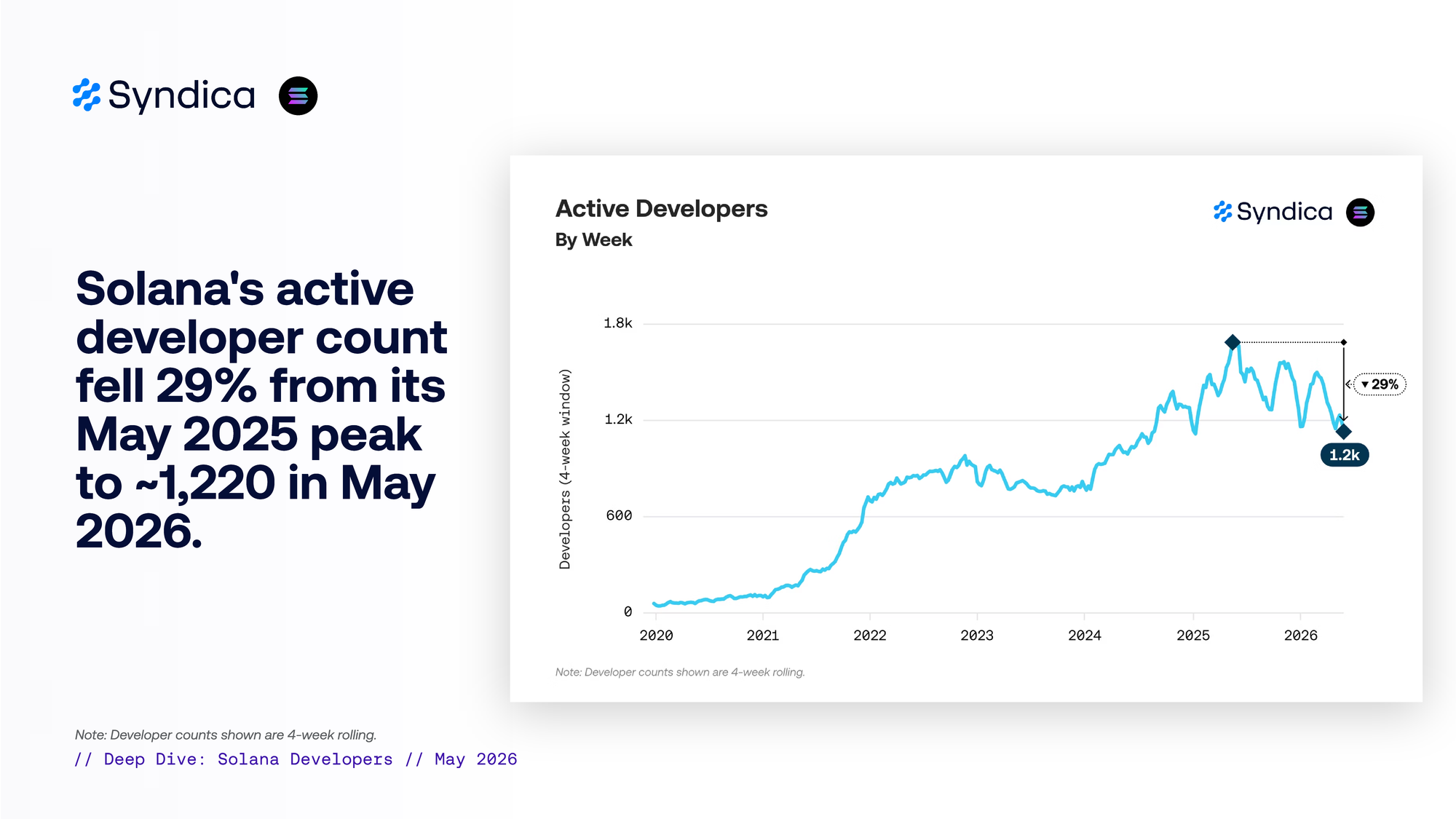
Solana's active developer count fell 29% from its May 2025 peak to ~1,220 in May 2026.
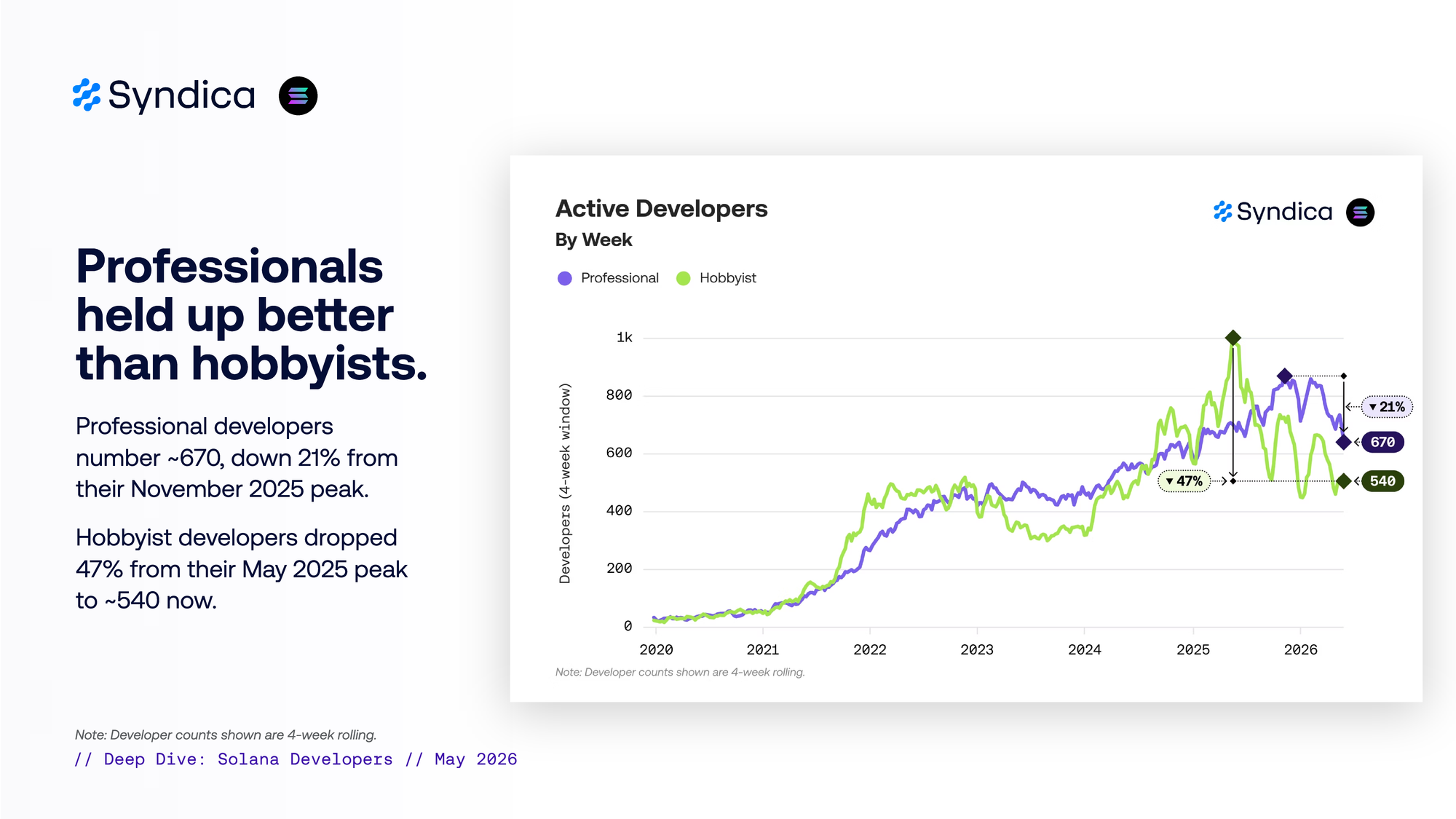
Professionals held up better than hobbyists.
Professional developers number ~670, down 21% from their November 2025 peak. Hobbyist developers dropped 47% from their May 2025 peak to ~540 now.
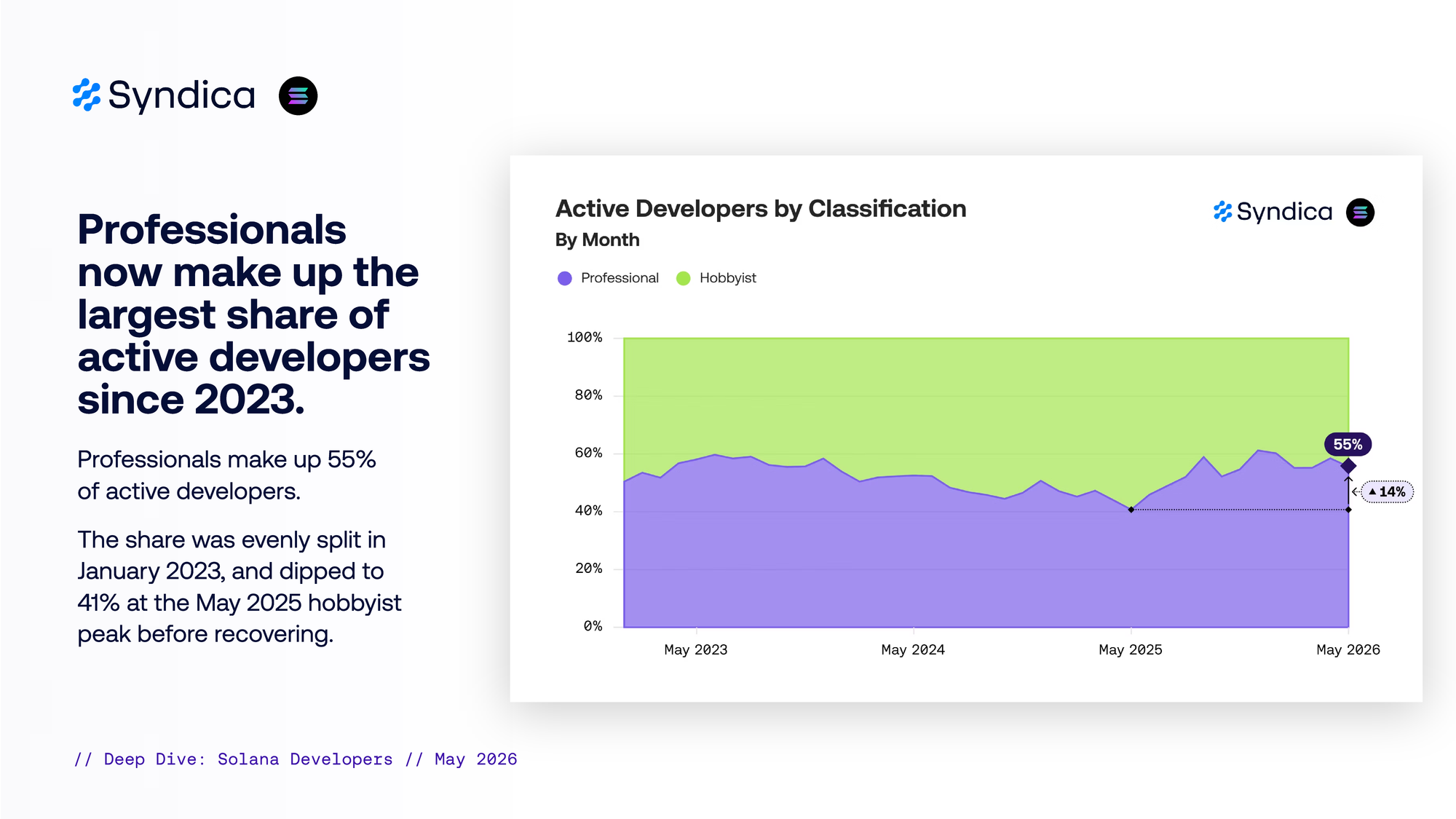
Professionals now make up the largest share of active developers since 2023.
Professionals make up 55% of active developers. The share was evenly split in January 2023, and dipped to 41% at the May 2025 hobbyist peak before recovering.
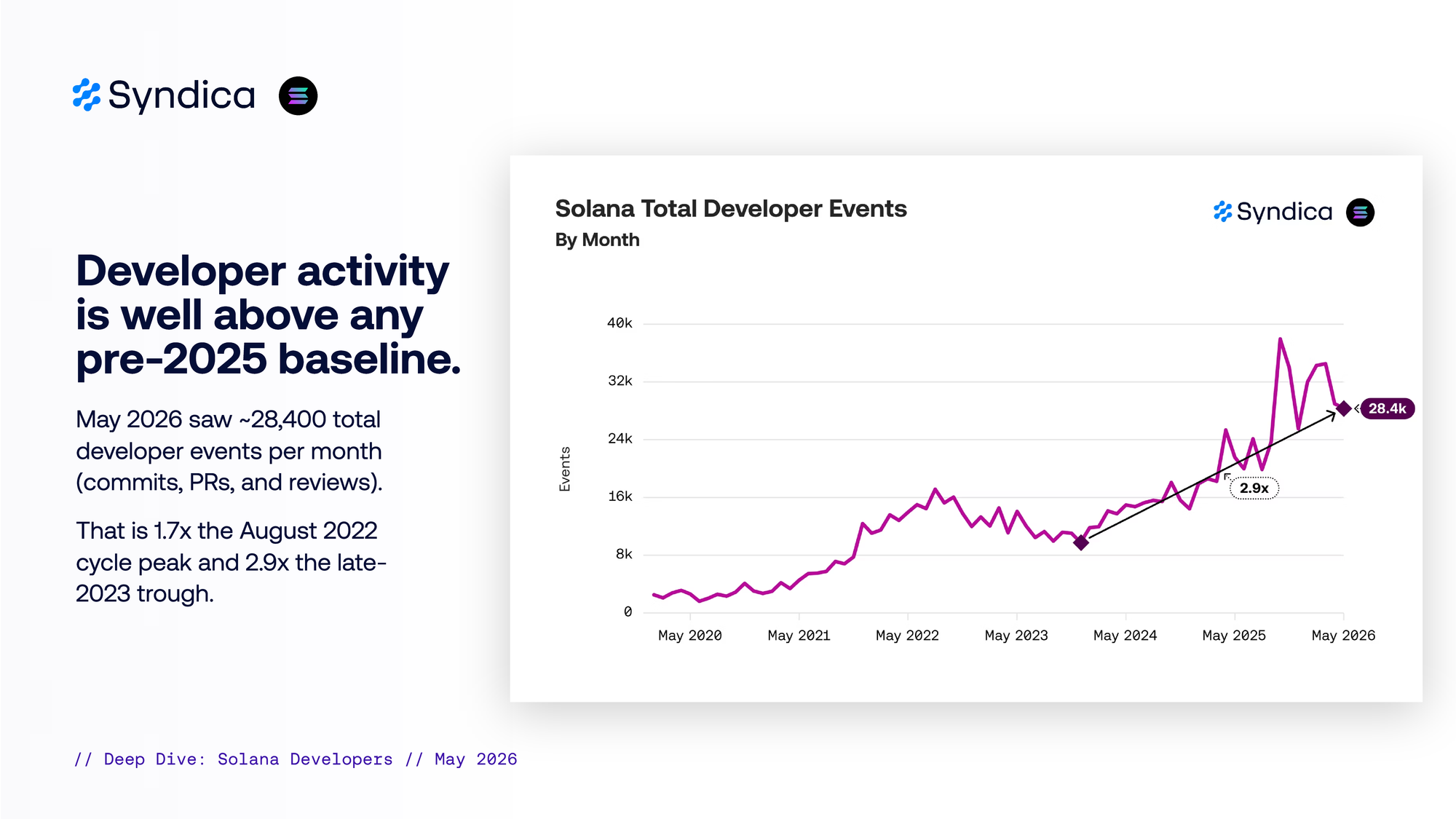
Developer activity is well above any pre-2025 baseline.
May 2026 saw ~28,400 total developer events per month (commits, PRs, and reviews). That is 1.7x the August 2022 cycle peak and 2.9x the late-2023 trough.
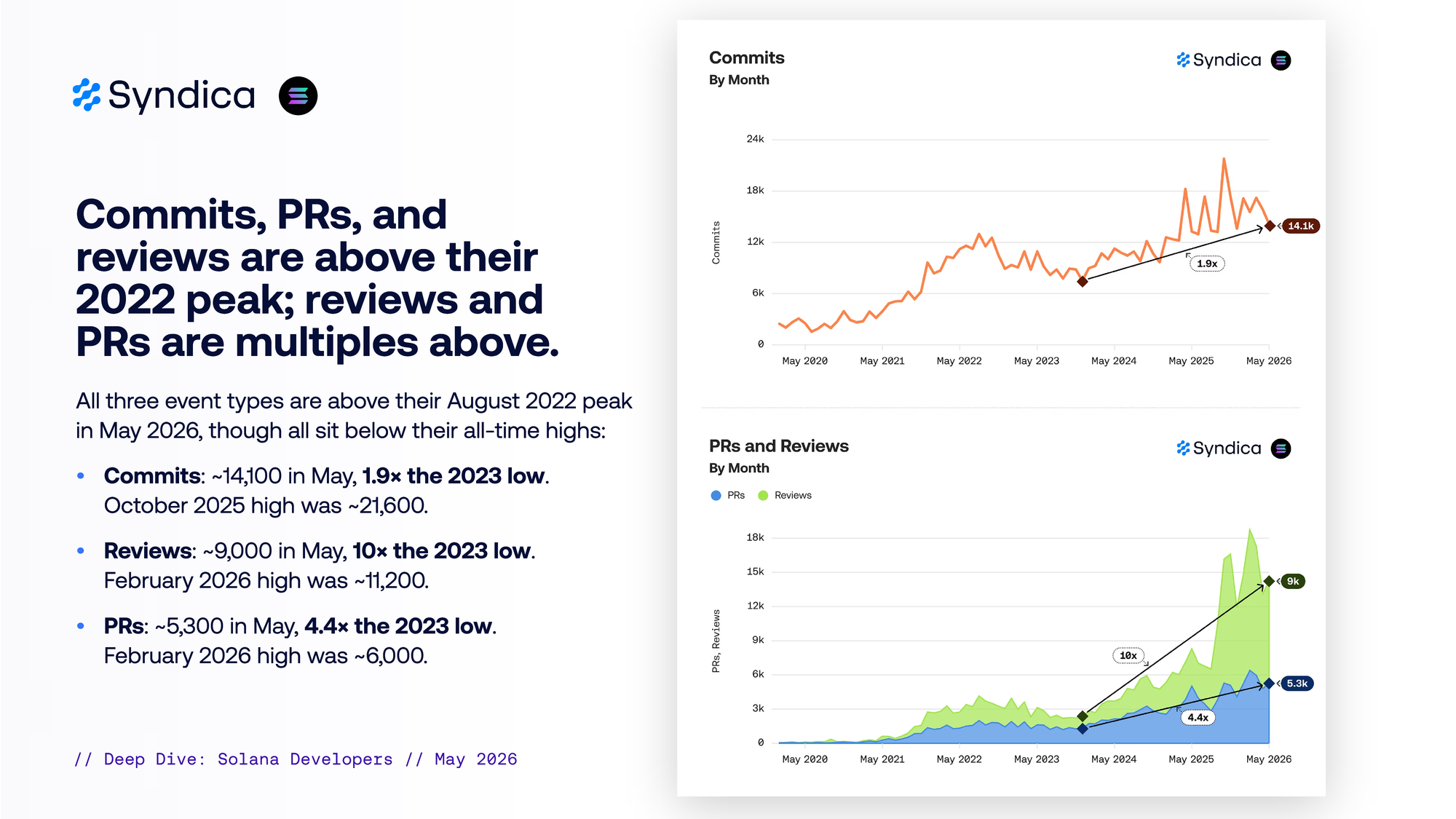
Commits, PRs, and reviews are above their 2022 peak; reviews and PRs are multiples above.
All three event types are above their August 2022 peak in May 2026, though all sit below their all-time highs:
- Commits: ~14,100 in May, 1.9x the 2023 low. October 2025 high was ~21,600.
- Reviews: ~9,000 in May, 10x the 2023 low. February 2026 high was ~11,200.
- PRs: ~5,300 in May, 4.4x the 2023 low. February 2026 high was ~6,000.
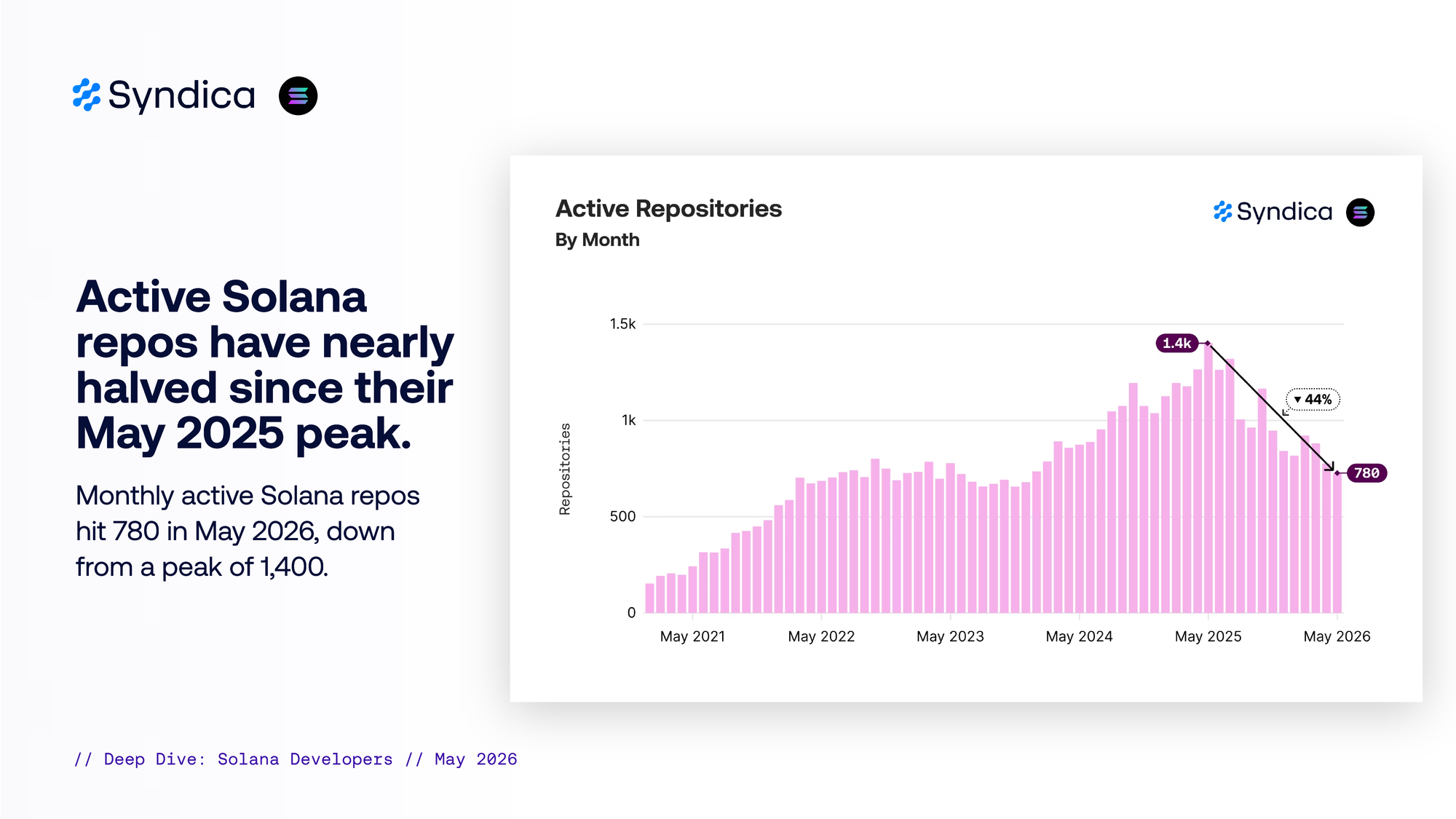
Active Solana repos have nearly halved since their May 2025 peak.
Monthly active Solana repos hit 780 in May 2026, down from a peak of 1,400.
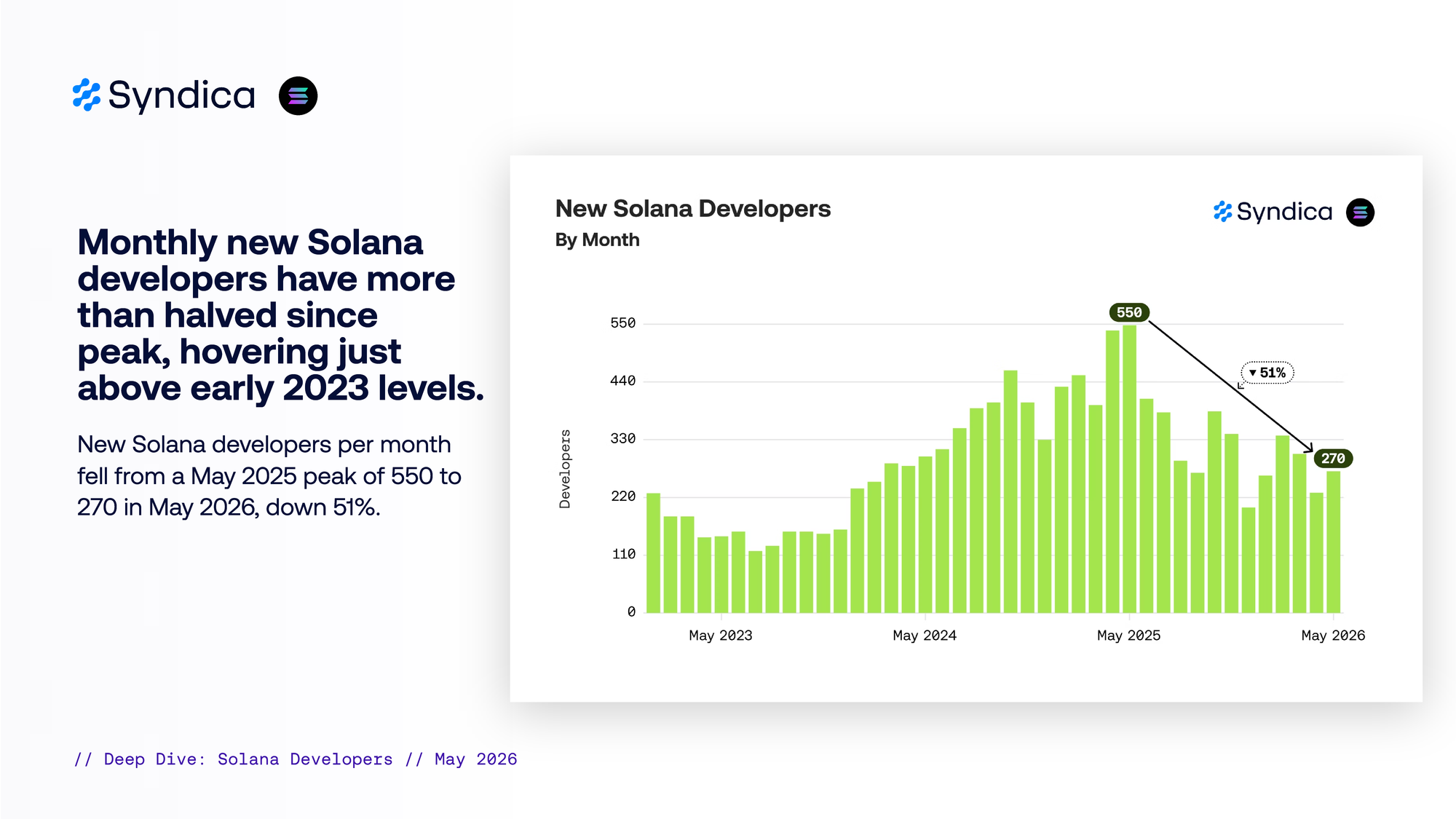
Monthly new Solana developers have more than halved since peak, hovering just above early 2023 levels.
New Solana developers per month fell from a May 2025 peak of 550 to 270 in May 2026, down 51%. The first four months of 2026 added 45% fewer new developers than the same window a year earlier.
Part II AI Tooling
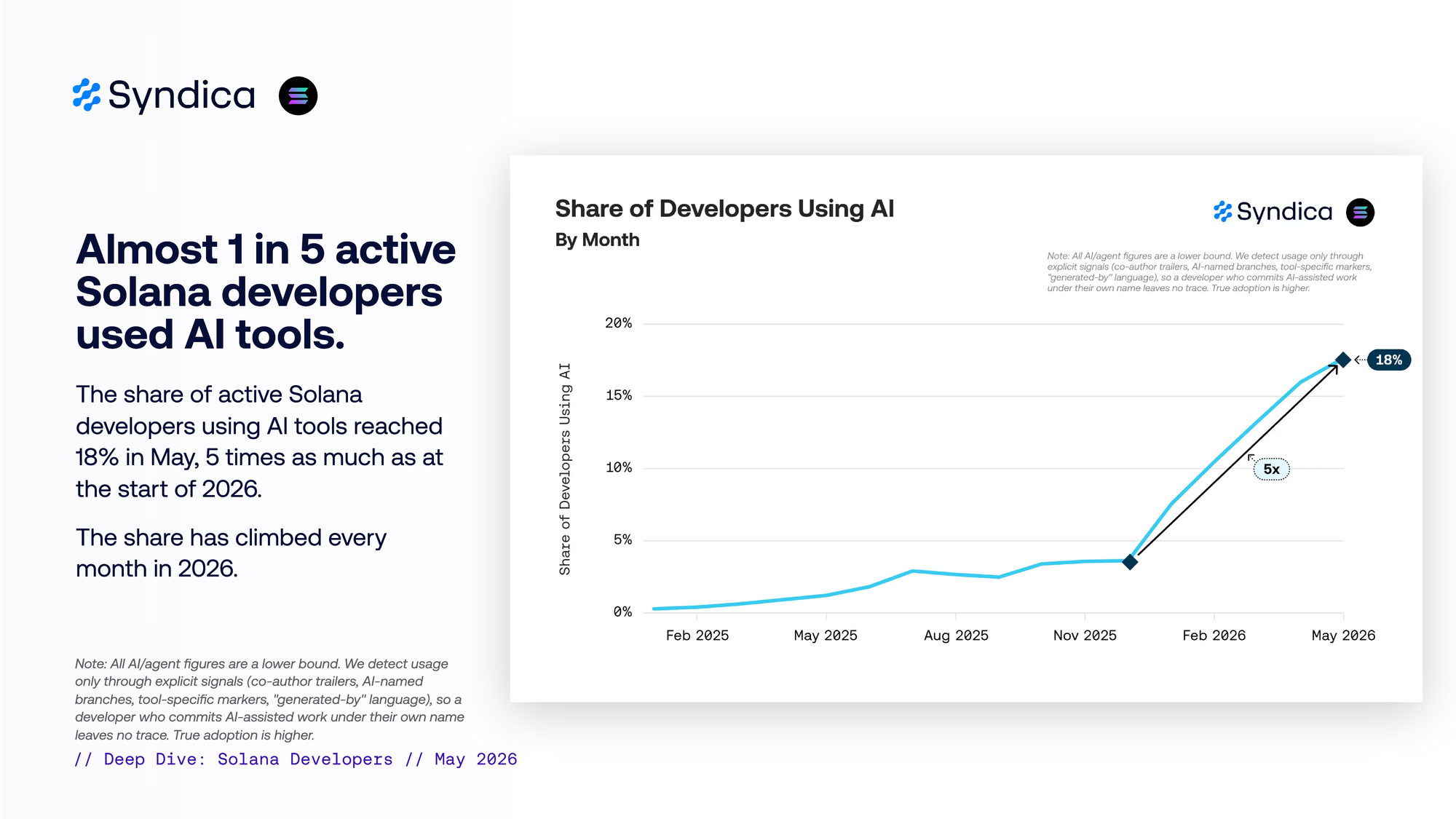
Almost 1 in 5 active Solana developers used AI tools.
The share of active Solana developers using AI tools reached 18% in May, 5 times as much as at the start of 2026. The share has climbed every month in 2026.
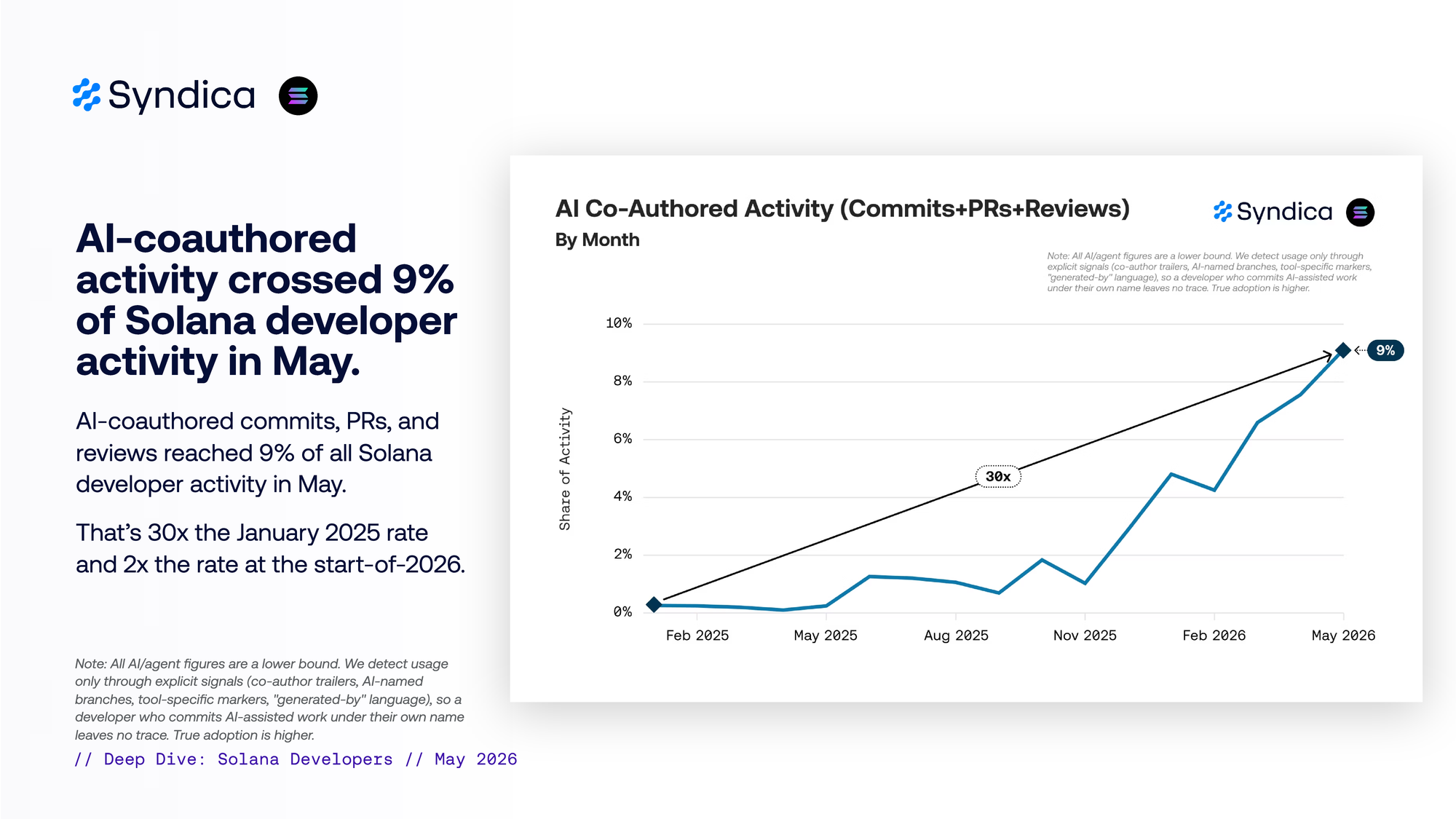
AI-coauthored activity crossed 9% of Solana developer activity in May.
AI-coauthored commits, PRs, and reviews reached 9% of all Solana developer activity in May. That's 30x the January 2025 rate and 2x the rate at the start-of-2026.
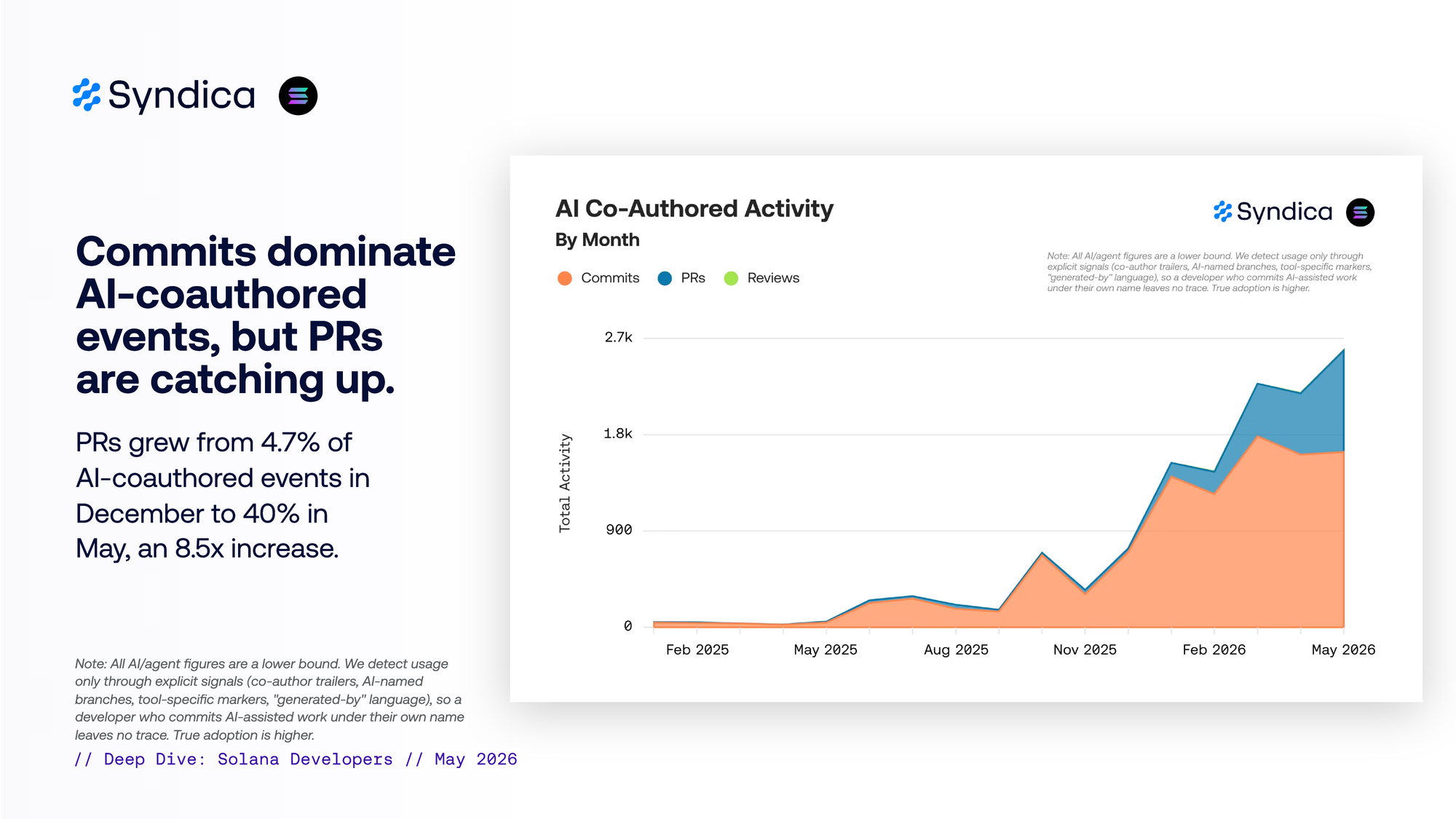
Commits dominate AI-coauthored events, but PRs are catching up.
PRs grew from 4.7% of AI-coauthored events in December to 40% in May, an 8.5x increase.
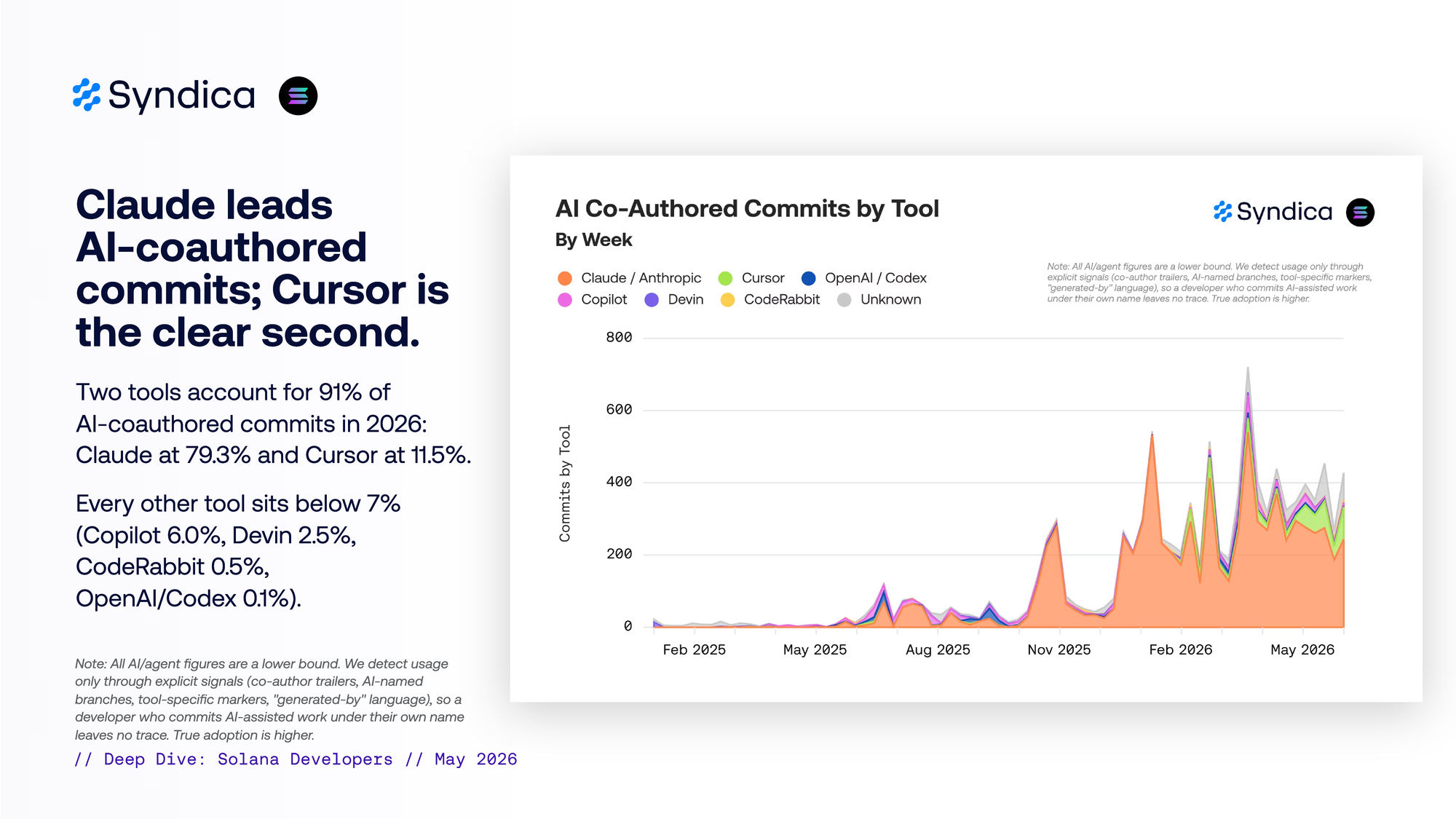
Claude leads AI-coauthored commits; Cursor is the clear second.
Two tools account for 91% of AI-coauthored commits in 2026: Claude at 79.3% and Cursor at 11.5%. Every other tool sits below 7% (Copilot 6.0%, Devin 2.5%, CodeRabbit 0.5%, OpenAI/Codex 0.1%).
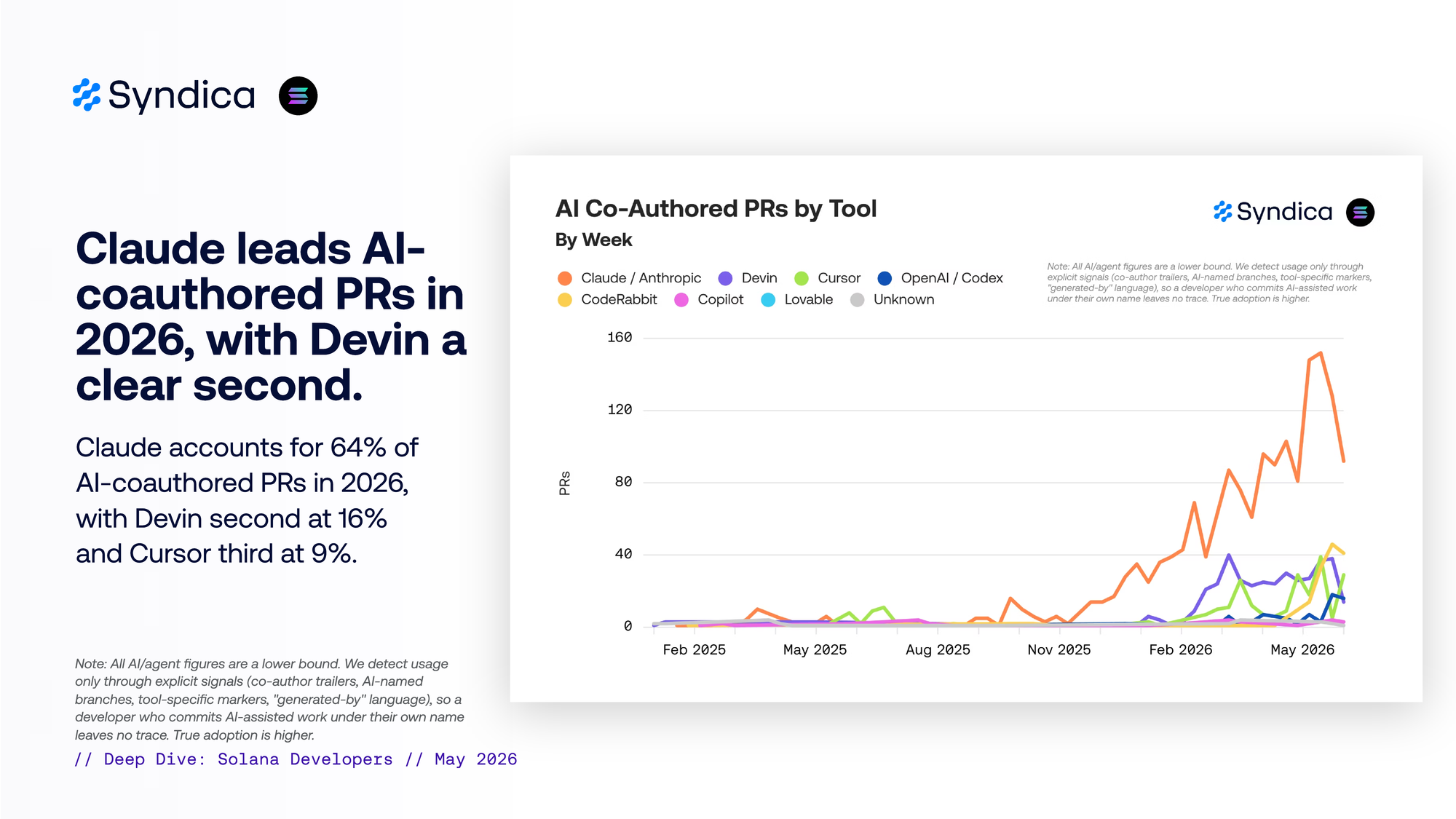
Claude leads AI-coauthored PRs in 2026, with Devin a clear second.
Claude accounts for 64% of AI-coauthored PRs in 2026, with Devin second at 16% and Cursor third at 9%.
Part III Geography
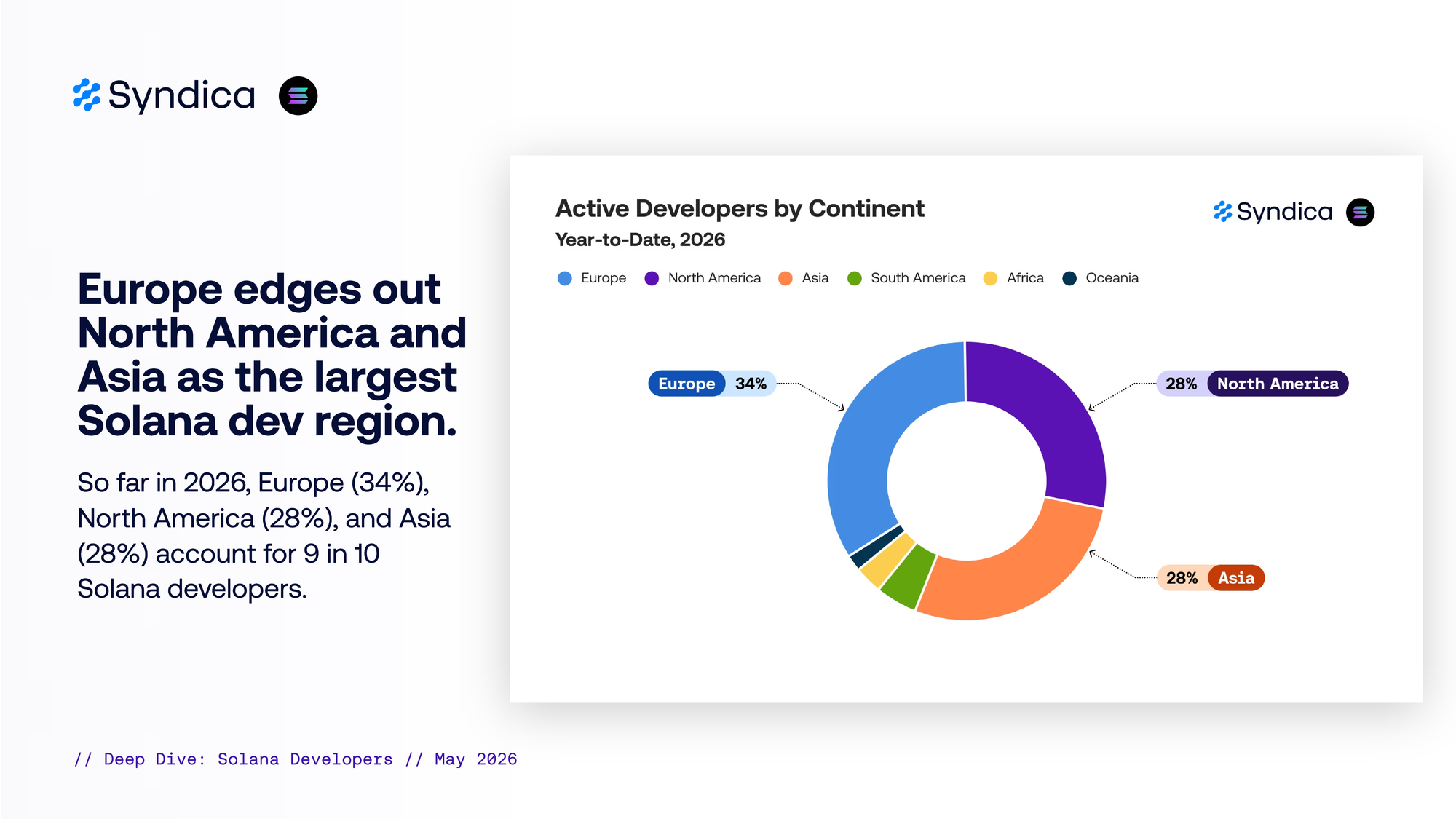
Europe edges out North America and Asia as the largest Solana dev region.
So far in 2026, Europe (34%), North America (28%), and Asia (28%) account for 9 in 10 Solana developers.
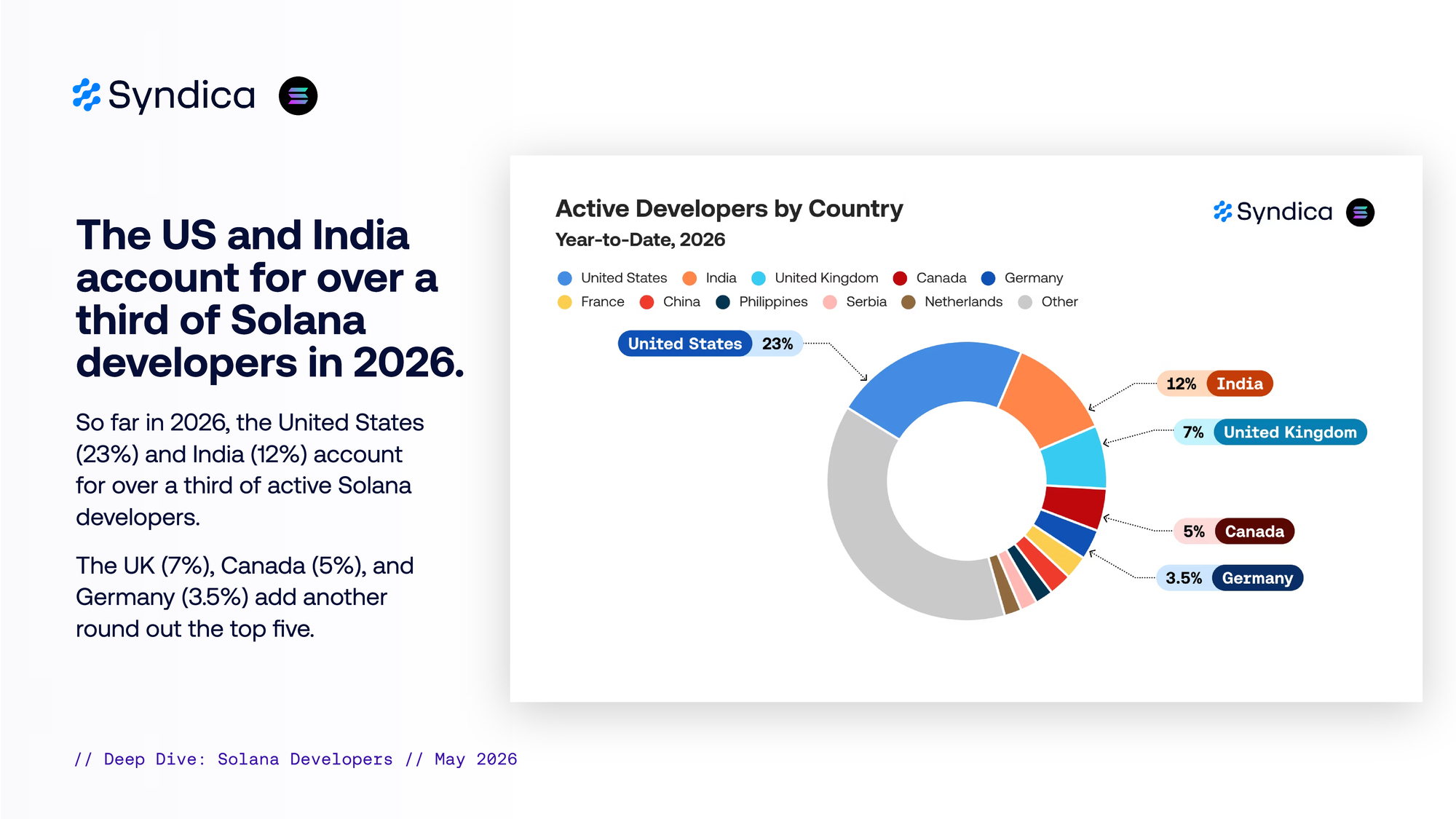
The US and India account for over a third of Solana developers in 2026.
So far in 2026, the United States (23%) and India (12%) account for over a third of active Solana developers. The UK (7%), Canada (5%), and Germany (3.5%) round out the top five.
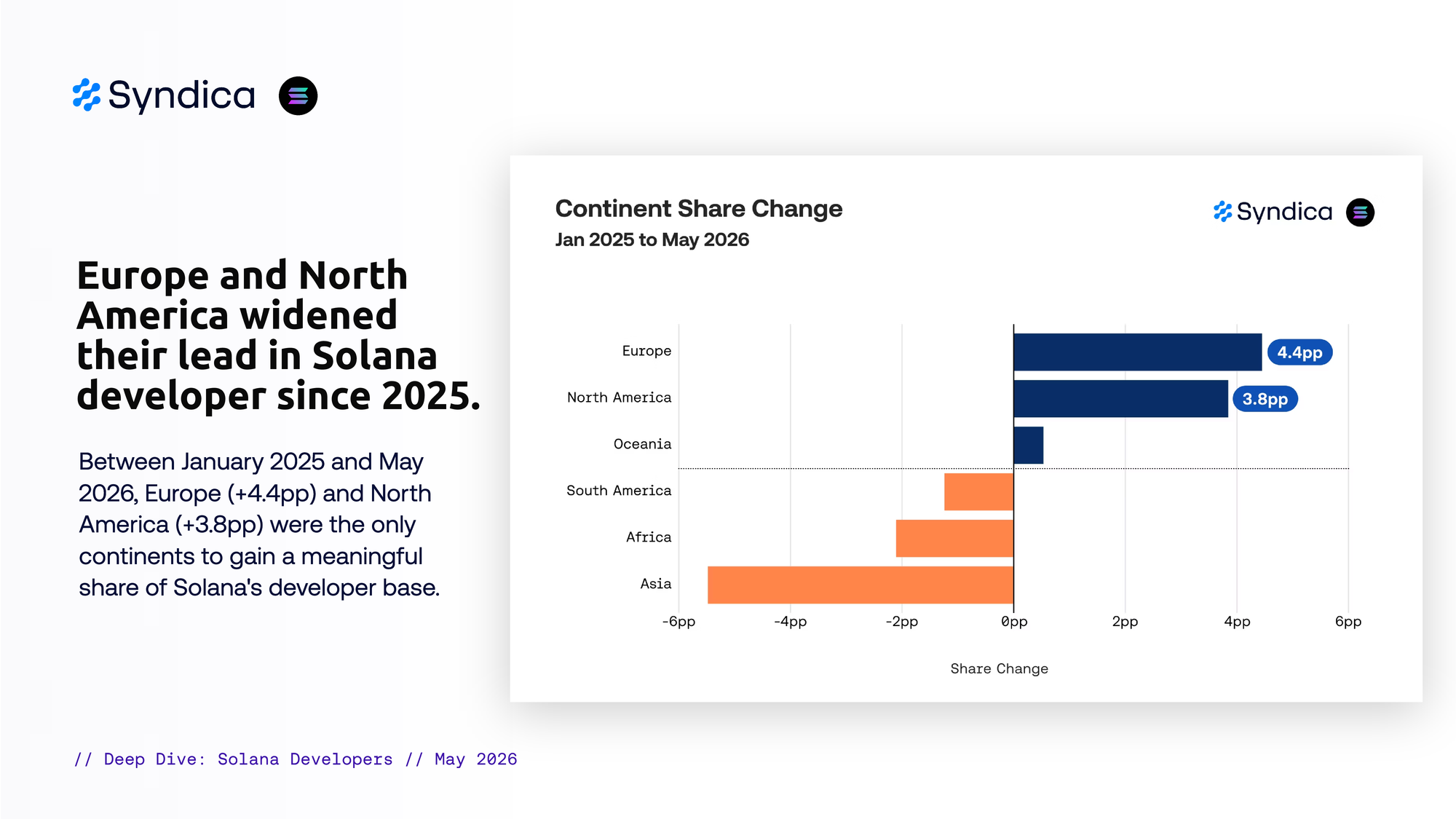
Europe and North America widened their lead in Solana developer since 2025.
Between January 2025 and May 2026, Europe (+4.4pp) and North America (+3.8pp) were the only continents to gain a meaningful share of Solana's developer base.
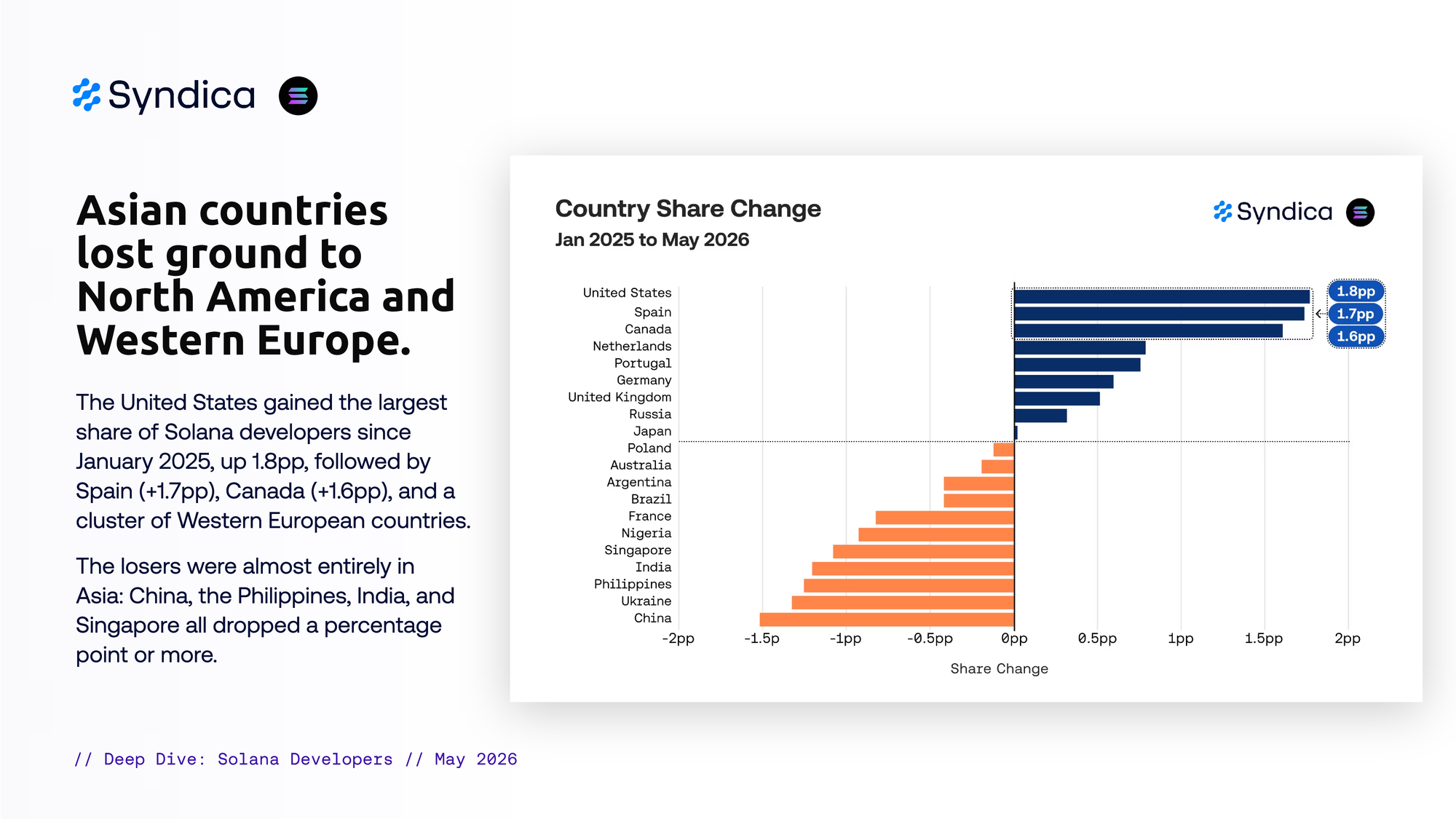
Asian countries lost ground to North America and Western Europe.
The United States gained the largest share of Solana developers since January 2025, up 1.8pp, followed by Spain (+1.7pp), Canada (+1.6pp), and a cluster of Western European countries. The losers were almost entirely in Asia: China, the Philippines, India, and Singapore all dropped a percentage point or more.