Deep Dive: Solana Onchain Activity - January 2026
Deep Dive: Solana Onchain Activity - January 2026
Note: Below is the text-accessible version of this post for visually impaired readers.
Syndica Deep Dive: Solana Onchain Activity - January 2026
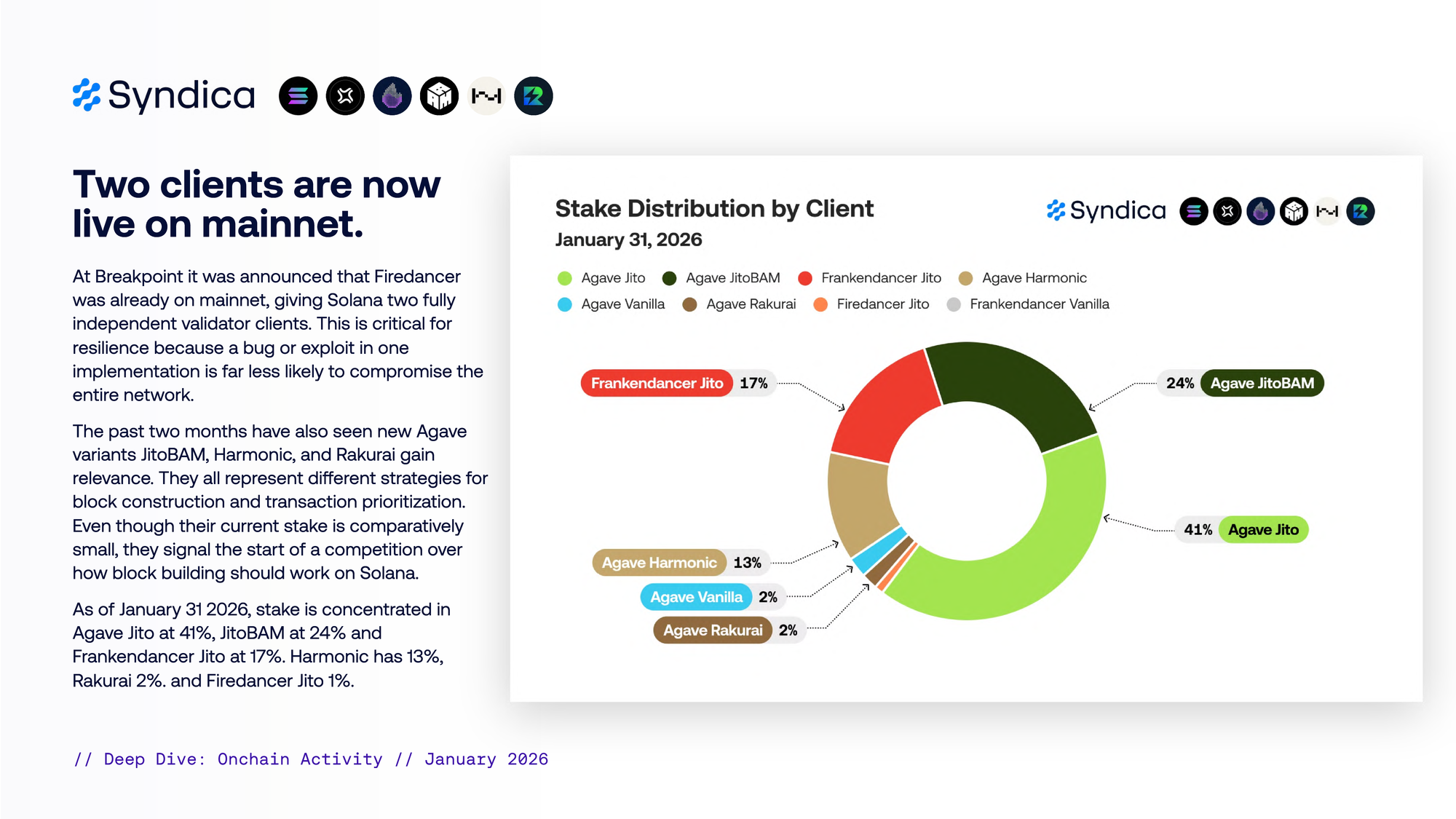
Two Clients are now Live on Mainnet
At Breakpoint it was announced that Firedancer was already on mainnet, giving Solana two fully independent validator clients. This is critical for resilience because a bug or exploit in one implementation is far less likely to compromise the entire network.
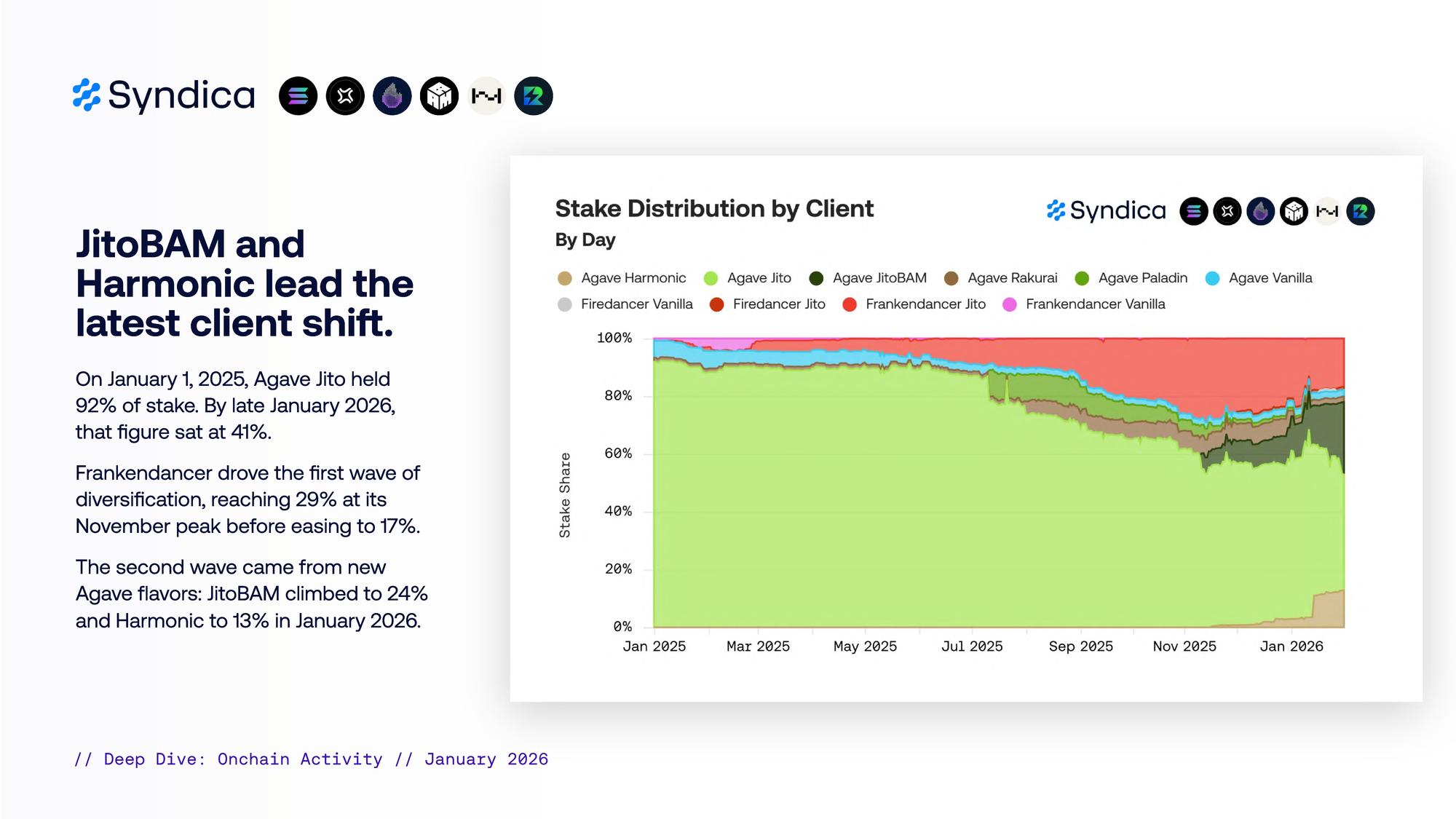
The past two months have also seen new Agave variants JitoBAM, Harmonic, and Rakurai gain relevance. They all represent different strategies for block construction and transaction prioritization. Even though their current stake is comparatively small, they signal the start of a competition over how block building should work on Solana.
As of January 31 2026, stake is concentrated in Agave Jito at 41%, JitoBAM at 24%, and Frankendancer Jito at 17%. Harmonic has 13%, Rakurai 2%, and Firedancer Jito 1%.
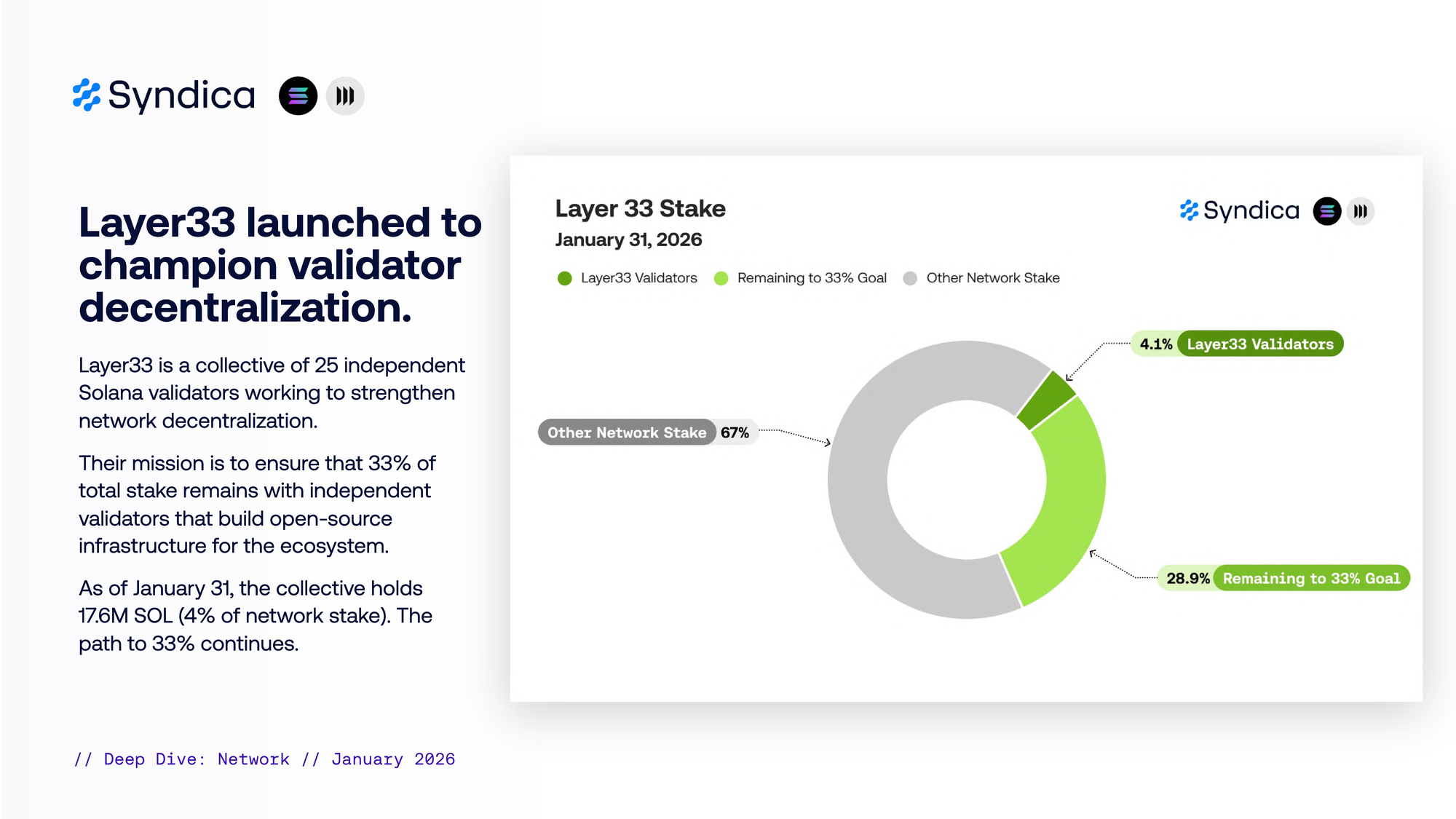
Validator Decentralization: Layer33
Layer33 is a collective of 25 independent Solana validators working to strengthen network decentralization.
Their mission is to ensure that 33% of total stake remains with independent validators that build open-source infrastructure for the ecosystem.
As of January 31, the collective holds 17.6M SOL (4% of network stake). The path to 33% continues.
Part I: Client Reward Distributions
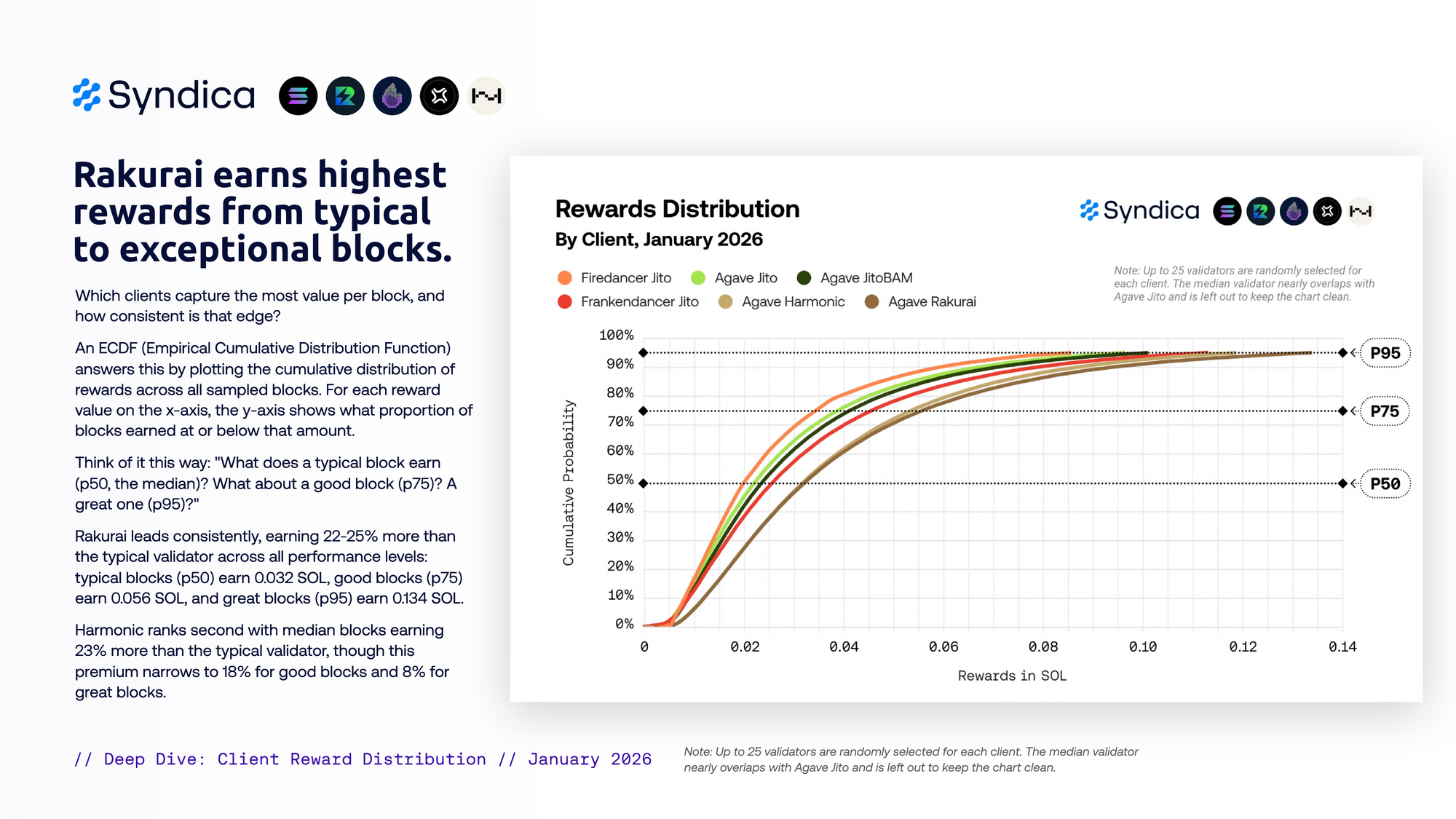
Rakurai Earns Highest Rewards from Typical to Exceptional Blocks
Which clients capture the most value per block, and how consistent is that edge?
An ECDF (Empirical Cumulative Distribution Function) plots the cumulative distribution of rewards across sampled blocks. For each reward value on the x-axis, the y-axis shows what proportion of blocks earned at or below that amount.
Think of it this way:
- What does a typical block earn (p50, the median)?
- What about a good block (p75)?
- A great one (p95)?
Rakurai leads consistently, earning 22–25% more than the typical validator across all performance levels.
- Typical blocks (p50): 0.032 SOL
- Good blocks (p75): 0.056 SOL
- Great blocks (p95): 0.134 SOL
Harmonic ranks second with median blocks earning 23% more than the typical validator, though this premium narrows to 18% for good blocks and 8% for great blocks.
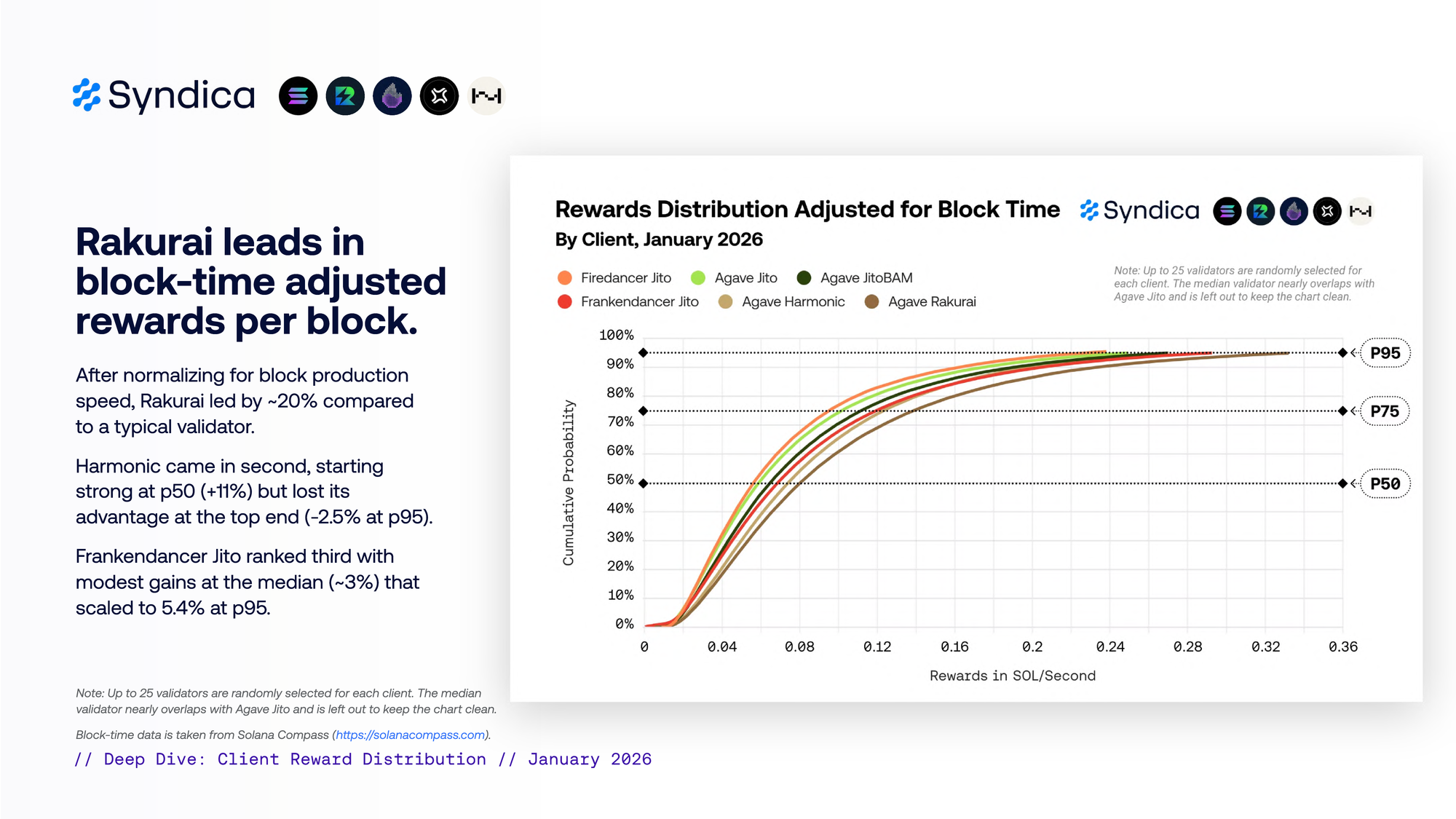
Block-Time Adjusted Rewards
After normalizing for block production speed, Rakurai led by ~20% compared to a typical validator.
Harmonic came in second, starting strong at p50 (+11%) but lost its advantage at the top end (-2.5% at p95).
Frankendancer Jito ranked third with modest gains at the median (~3%) that scaled to 5.4% at p95.
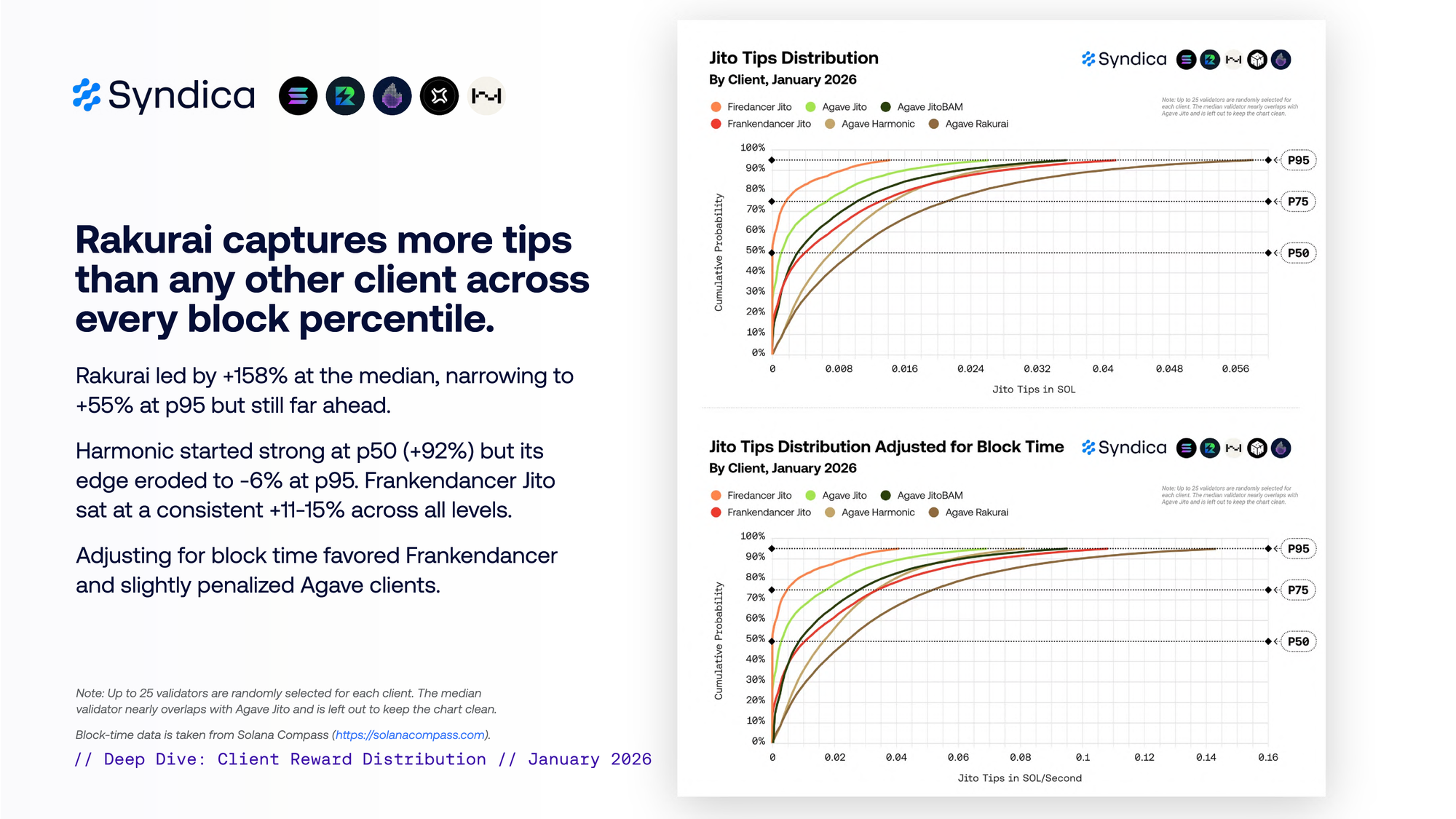
Tip Capture by Client
Rakurai captures more tips than any other client across every block percentile.
- +158% at the median
- +55% at p95
Harmonic:
- +92% at p50
- -6% at p95
Frankendancer Jito maintained a consistent +11–15% across all levels.
Adjusting for block time favored Frankendancer and slightly penalized Agave clients.
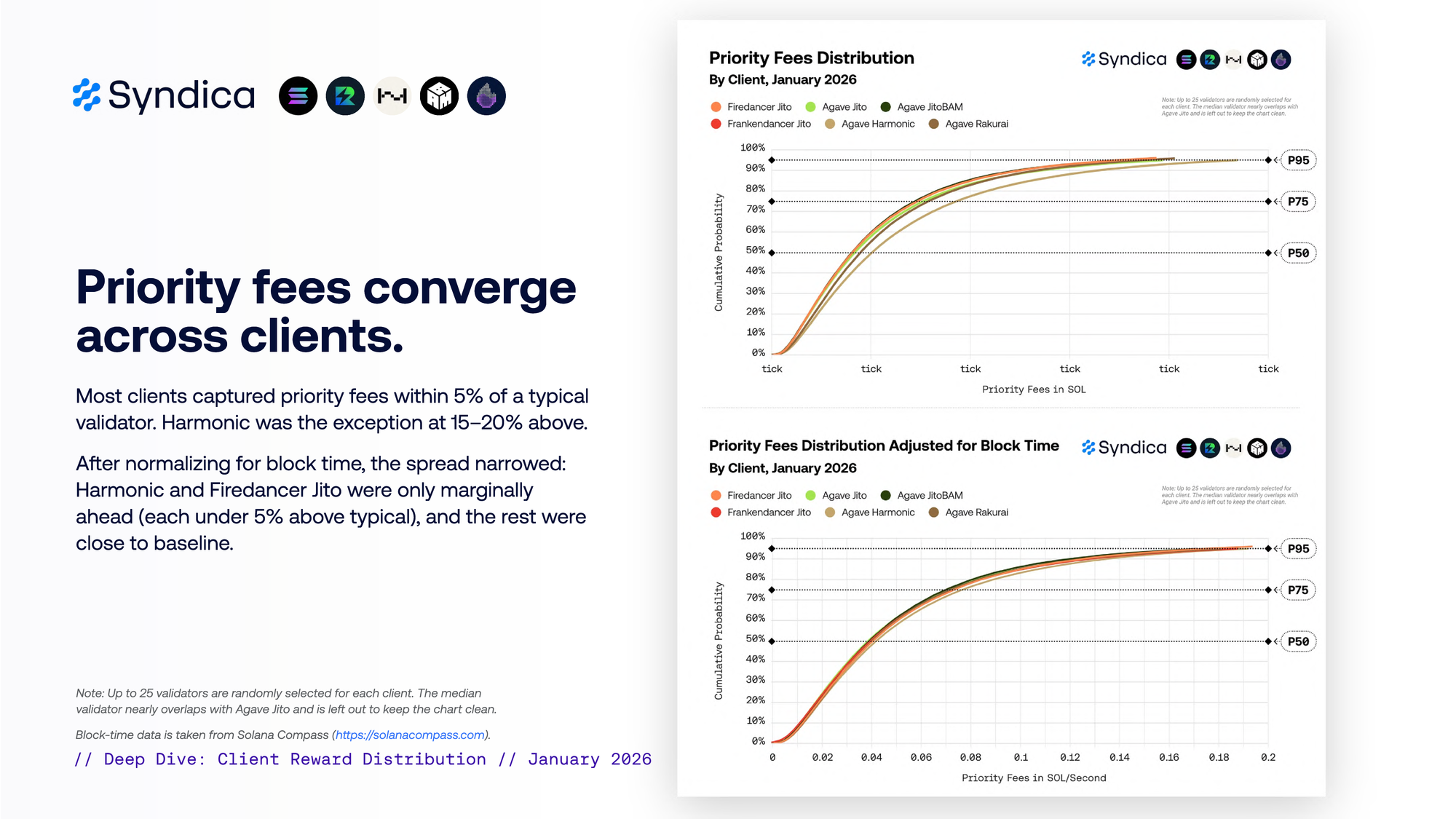
Priority Fees
Most clients captured priority fees within 5% of a typical validator. Harmonic was the exception at 15–20% above.
After normalizing for block time, the spread narrowed. Harmonic and Firedancer Jito were only marginally ahead (under 5% above typical), and the rest were close to baseline.
Part II: Client Performance
Skip Rates
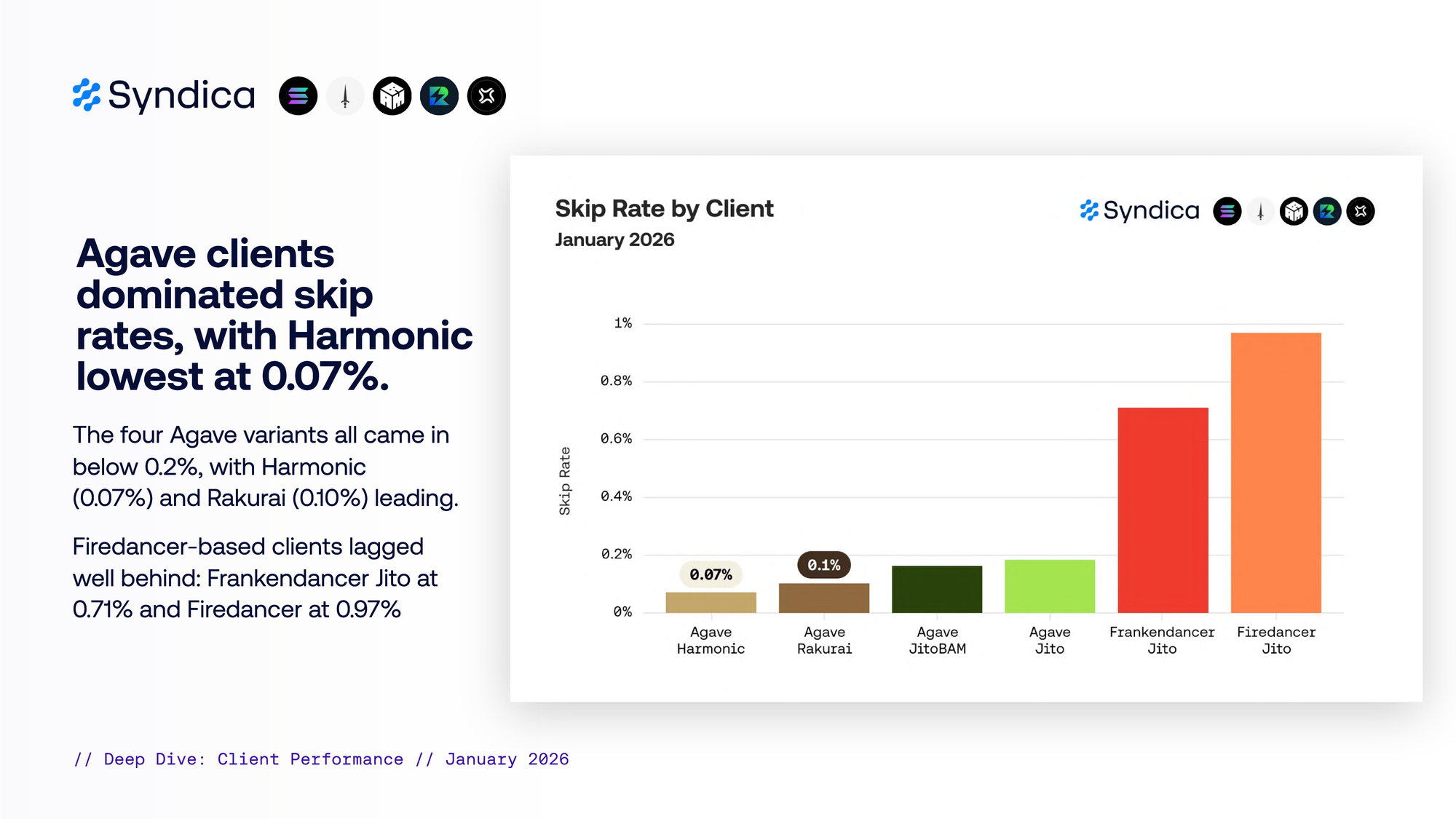
Agave clients dominated skip rates, with Harmonic lowest at 0.07%.
- Harmonic: 0.07%
- Rakurai: 0.10%
- All four Agave variants: below 0.2%
Firedancer-based clients lagged:
- Frankendancer Jito: 0.71%
- Firedancer: 0.97%
First-Slot Vote Success
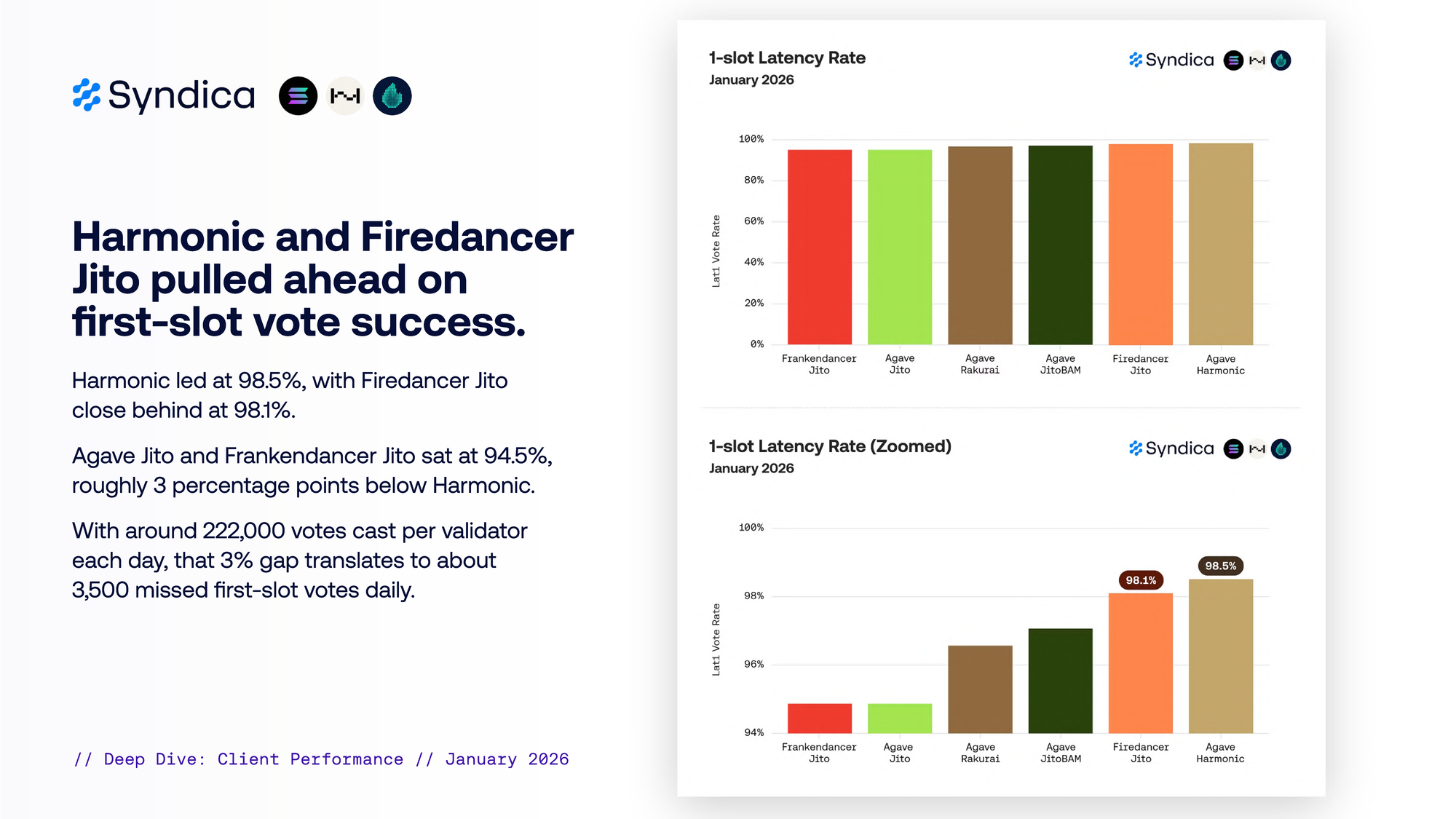
Harmonic and Firedancer Jito pulled ahead on first-slot vote success.
- Harmonic: 98.5%
- Firedancer Jito: 98.1%
- Agave Jito: 94.5%
- Frankendancer Jito: 94.5%
With around 222,000 votes cast per validator each day, a 3% gap translates to roughly 3,500 missed first-slot votes daily.
Block Times
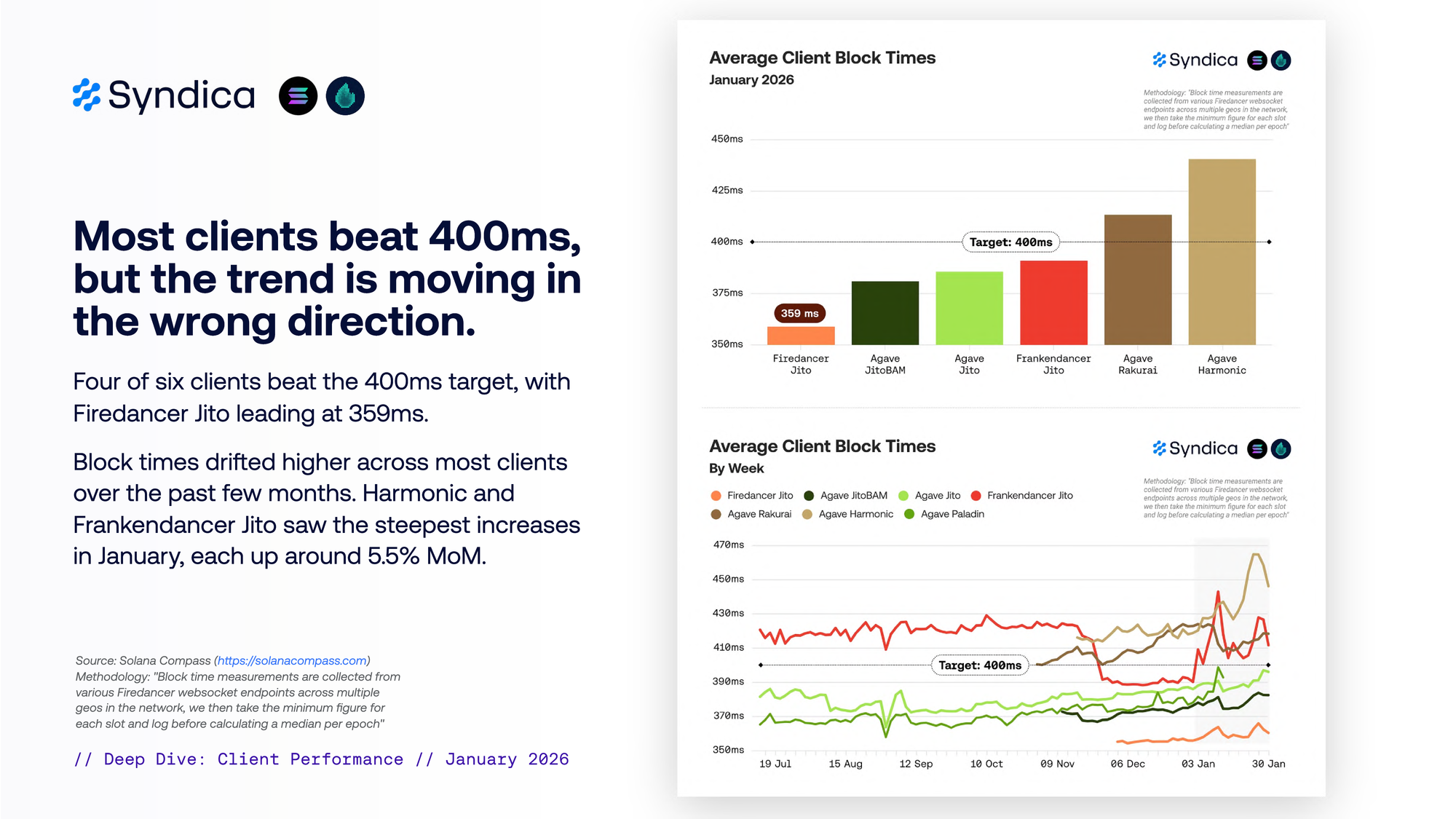
Four of six clients beat the 400ms target, with Firedancer Jito leading at 359ms.
Block times drifted higher across most clients over the past few months. Harmonic and Frankendancer Jito saw the steepest increases in January, each up around 5.5% month-over-month.
Methodology: Block time measurements are collected from various Firedancer websocket endpoints across multiple geographies in the network. The minimum figure for each slot is logged before calculating a median per epoch.
Rewards Per Block (Time-Adjusted)
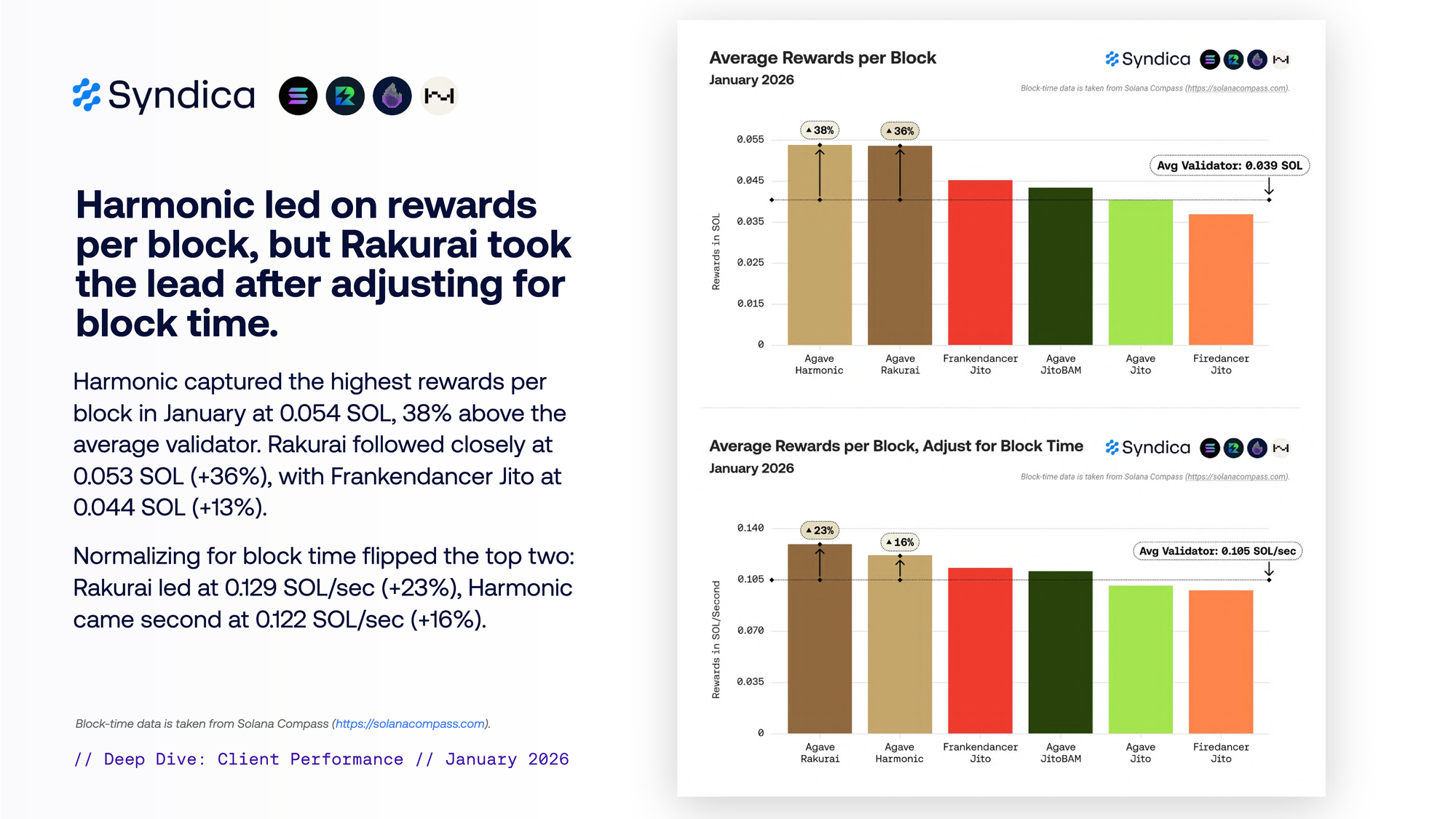
Harmonic captured the highest rewards per block in January at 0.054 SOL (38% above the average validator). Rakurai followed at 0.053 SOL (+36%), with Frankendancer Jito at 0.044 SOL (+13%).
After normalizing for block time:
- Rakurai: 0.129 SOL/sec (+23%)
- Harmonic: 0.122 SOL/sec (+16%)
Compute Units Per Block
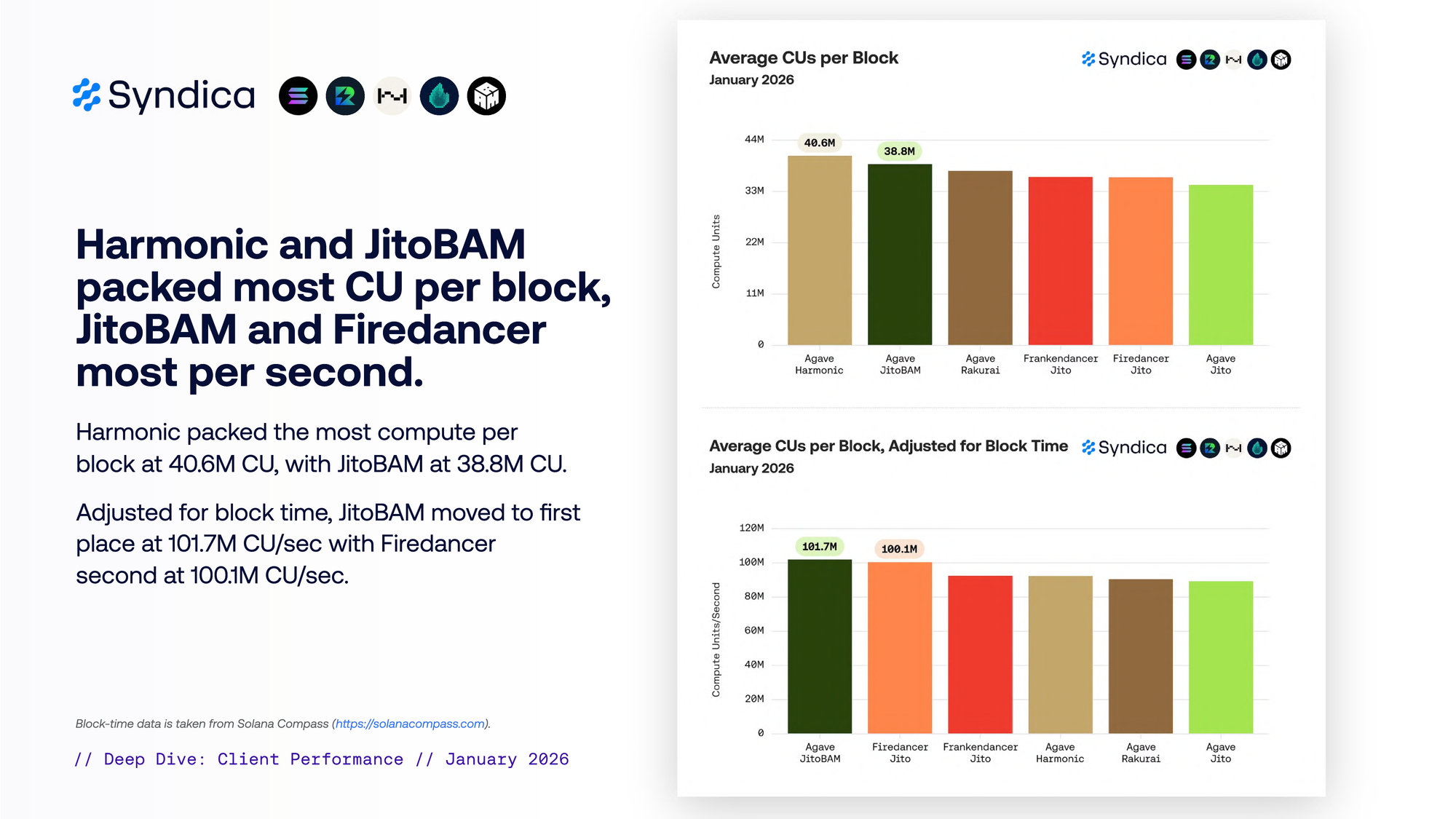
Harmonic packed the most compute per block at 40.6M CU, with JitoBAM at 38.8M CU.
Adjusted for block time:
- JitoBAM: 101.7M CU/sec
- Firedancer: 100.1M CU/sec
Revenue Per Compute Unit
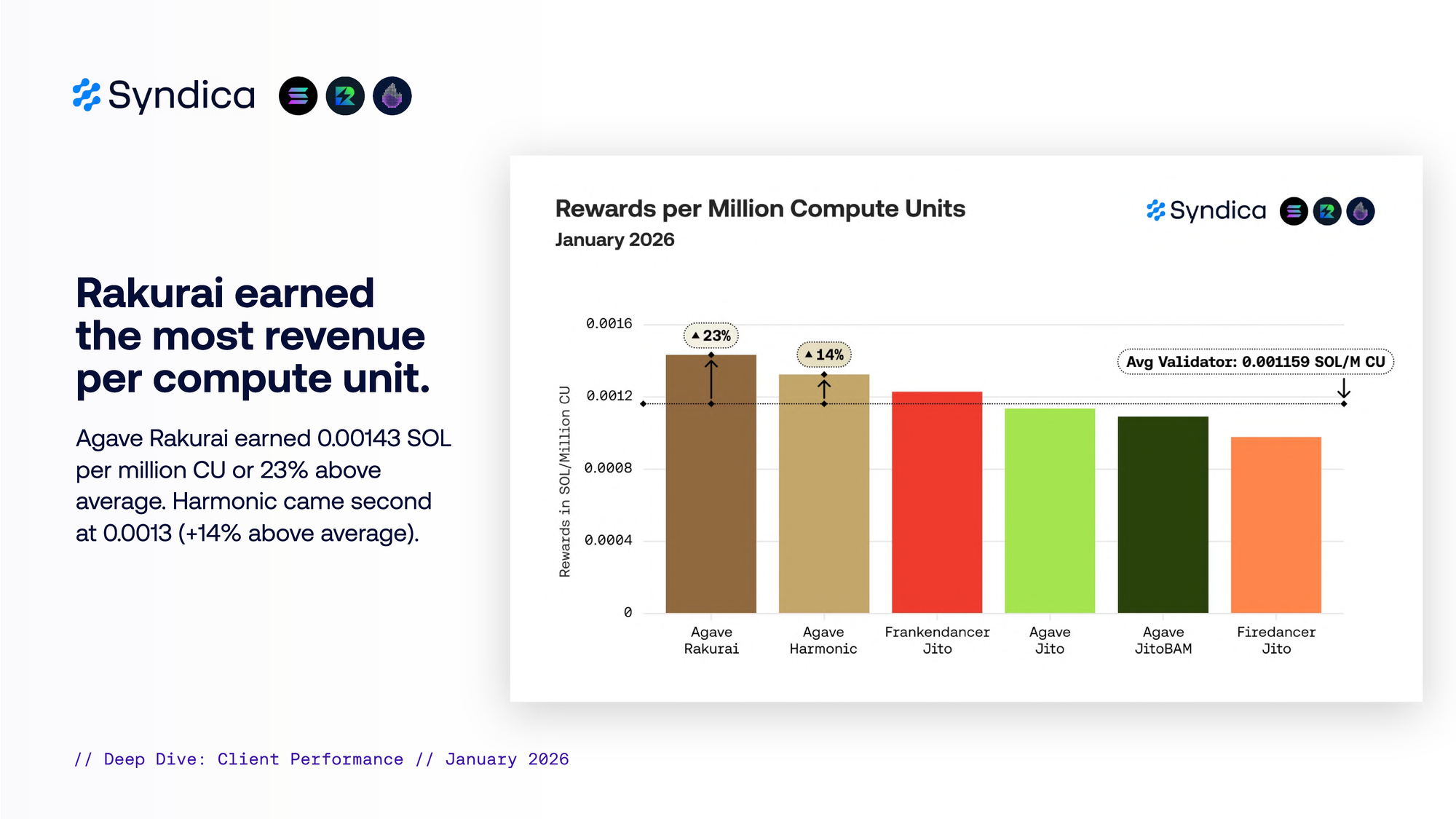
Agave Rakurai earned 0.00143 SOL per million CU (23% above average). Harmonic came second at 0.0013 SOL (+14% above average).
Part III: Validator Profitability
Validator Profitability by Client
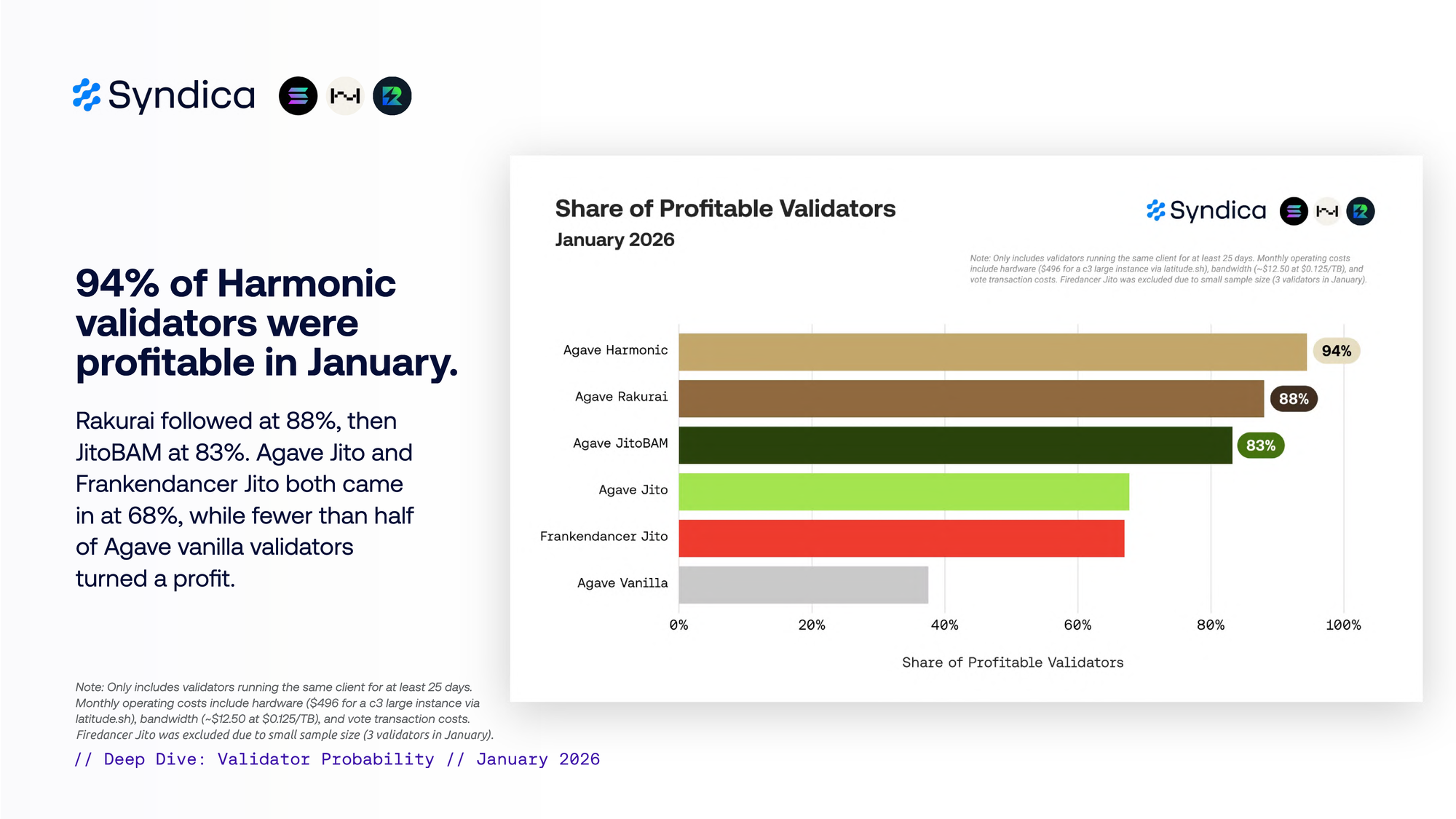
94% of Harmonic validators were profitable in January.
- Harmonic: 94%
- Rakurai: 88%
- JitoBAM: 83%
- Agave Jito: 68%
- Frankendancer Jito: 68%
- Fewer than half of Agave vanilla validators turned a profit
Only includes validators running the same client for at least 25 days.
Monthly operating costs include:
- Hardware ($496 for a c3 large instance via latitude.sh)
- Bandwidth (~$12.50 at $0.125/TB)
- Vote transaction costs
Firedancer Jito excluded due to small sample size.
Tip- and Fee-Based APY
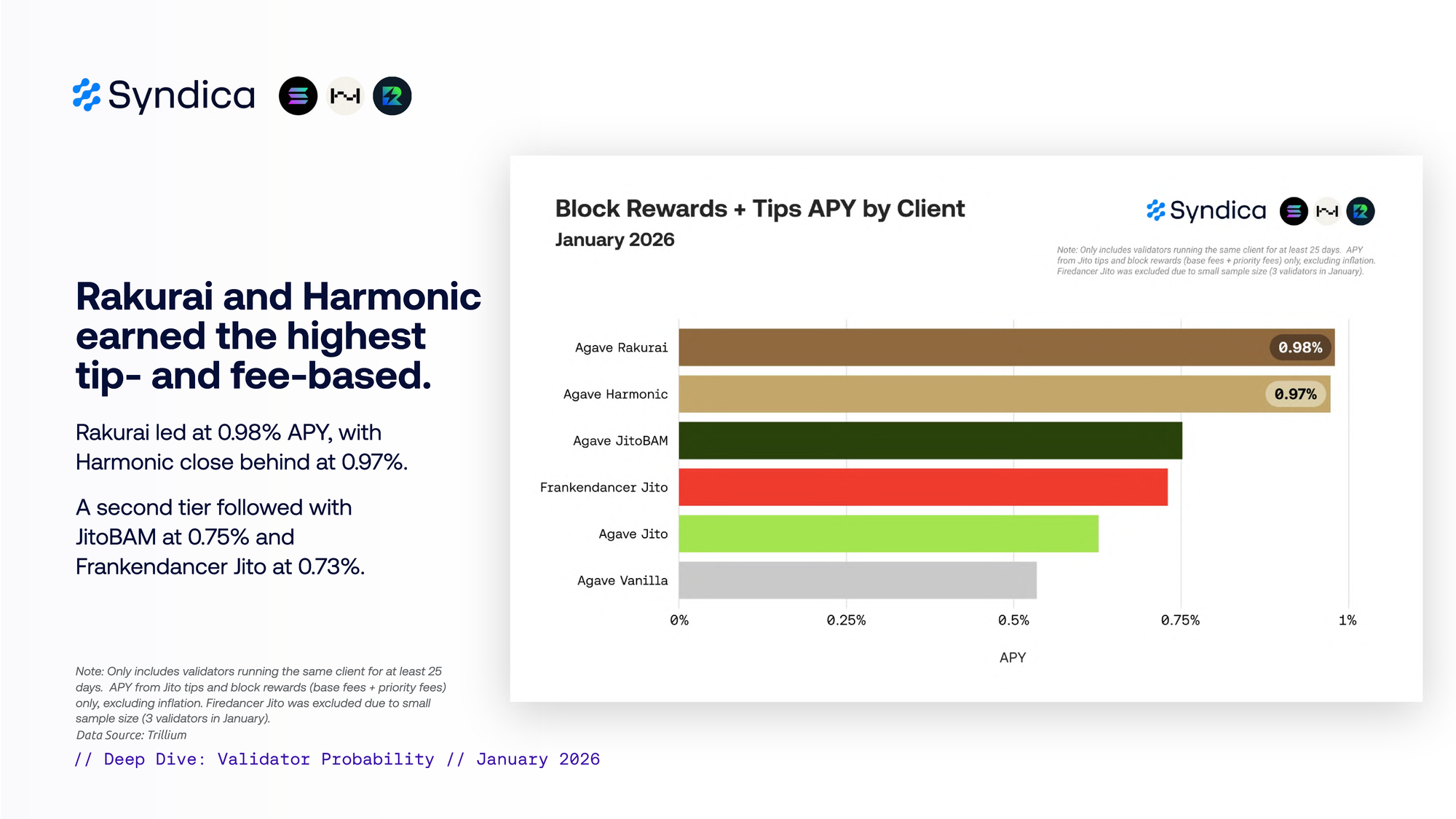
Rakurai led at 0.98% APY, with Harmonic close behind at 0.97%.
Second tier:
- JitoBAM: 0.75%
- Frankendancer Jito: 0.73%
APY reflects Jito tips and block rewards (base fees + priority fees) only, excluding inflation.
Data Source: Trillium.
Operator vs Delegator Returns
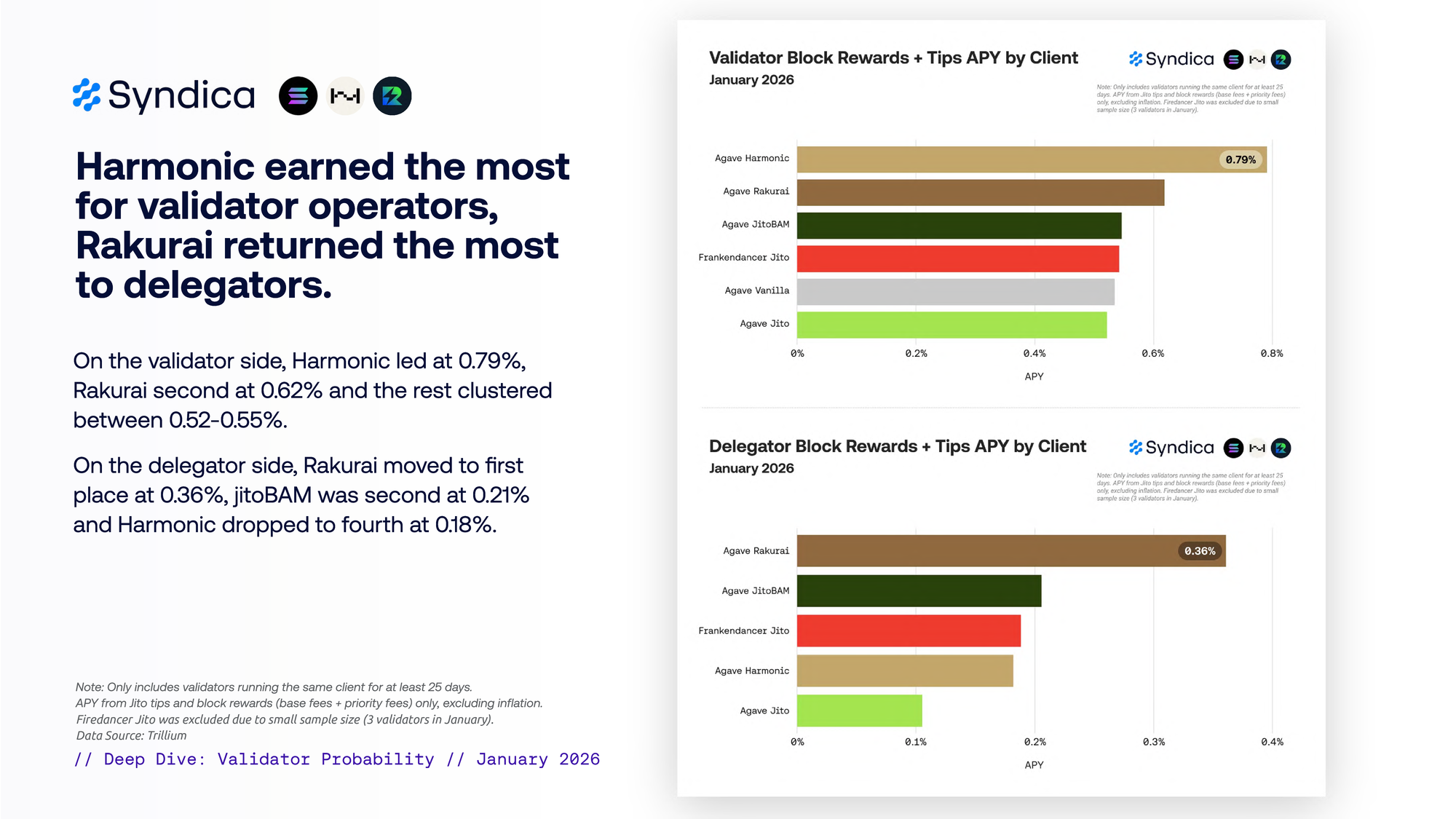
Validator operator returns:
- Harmonic: 0.79%
- Rakurai: 0.62%
- Others clustered between 0.52–0.55%
Delegator returns:
- Rakurai: 0.36%
- JitoBAM: 0.21%
- Harmonic: 0.18%
APY excludes inflation.
Data Source: Trillium.
Network-Wide Profitability
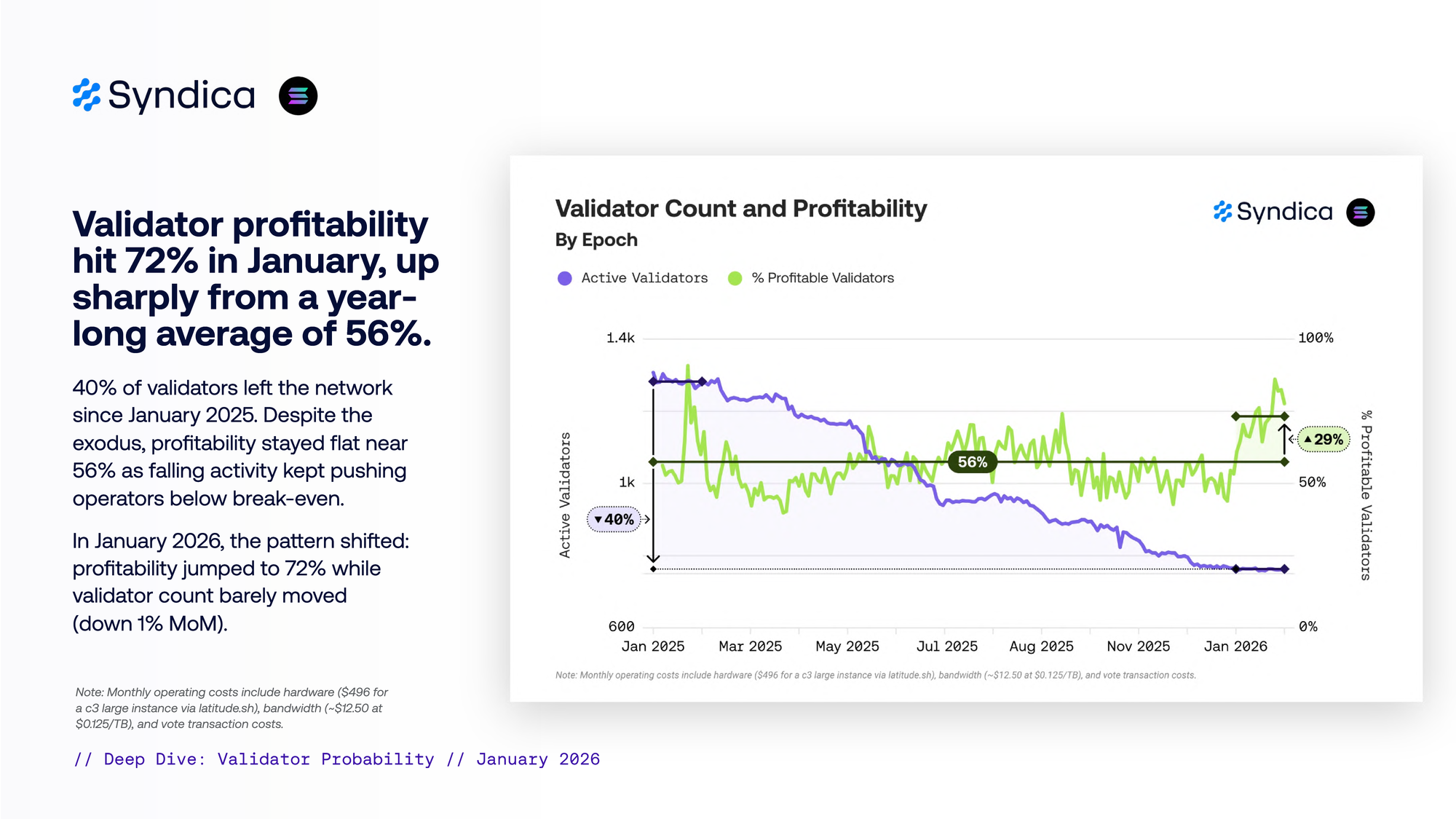
Validator profitability hit 72% in January, up sharply from a year-long average of 56%.
40% of validators left the network since January 2025. Despite the exodus, profitability stayed flat near 56% as falling activity pushed operators below break-even.
In January 2026, the pattern shifted:
- Profitability jumped to 72%
- Validator count moved down just 1% month-over-month
Part IV: Network Activity
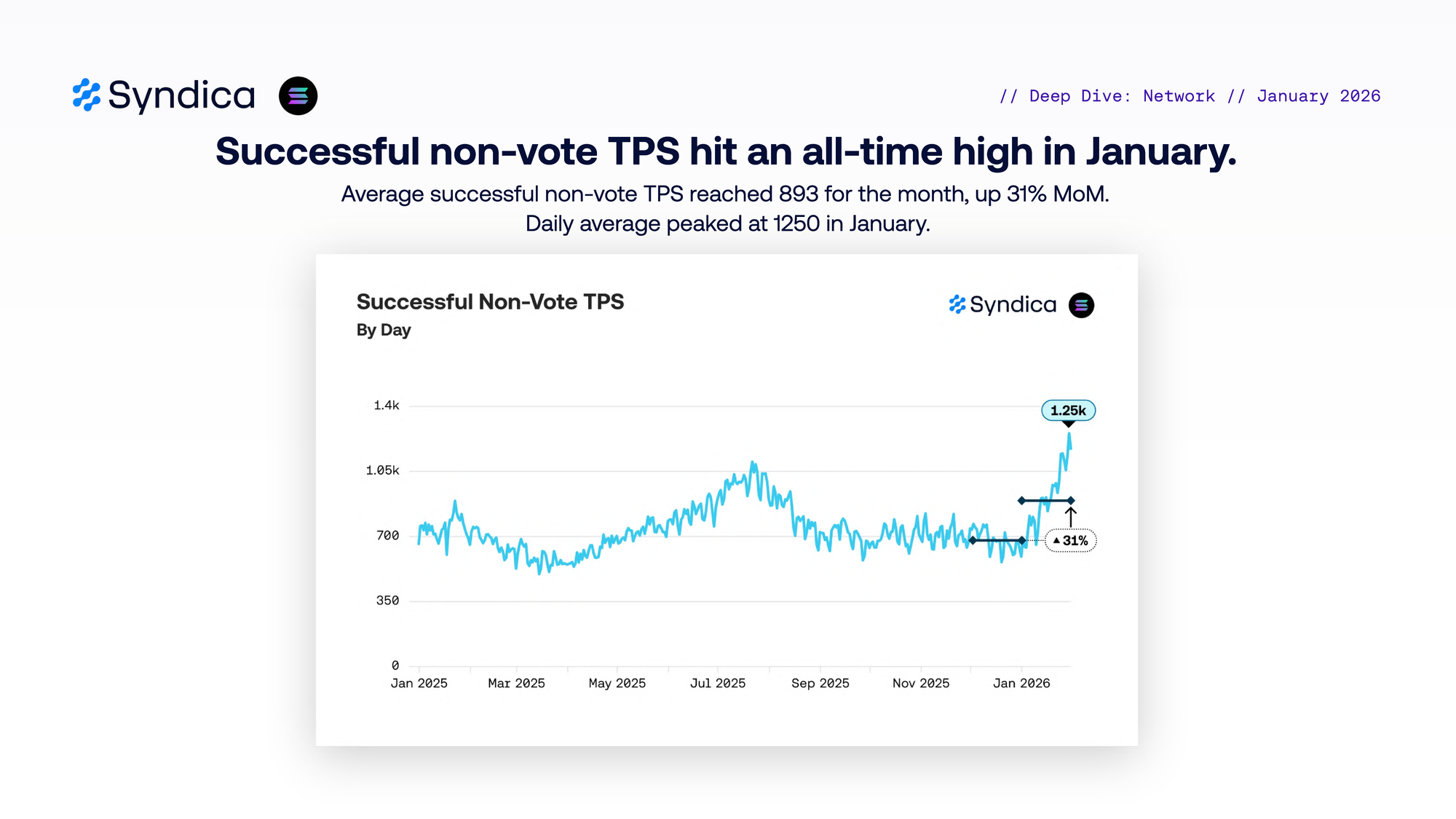
Non-Vote TPS
Successful non-vote TPS hit an all-time high in January.
- Monthly average: 893
- Up 31% month-over-month
- Daily peak: 1250
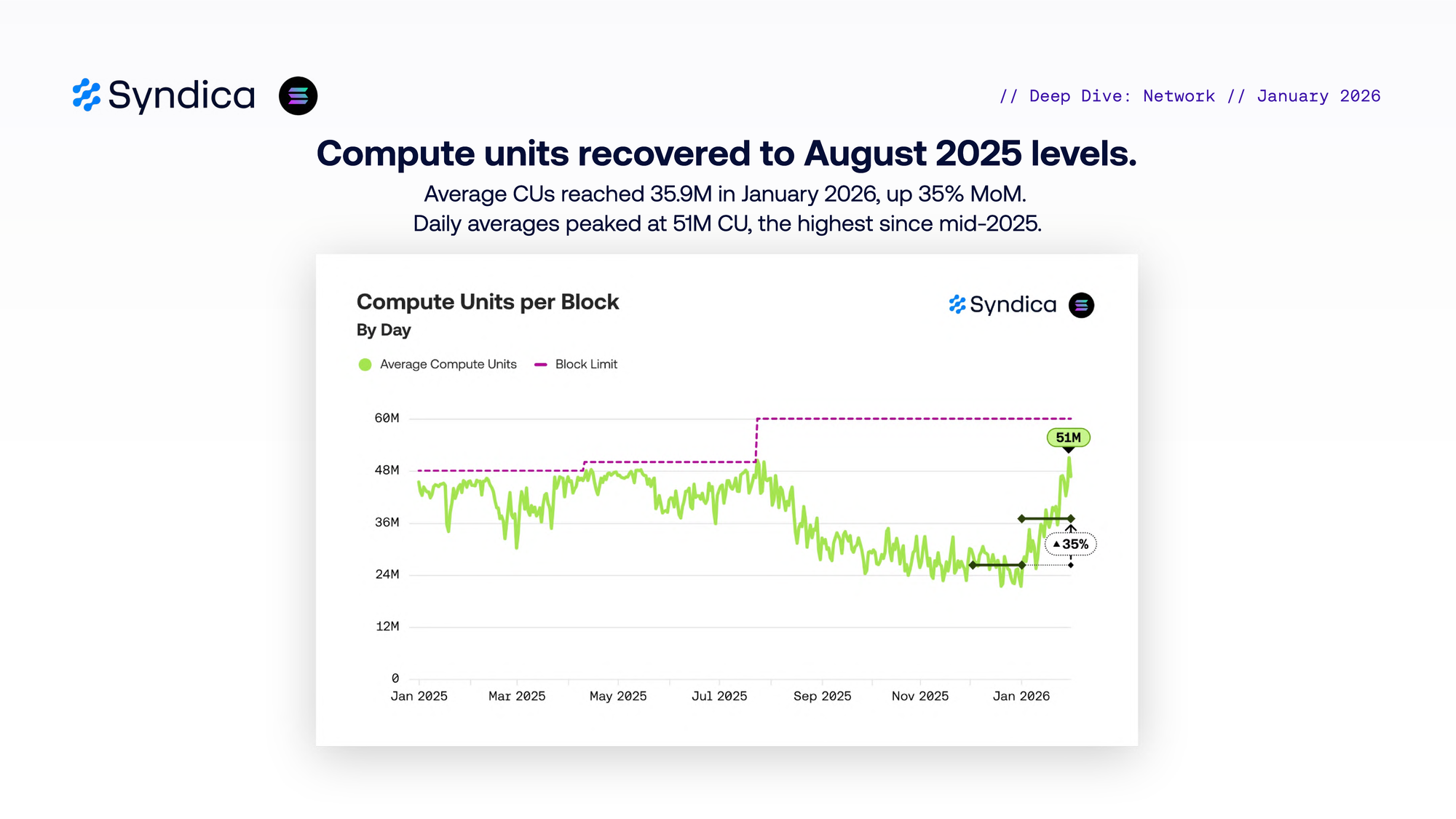
Compute Units
Compute units recovered to August 2025 levels.
- Monthly average: 35.9M CU
- Up 35% month-over-month
- Daily peak: 51M CU
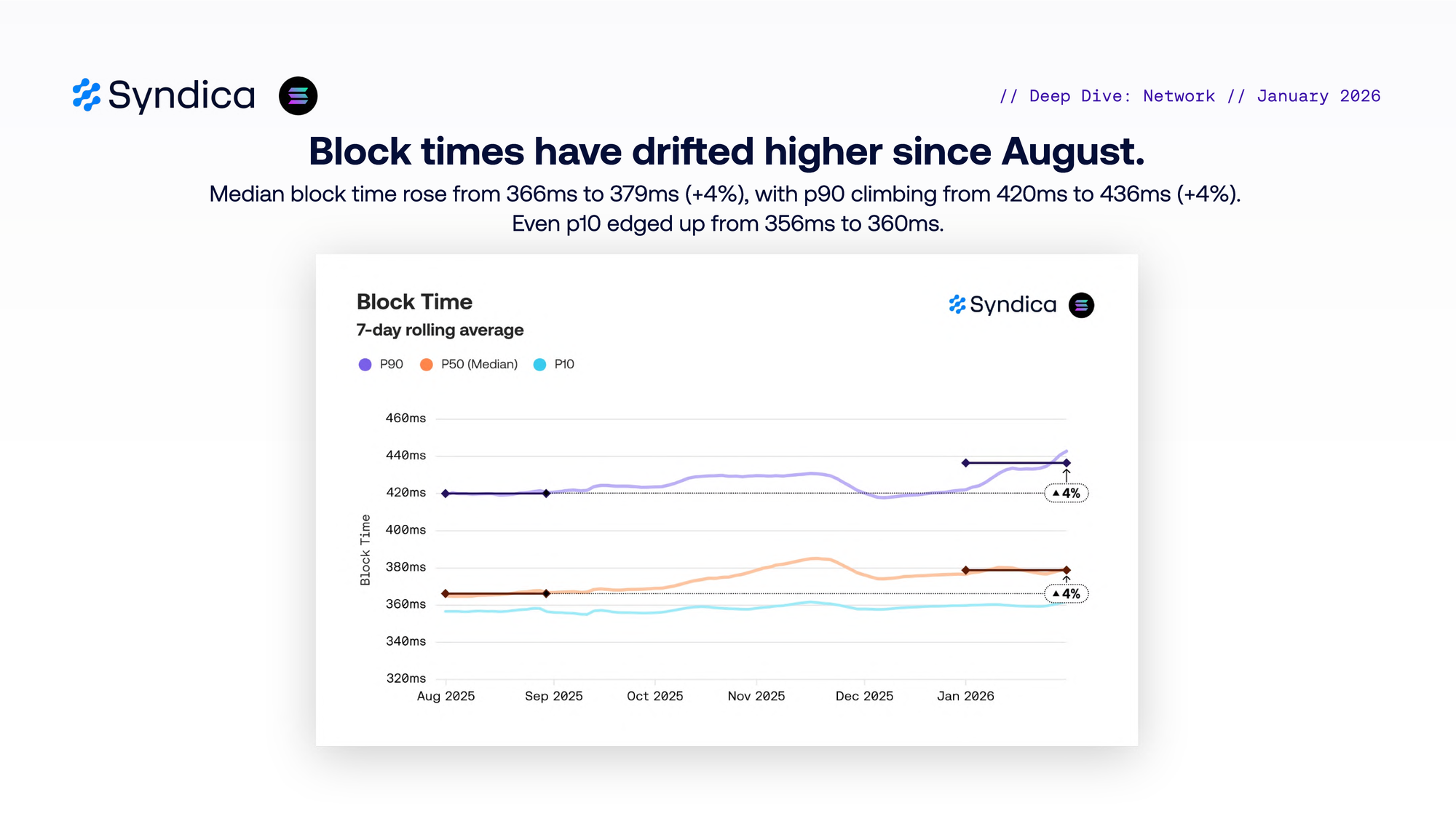
Block Times
Block times have drifted higher since August.
- Median: 366ms → 379ms (+4%)
- p90: 420ms → 436ms (+4%)
- p10: 356ms → 360ms
Appendix: Background Theory
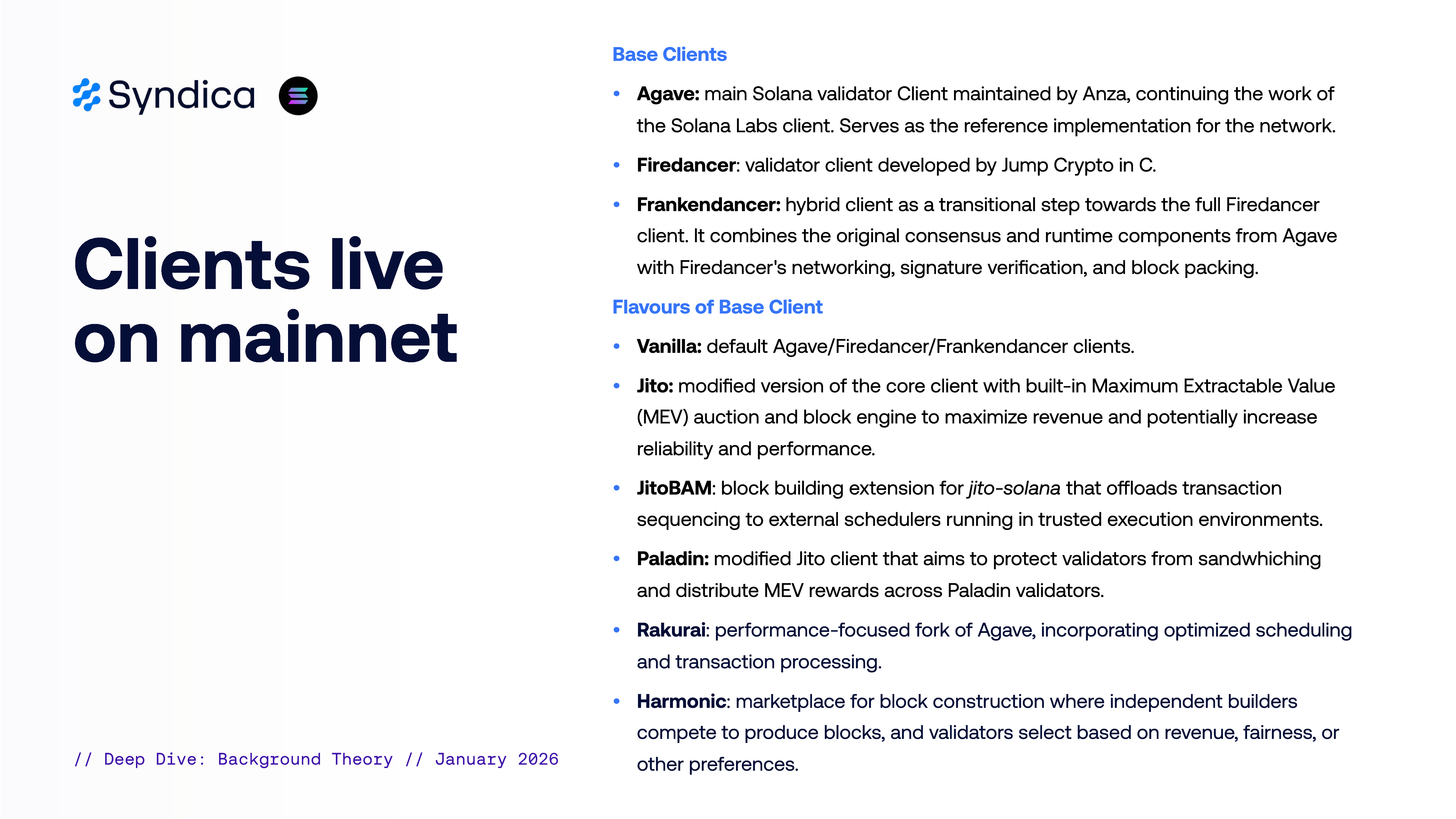
Clients Live on Mainnet
Base Clients
Agave: Main Solana validator client maintained by Anza, continuing the work of the Solana Labs client. Serves as the reference implementation.
Firedancer: Validator client developed by Jump Crypto in C.
Frankendancer: Hybrid client combining Agave consensus/runtime with Firedancer networking, signature verification, and block packing.
Flavours of Base Client
Vanilla: Default Agave, Firedancer, or Frankendancer clients.
Jito: Modified client with built-in MEV auction and block engine.
JitoBAM: Extension for jito-solana that offloads transaction sequencing to external schedulers running in trusted execution environments.
Paladin: Modified Jito client designed to protect validators from sandwiching and distribute MEV rewards.
Rakurai: Performance-focused fork of Agave with optimized scheduling and transaction processing.
Harmonic: Marketplace for block construction where independent builders compete to produce blocks.
Validators and Block Production
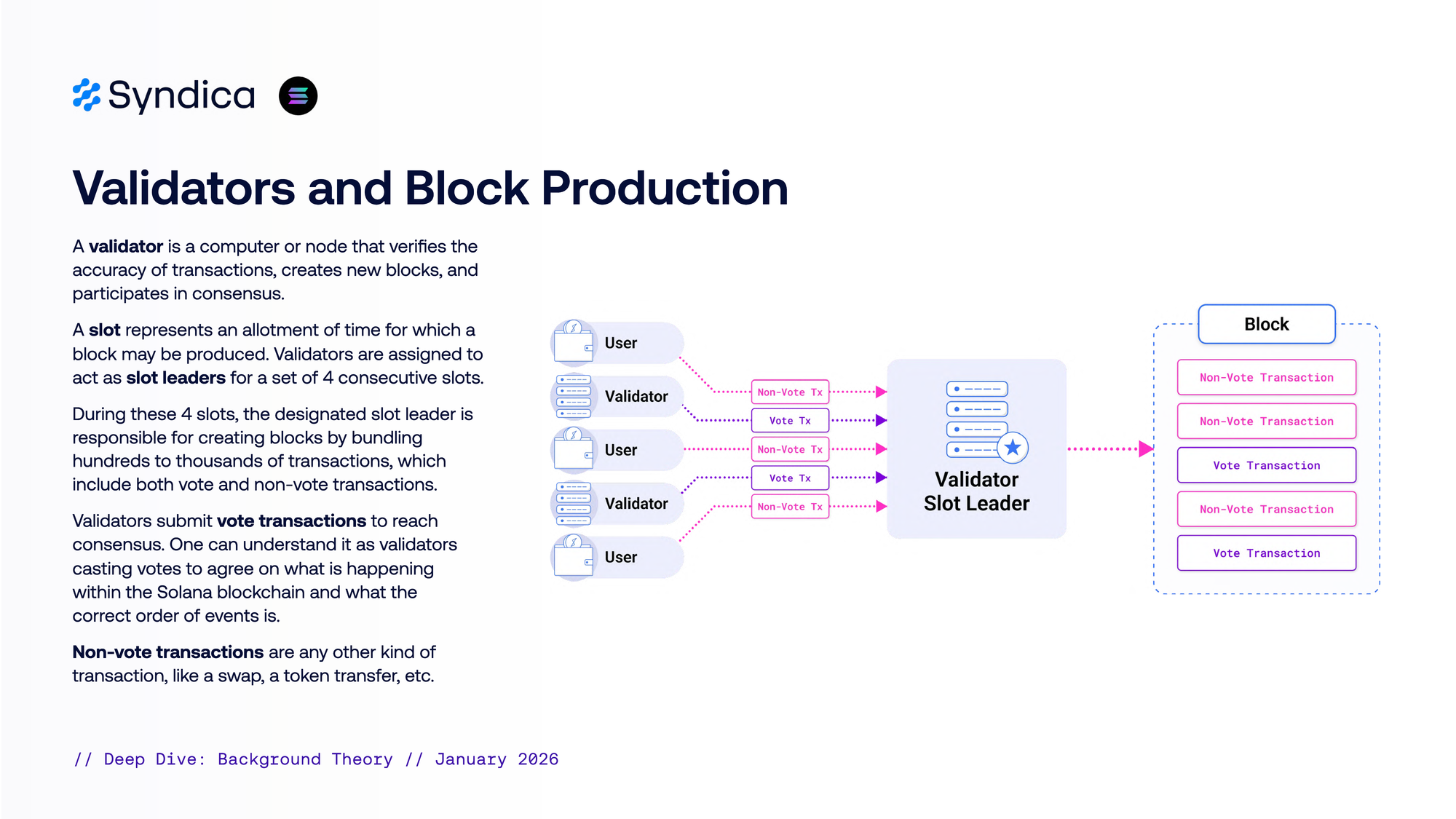
A validator verifies transactions, creates new blocks, and participates in consensus.
A slot represents a time allotment during which a block may be produced. Validators act as slot leaders for four consecutive slots. During these slots, they bundle hundreds to thousands of vote and non-vote transactions.
Vote transactions help validators reach consensus on the correct order of events.
Non-vote transactions include swaps, token transfers, and other user actions.
Measuring Network Performance
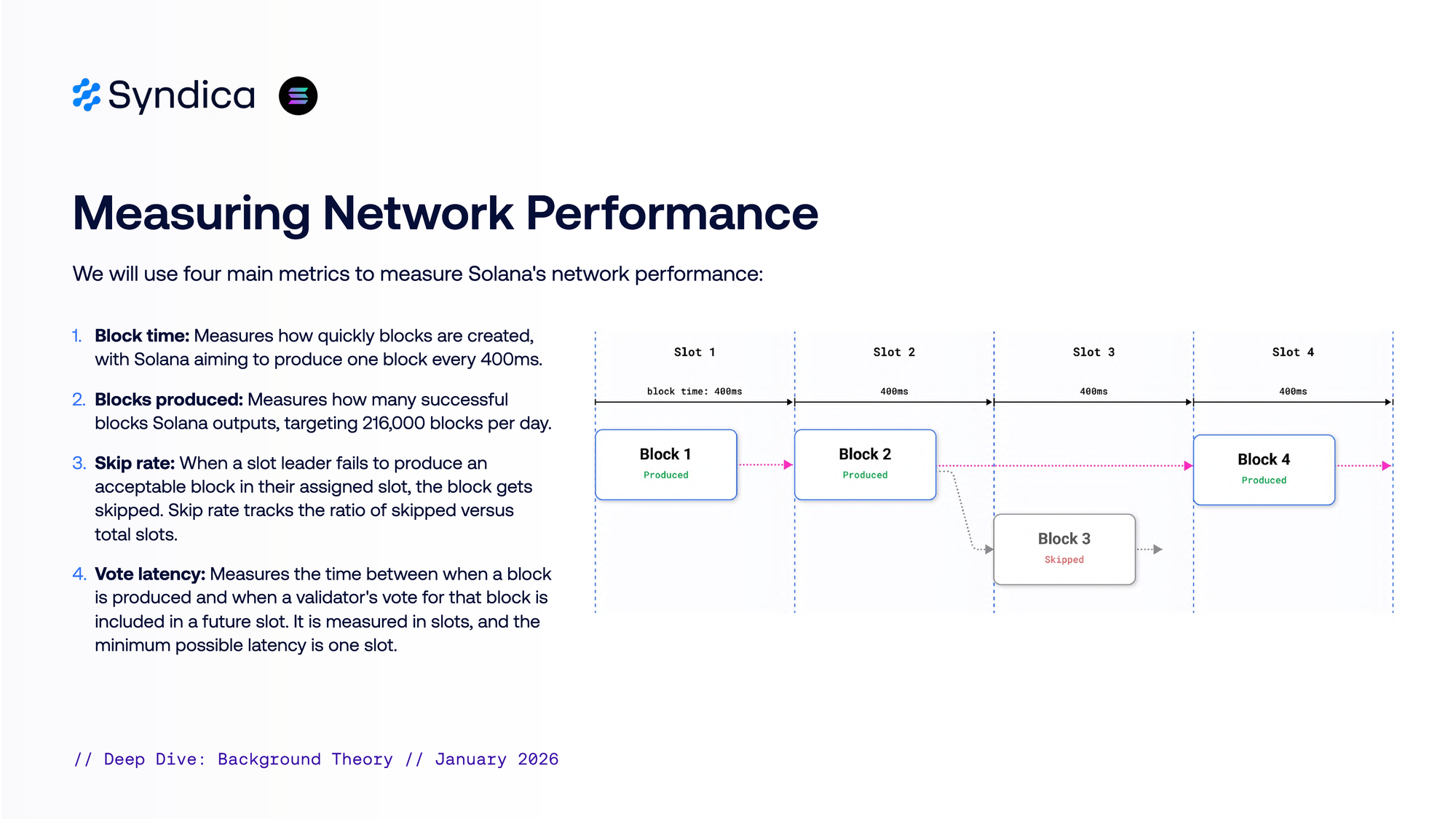
Four main metrics measure Solana network performance:
- Block time — Target: 400ms per block
- Blocks produced — Target: 216,000 per day
- Skip rate — Ratio of skipped slots to total slots
- Vote latency — Time between block production and vote inclusion
Solana Fee Structure
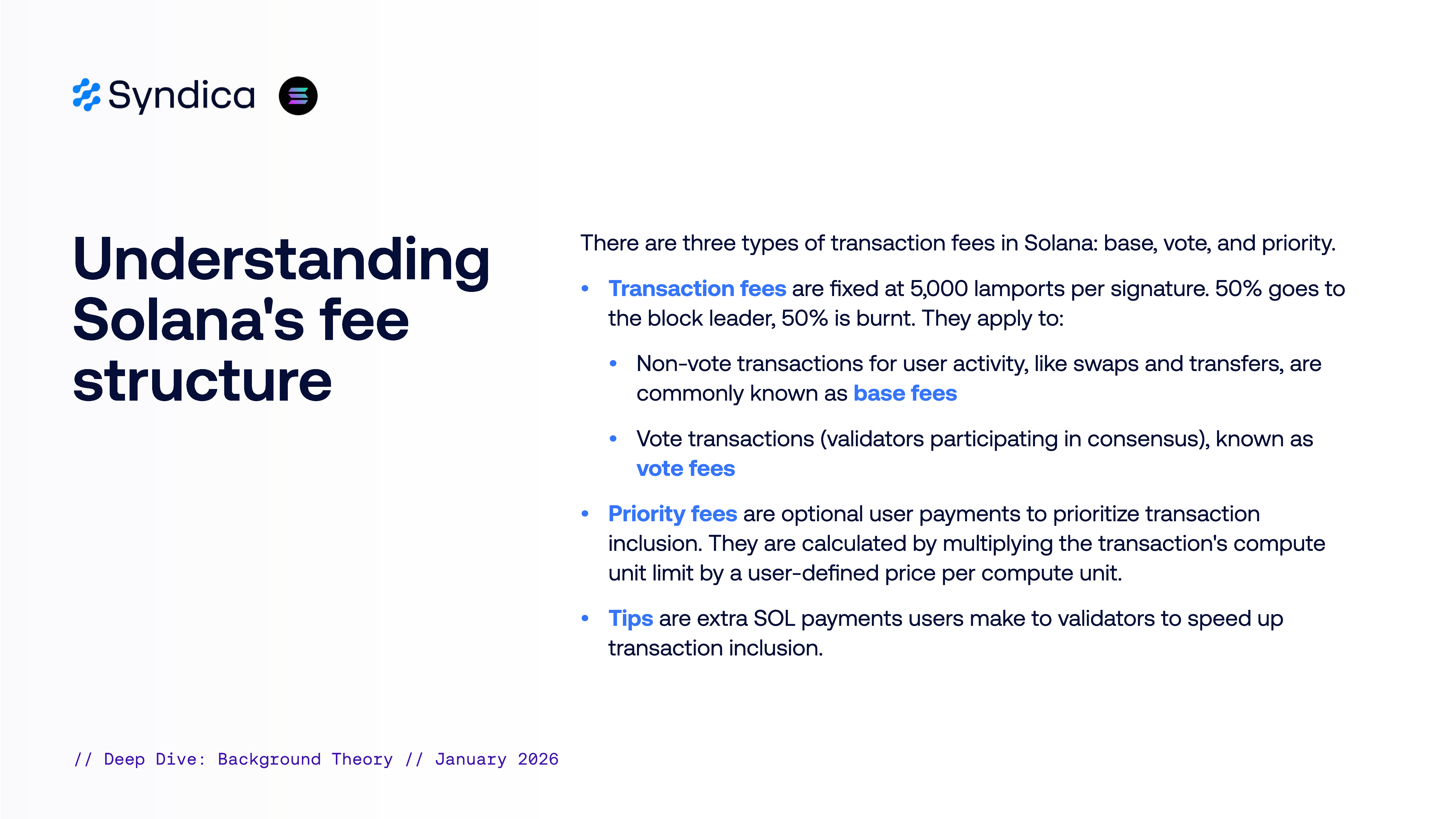
There are three types of transaction fees:
- Base fees (non-vote transactions)
- Vote fees
- Priority fees
Transaction fees are fixed at 5,000 lamports per signature. 50% goes to the block leader and 50% is burned.
Priority fees are optional and calculated as:
Compute Unit Limit × User-Defined Price Per CU
Tips are additional SOL payments to validators to speed up inclusion.
Compute Units (CU)
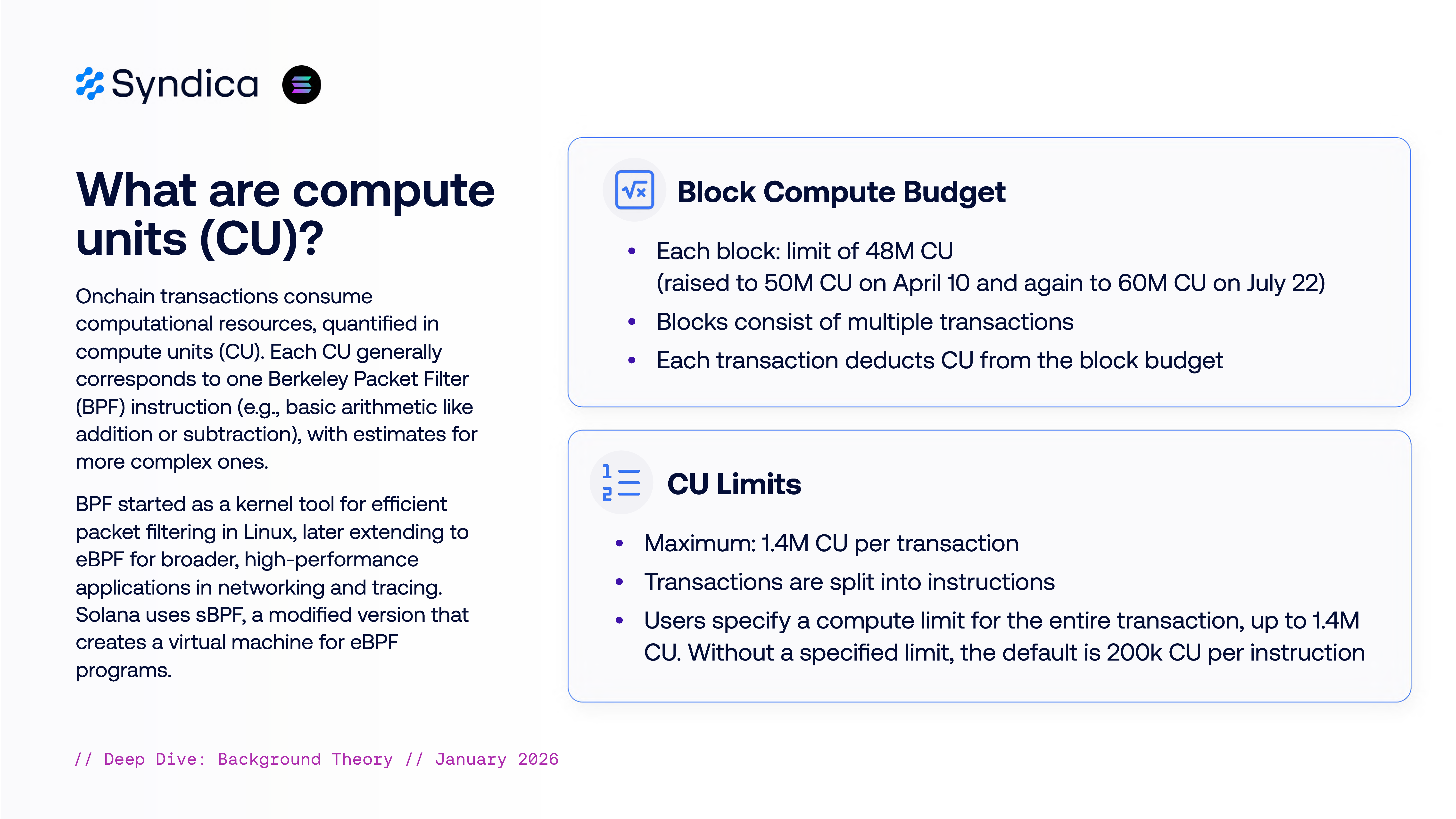
Each block has a compute limit:
- 48M CU
- Raised to 50M CU on April 10
- Raised to 60M CU on July 22
Maximum per transaction: 1.4M CU.
Without a specified limit, default is 200k CU per instruction.
Compute Units represent computational resources consumed by transactions. Each CU roughly corresponds to one Berkeley Packet Filter (BPF) instruction.
Solana uses sBPF, a modified version of eBPF that creates a virtual machine for programs.