Deep Dive: Solana Onchain Activity
Deep Dive: Solana Onchain Activity - March 2026
Note: Below is the text-accessible version of this post for visually impaired readers.
Syndica Deep Dive: Solana Onchain Activity - March 2026
Part I Client & Scheduler Stakes
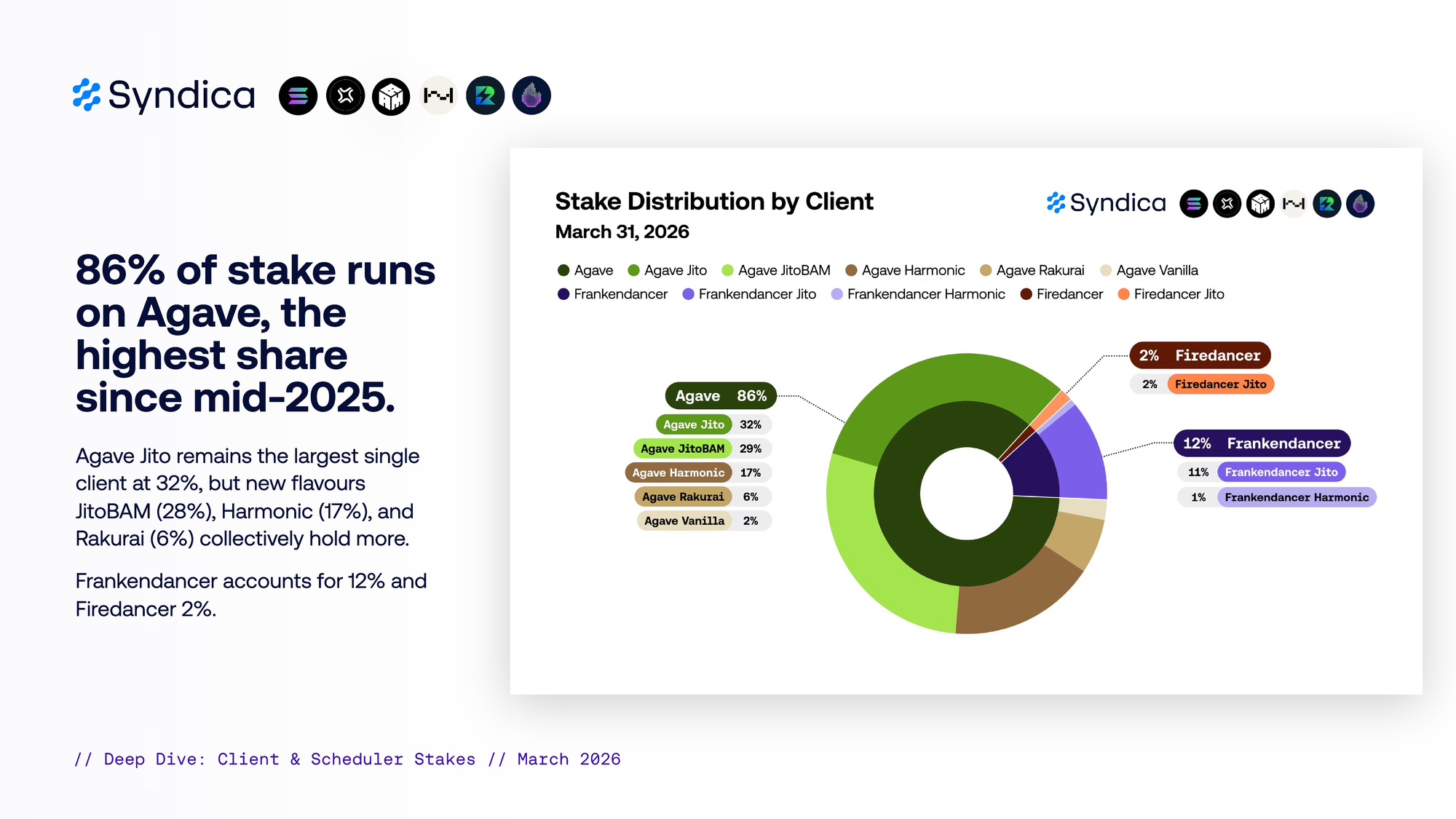
86% of stake runs on Agave, the highest share since mid-2025.
Agave Jito remains the largest single client at 32%, but new flavours JitoBAM (28%), Harmonic (17%), and Rakurai (6%) collectively hold more. Frankendancer accounts for 12% and Firedancer 2%.
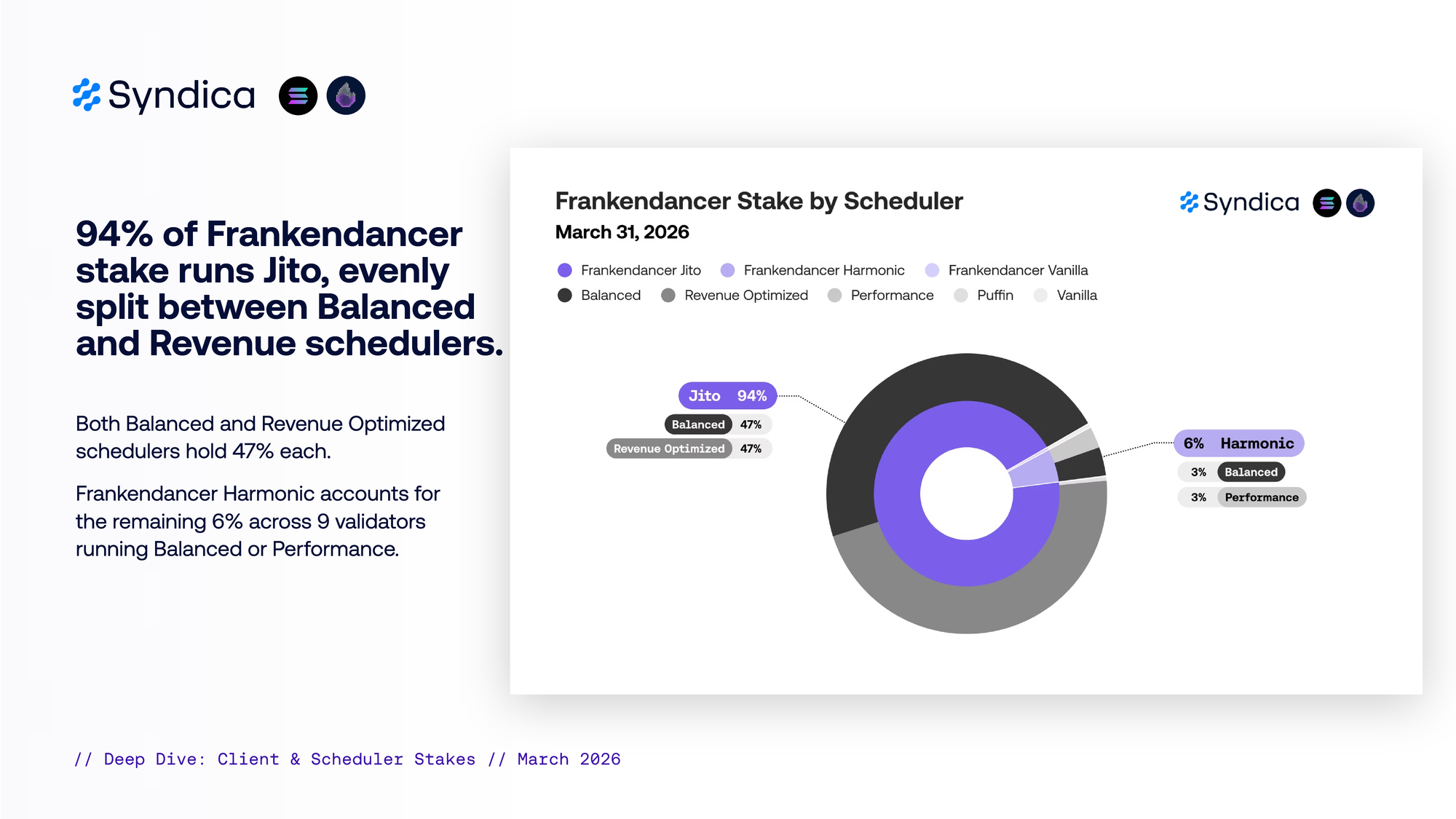
94% of Frankendancer stake runs Jito, evenly split between Balanced and Revenue schedulers.
Both Balanced and Revenue Optimized schedulers hold 47% each. Frankendancer Harmonic accounts for the remaining 6% across 9 validators running Balanced or Performance.
Part II Client Reward Distributions
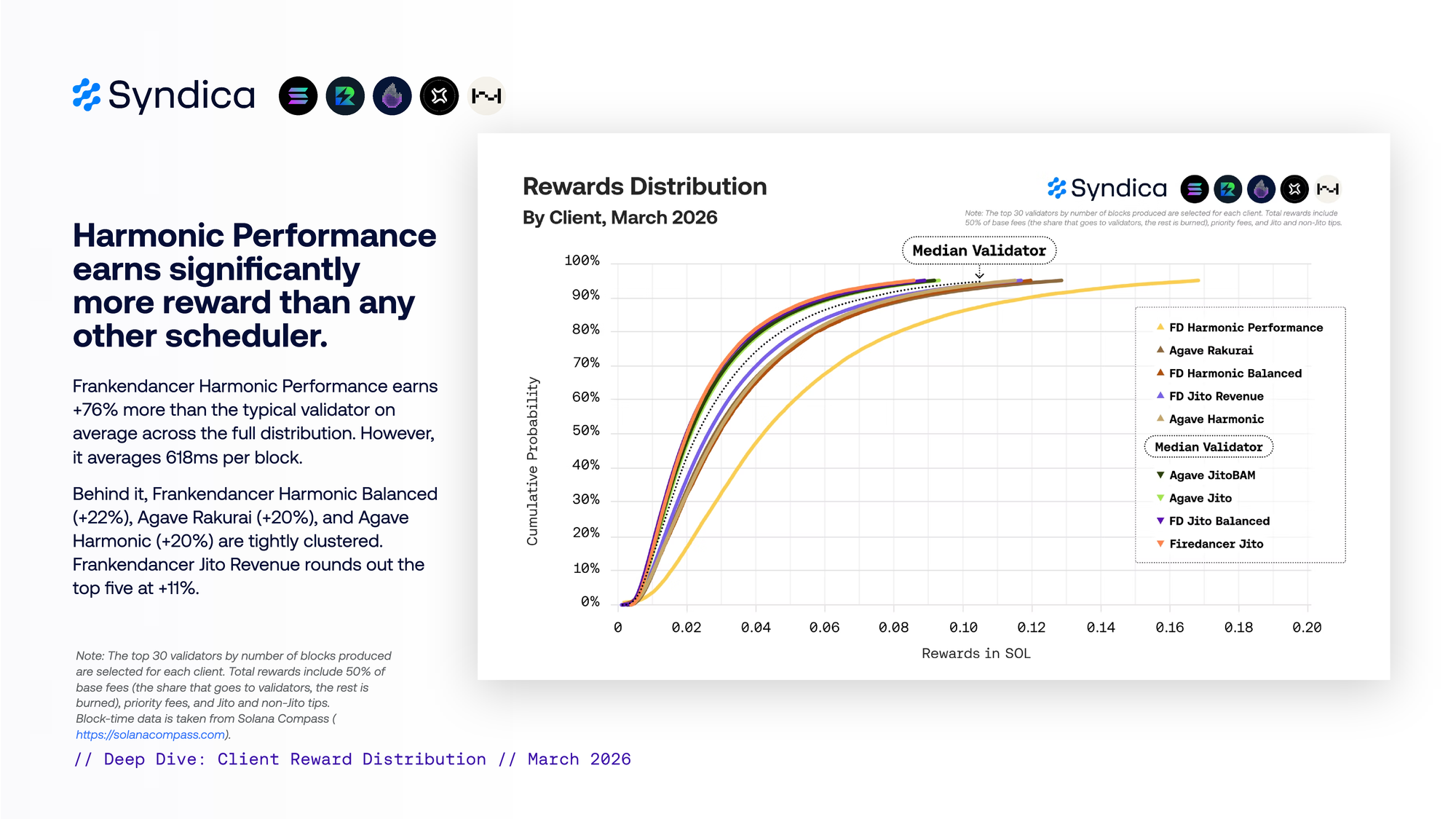
Harmonic Performance earns significantly more reward than any other scheduler.
Frankendancer Harmonic Performance earns +76% more than the typical validator on average across the full distribution. However, it averages 618ms per block. Behind it, Frankendancer Harmonic Balanced (+22%), Agave Rakurai (+20%), and Agave Harmonic (+20%) are tightly clustered. Frankendancer Jito Revenue rounds out the top five at +11%.
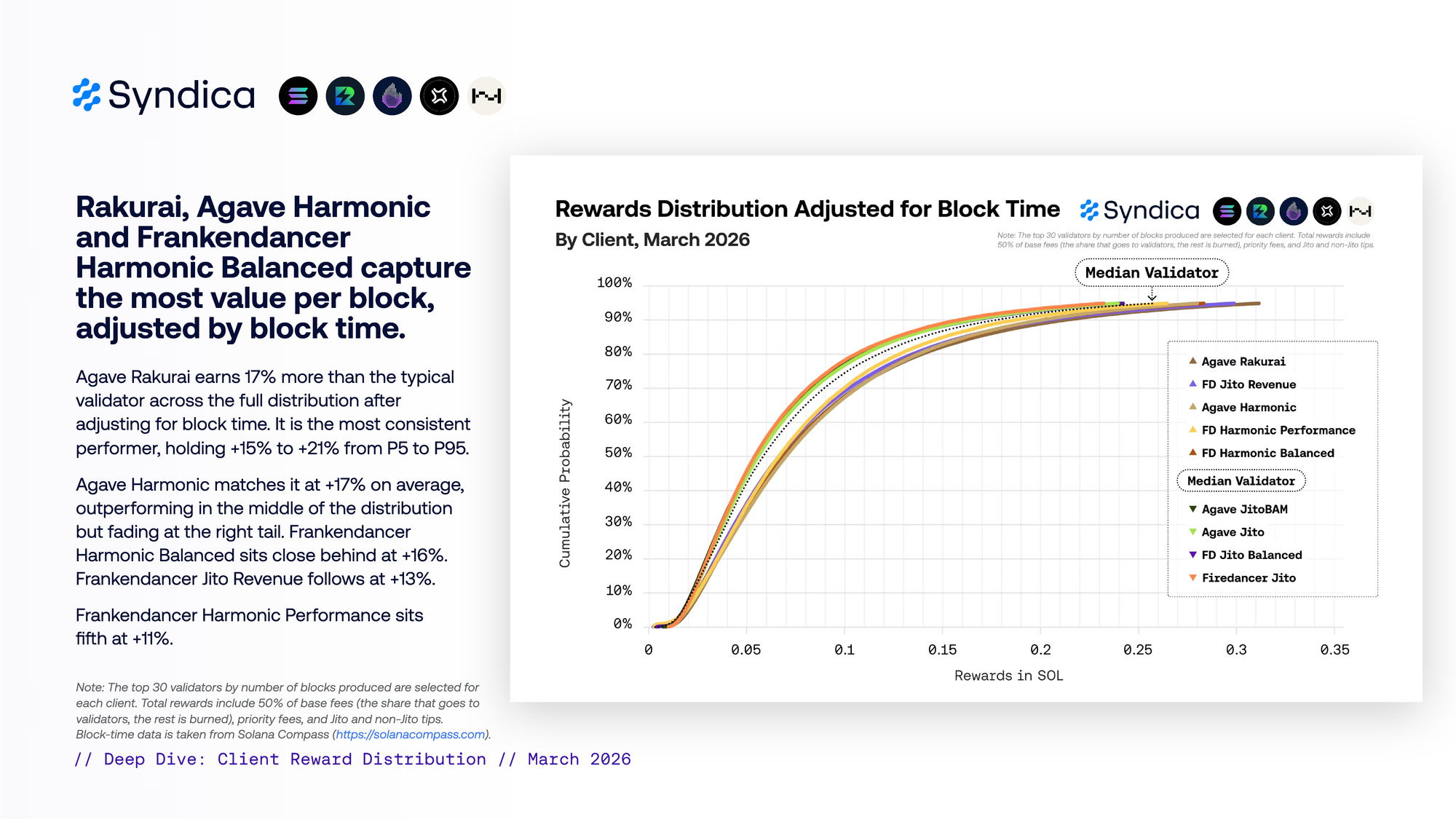
Rakurai, Agave Harmonic and Frankendancer Harmonic Balanced capture the most value per block,
adjusted by block time. Agave Rakurai earns 17% more than the typical validator across the full distribution afer adjusting for block time. It is the most consistent performer, holding +15% to +21% from P5 to P95. Agave Harmonic matches it at +17% on average, outperforming in the middle of the distribution but fading at the right tail. Frankendancer Harmonic Balanced sits close behind at +16%. Frankendancer Jito Revenue follows at +13%. Frankendancer Harmonic Performance sits fifh at +11%.
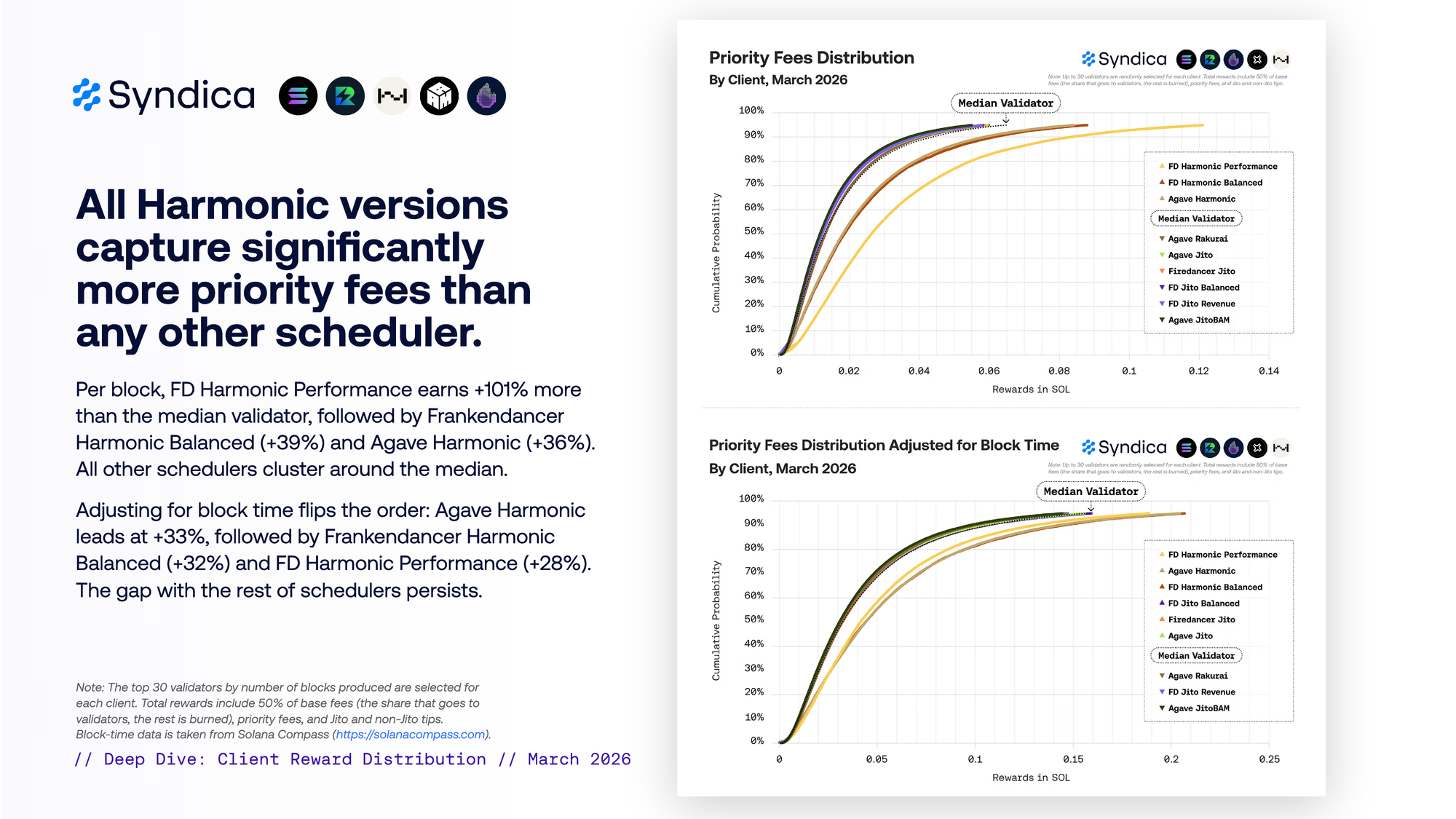
All Harmonic versions capture significantly more priority fees than any other scheduler.
Per block, FD Harmonic Performance earns +101% more than the median validator, followed by Frankendancer Harmonic Balanced (+39%) and Agave Harmonic (+36%). All other schedulers cluster around the median. Adjusting for block time flips the order: Agave Harmonic leads at +33%, followed by Frankendancer Harmonic Balanced (+32%) and FD Harmonic Performance (+28%). The gap with the rest of schedulers persists.
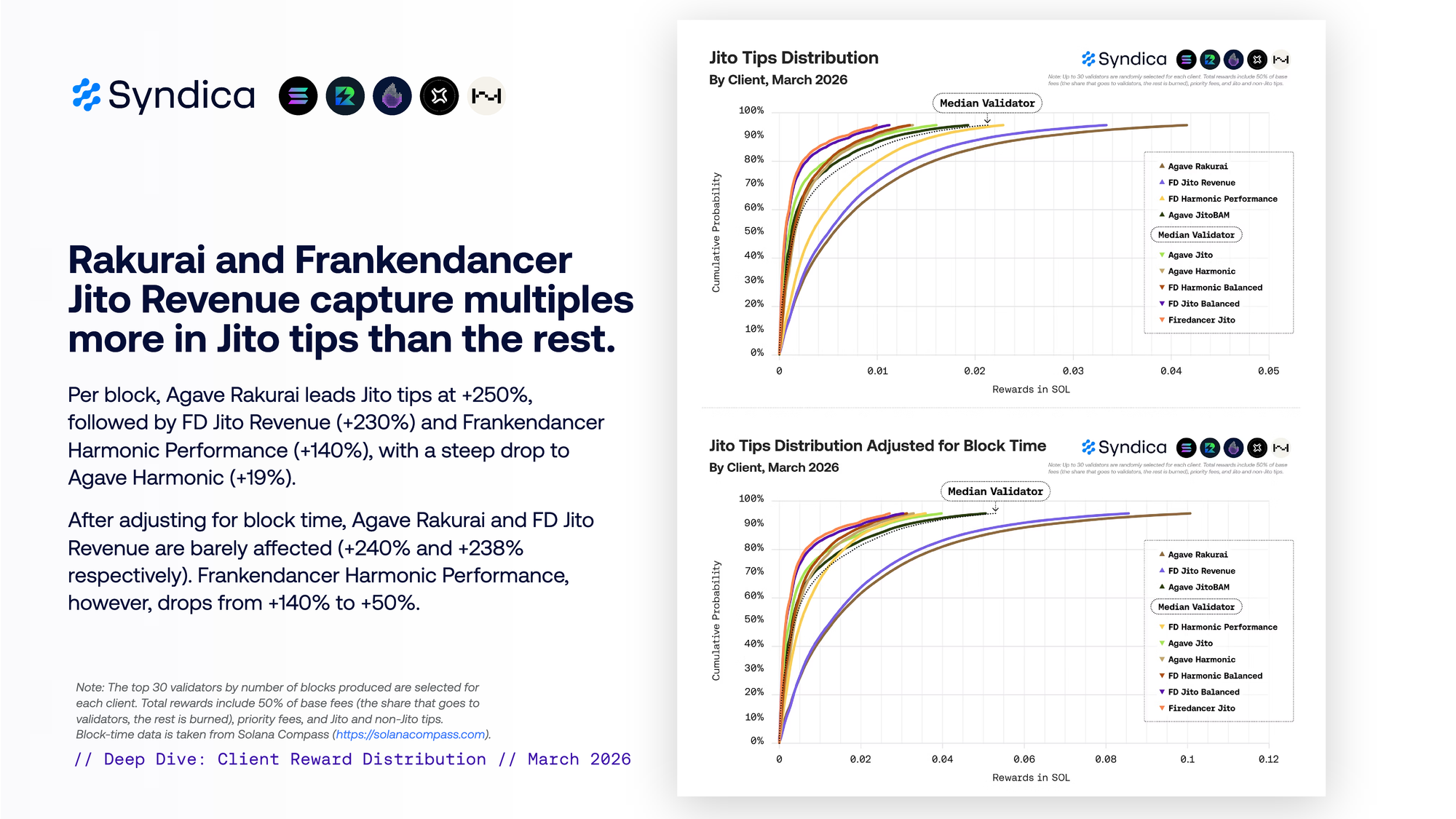
Rakurai and Frankendancer Jito Revenue capture multiples more in Jito tips than the rest.
Per block, Agave Rakurai leads Jito tips at +250%, followed by FD Jito Revenue (+230%) and Frankendancer Harmonic Performance (+140%), with a steep drop to Agave Harmonic (+19%). Afer adjusting for block time, Agave Rakurai and FD Jito Revenue are barely afected (+240% and +238% respectively). Frankendancer Harmonic Performance, however, drops from +140% to +50%.
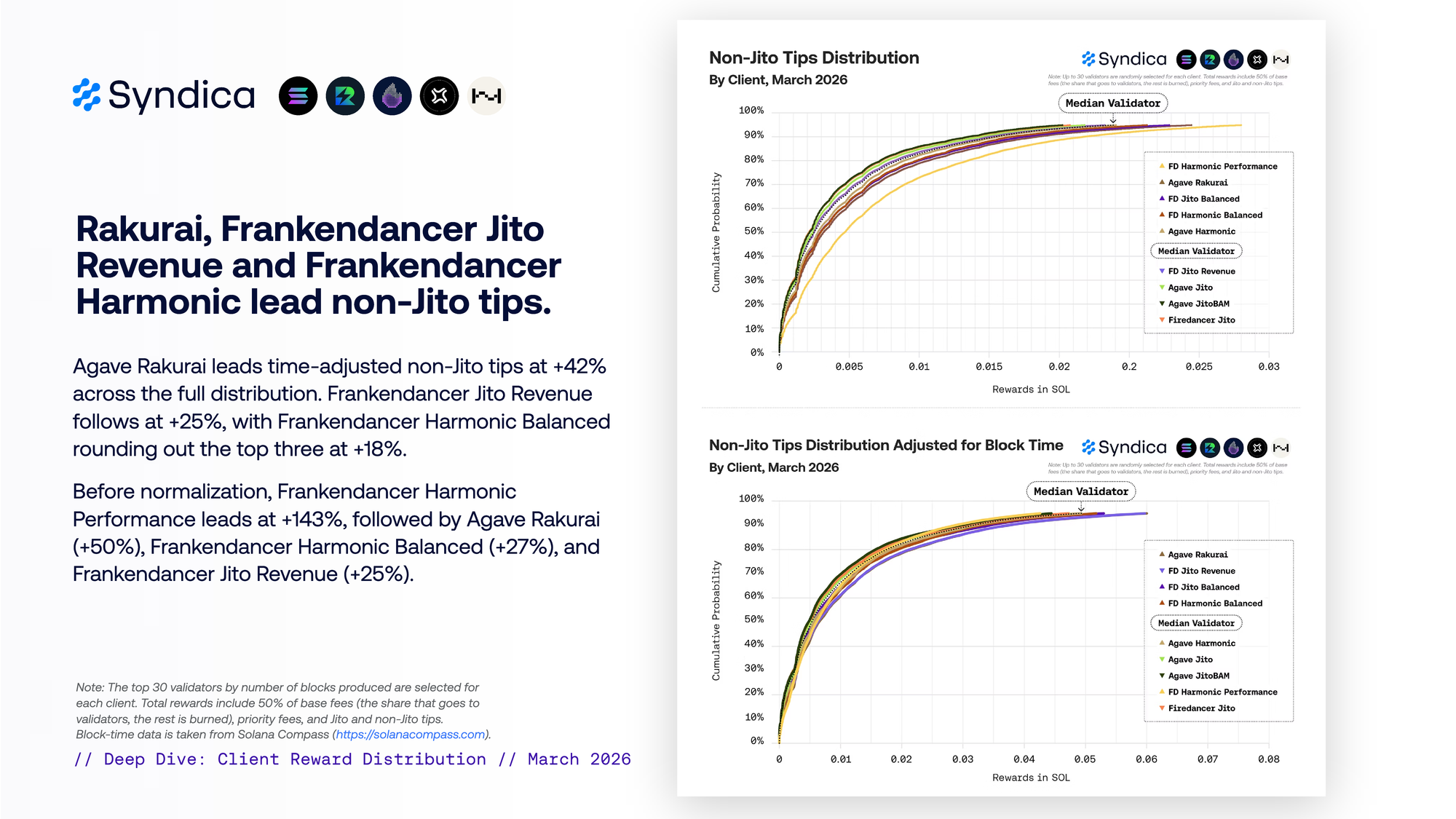
Rakurai, Frankendancer Jito Revenue and Frankendancer Harmonic lead non-Jito tips.
Agave Rakurai leads time-adjusted non-Jito tips at +42% across the full distribution. Frankendancer Jito Revenue follows at +25%, with Frankendancer Harmonic Balanced rounding out the top three at +18%. Before normalization, Frankendancer Harmonic Performance leads at +143%, followed by Agave Rakurai (+50%), Frankendancer Harmonic Balanced (+27%), and Frankendancer Jito Revenue (+25%).
Part III Validator Profitability
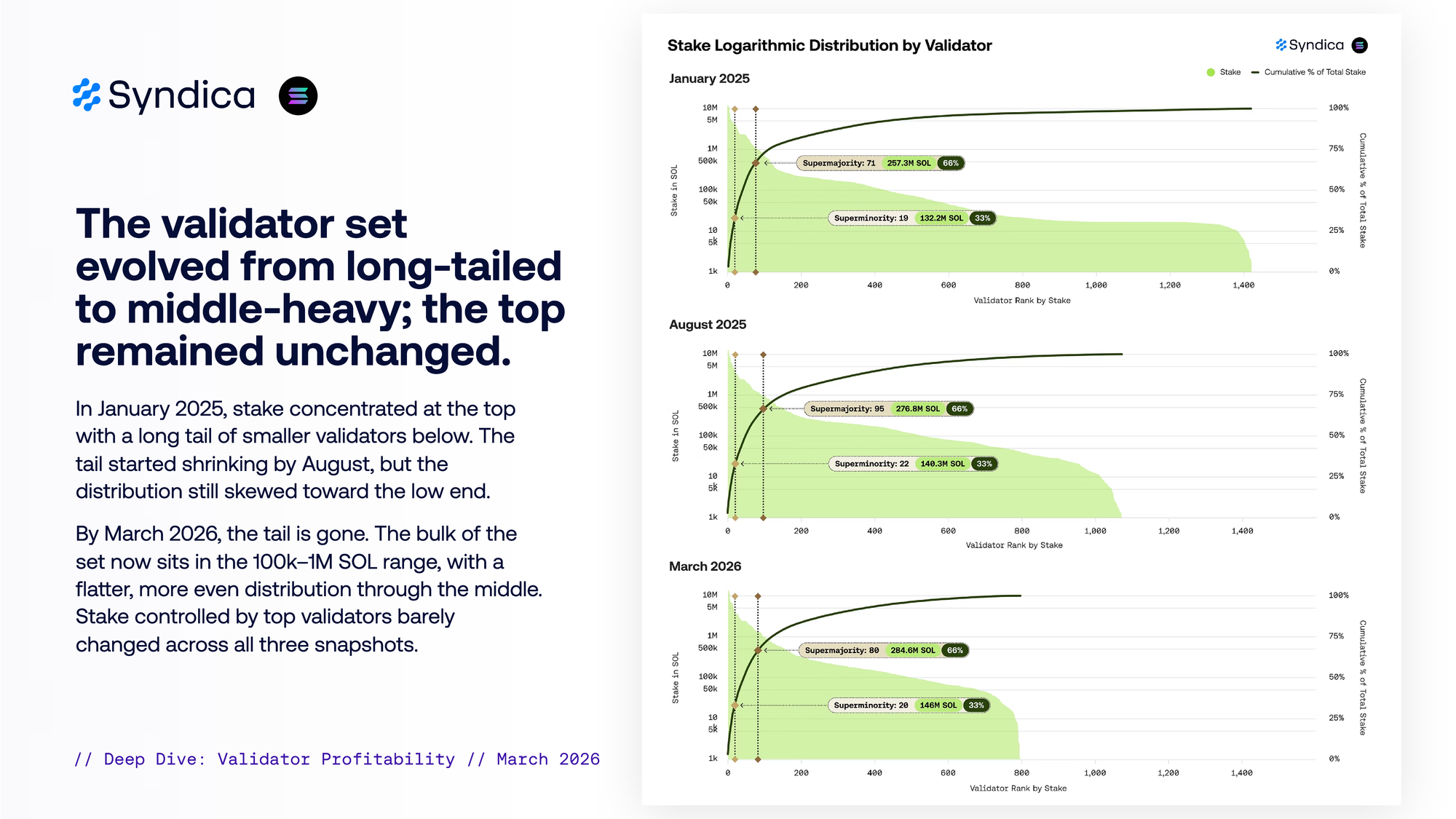
The validator set evolved from long-tailed to middle-heavy; the top remained unchanged.
In January 2025, stake concentrated at the top with a long tail of smaller validators below. The tail started shrinking by August, but the distribution still skewed toward the low end. By March 2026, the tail is gone. The bulk of the set now sits in the 100k–1M SOL range, with a flafer, more even distribution through the middle. Stake controlled by top validators barely changed across all three snapshots.
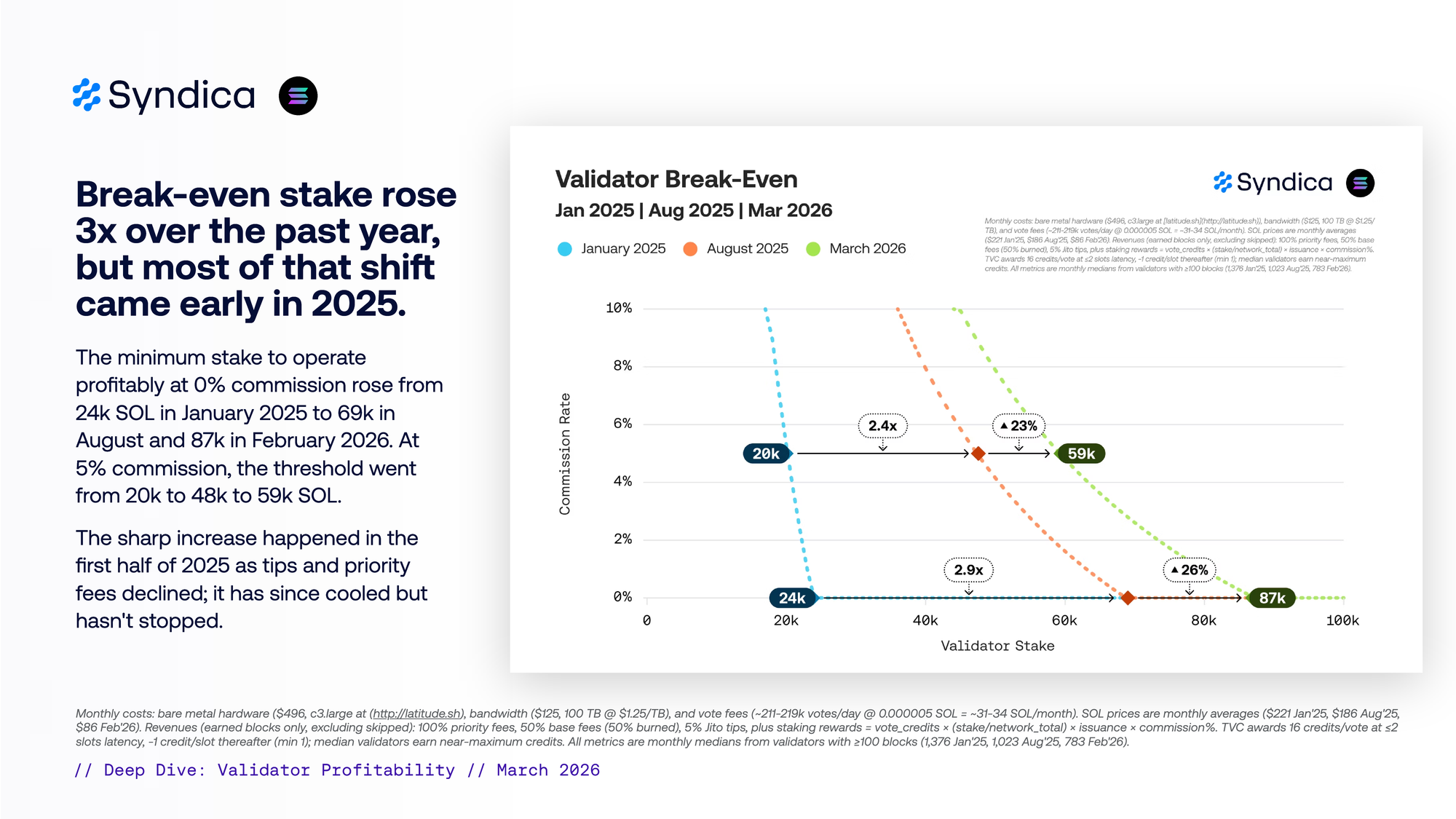
Break-even stake rose 3x over the past year, but most of that shif came early in 2025.
The minimum stake to operate profitably at 0% commission rose from 24k SOL in January 2025 to 69k in August and 87k in February 2026. At 5% commission, the threshold went from 20k to 48k to 59k SOL. The sharp increase happened in the first half of 2025 as tips and priority fees declined; it has since cooled but hasn't stopped.
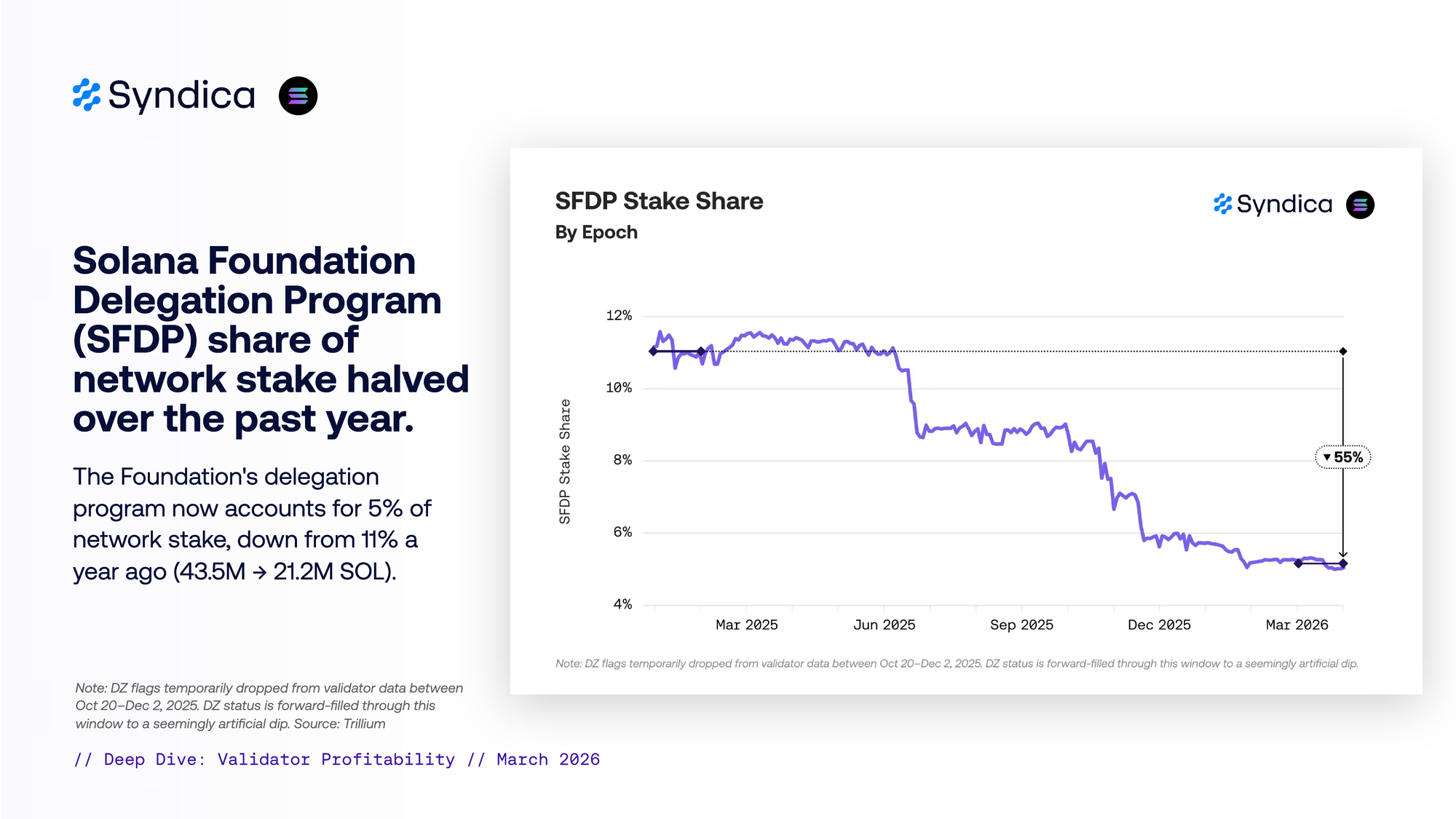
Solana Foundation Delegation Program (SFDP) share of network stake halved
over the past year. The Foundation's delegation program now accounts for 5% of network stake, down from 11% a year ago (43.5M → 21.2M SOL).
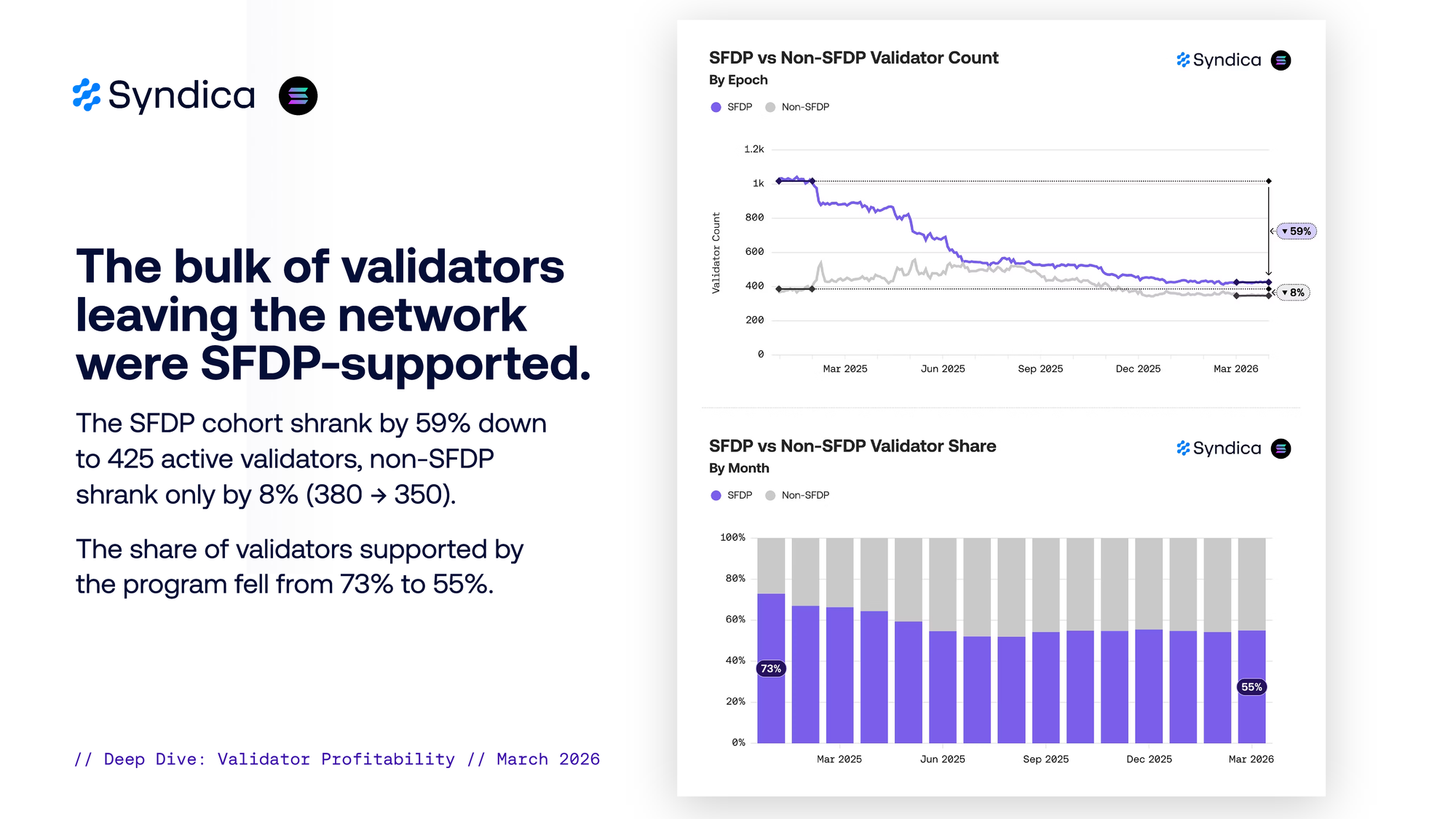
The bulk of validators leaving the network were SFDP-supported.
The SFDP cohort shrank by 59% down to 425 active validators, non-SFDP shrank only by 8% (380 → 350). The share of validators supported by the program fell from 73% to 55%.
Part IV Network Health
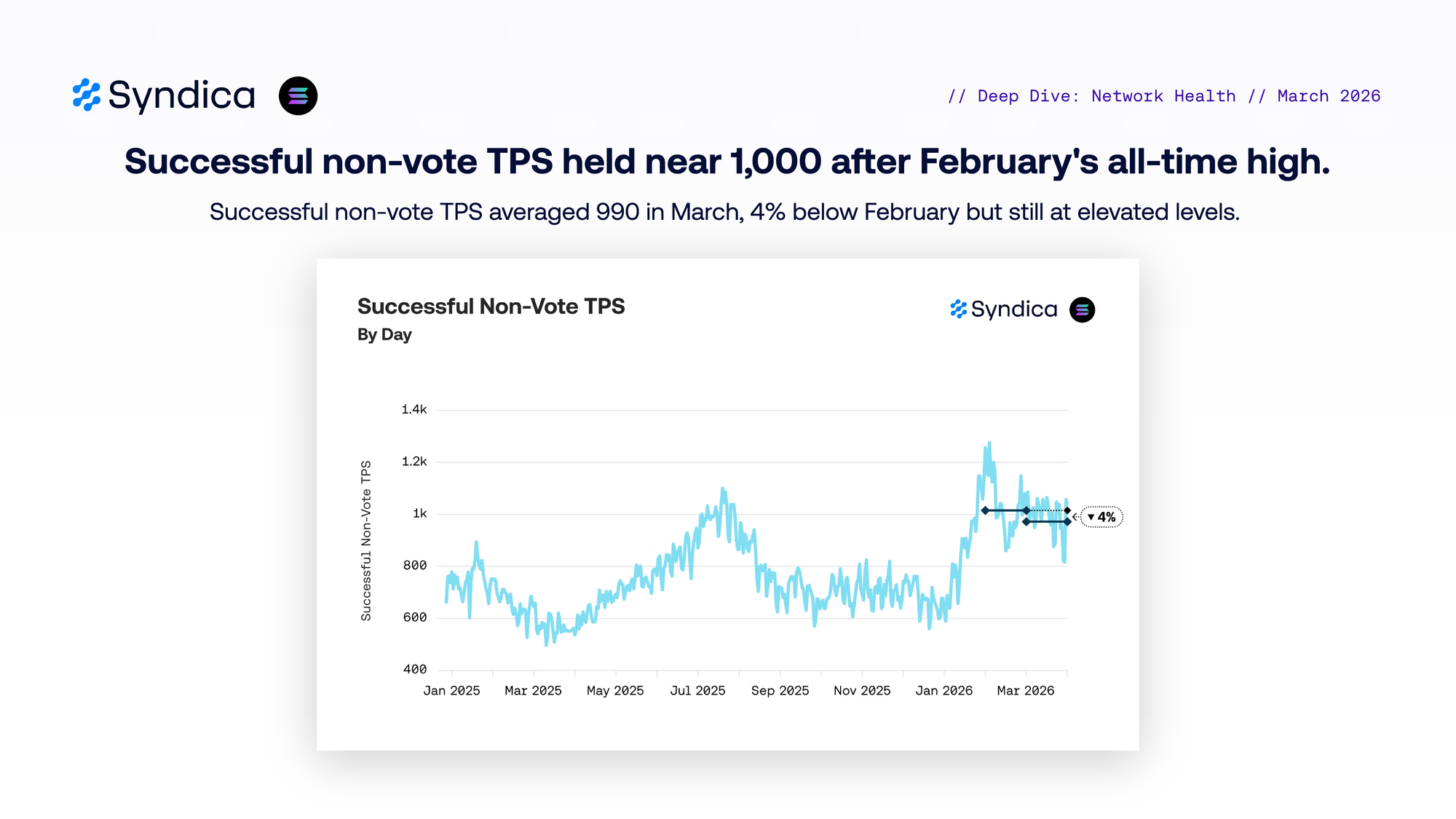
Successful non-vote TPS held near 1,000 afer February's all-time high. Successful non-vote TPS averaged 990 in March, 4% below February but still at elevated levels.
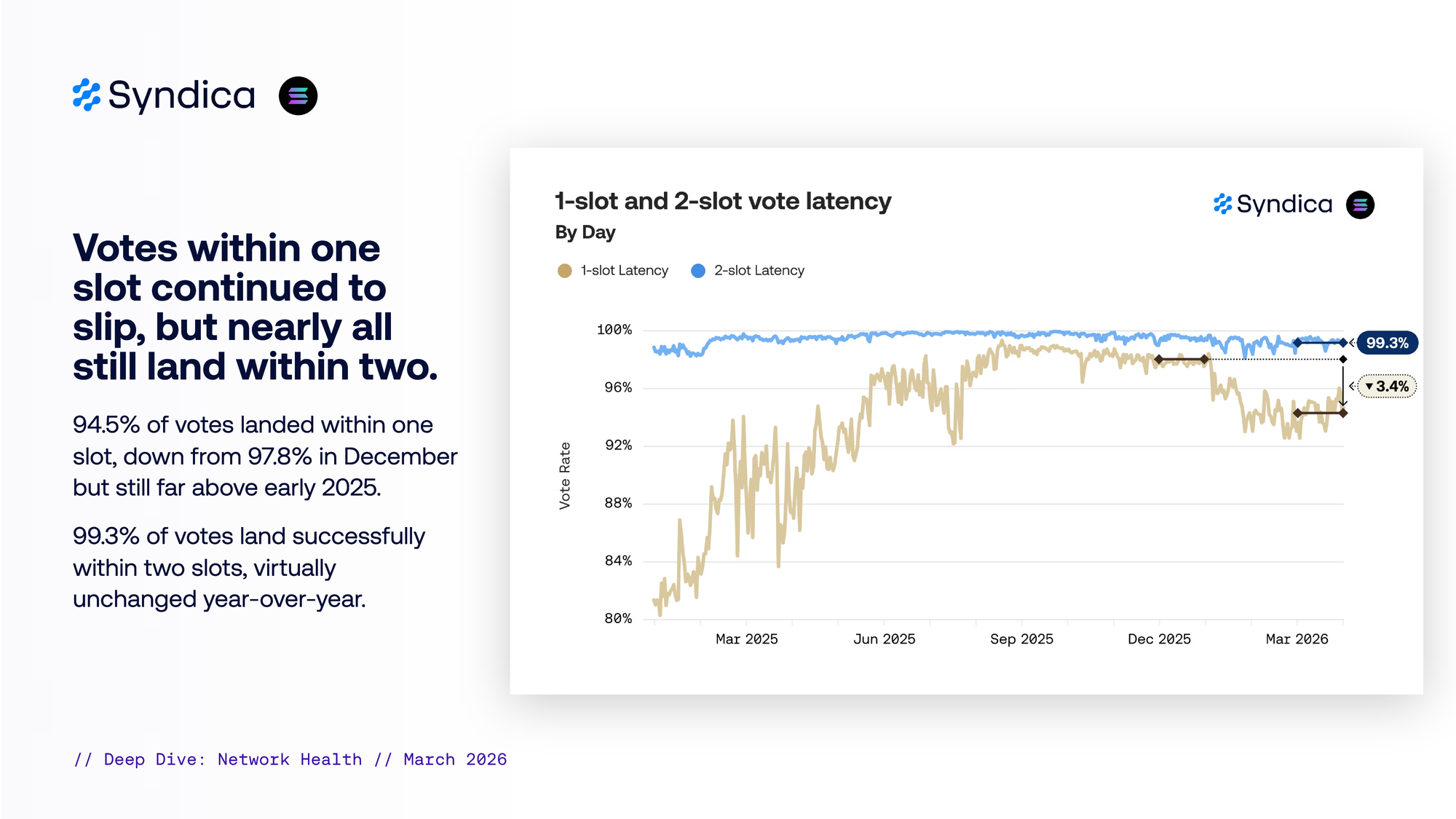
Votes within one slot continued to slip, but nearly all still land within two.
94.5% of votes landed within one slot, down from 97.8% in December but still far above early 2025. 99.3% of votes land successfully within two slots, virtually unchanged year-over-year.
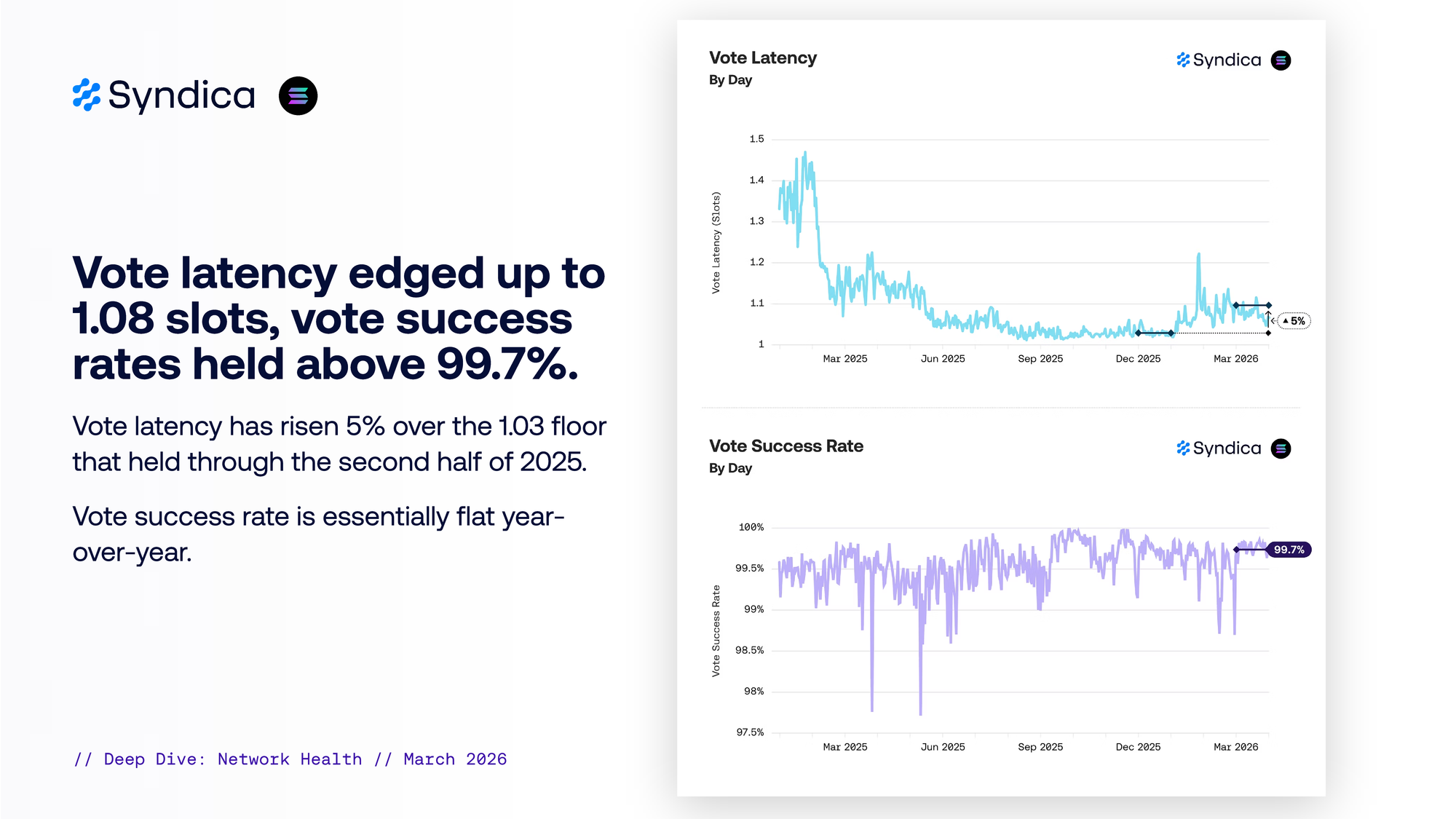
Vote latency edged up to 1.08 slots, vote success rates held above 99.7%.
Vote latency has risen 5% over the 1.03 floor that held through the second half of 2025. Vote success rate is essentially flat year- over-year.
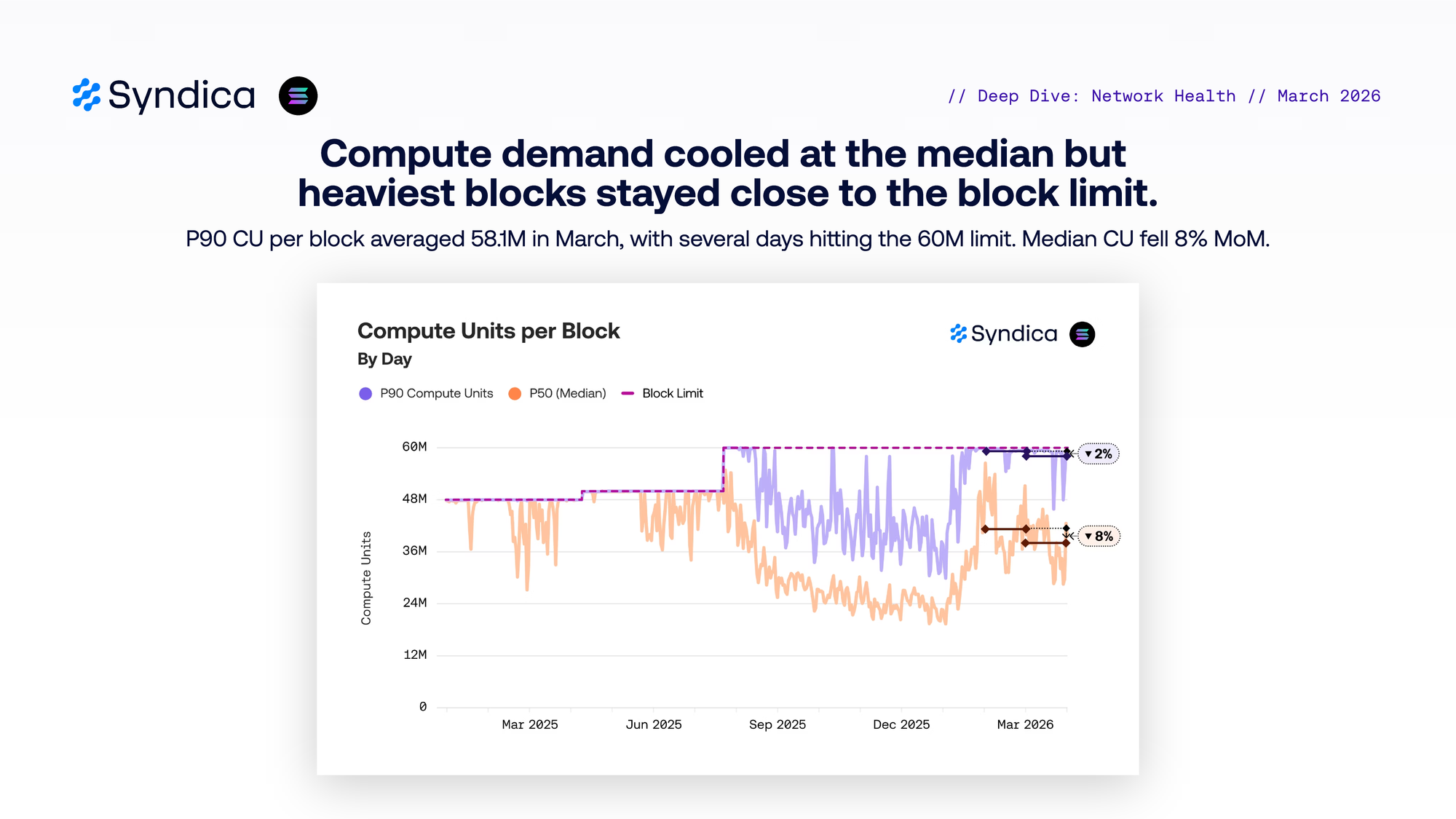
Compute demand cooled at the median but heaviest blocks stayed close to the block limit. P90 CU per block averaged 58.1M in March, with several days hifing the 60M limit. Median CU fell 8% MoM.
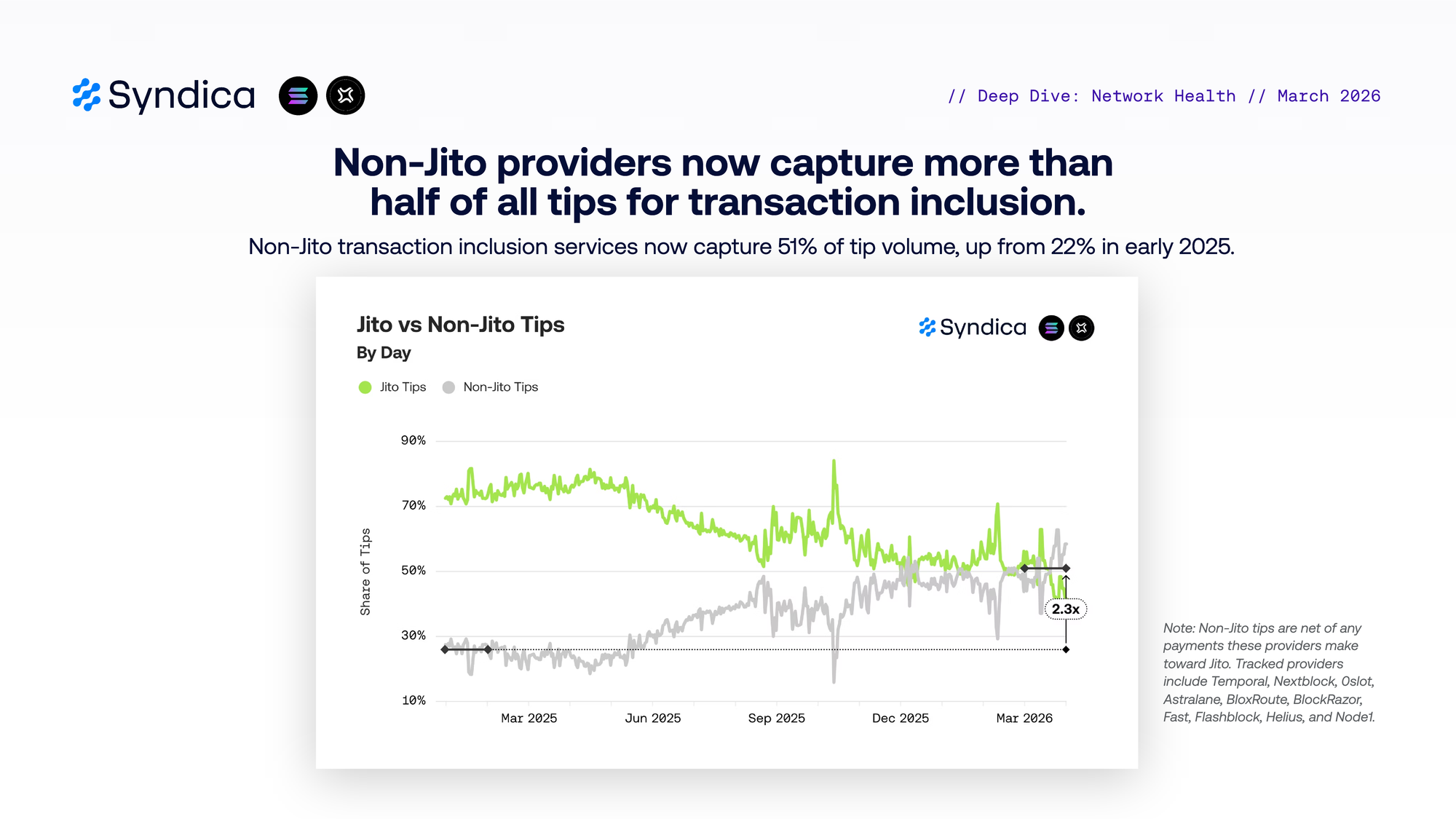
Non-Jito providers now capture more than half of all tips for transaction inclusion. Non-Jito transaction inclusion services now capture 51% of tip volume, up from 22% in early 2025.
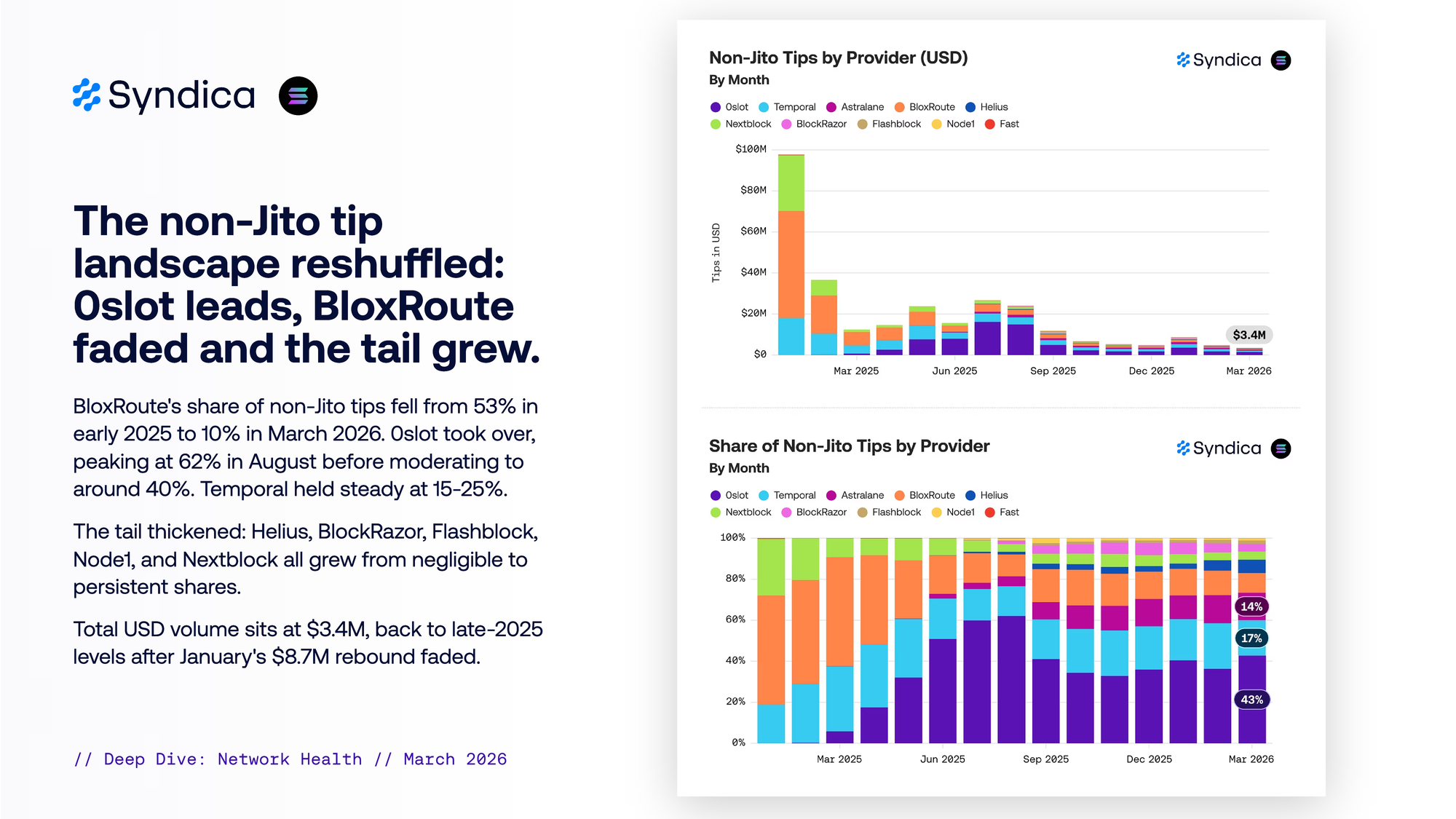
The non-Jito tip landscape reshufled:
0slot leads, BloxRoute faded and the tail grew. BloxRoute's share of non-Jito tips fell from 53% in early 2025 to 10% in March 2026. 0slot took over, peaking at 62% in August before moderating to around 40%. Temporal held steady at 15-25%. The tail thickened: Helius, BlockRazor, Flashblock, Node1, and Nextblock all grew from negligible to persistent shares. Total USD volume sits at $3.4M, back to late-2025 levels afer January's $8.7M rebound faded.
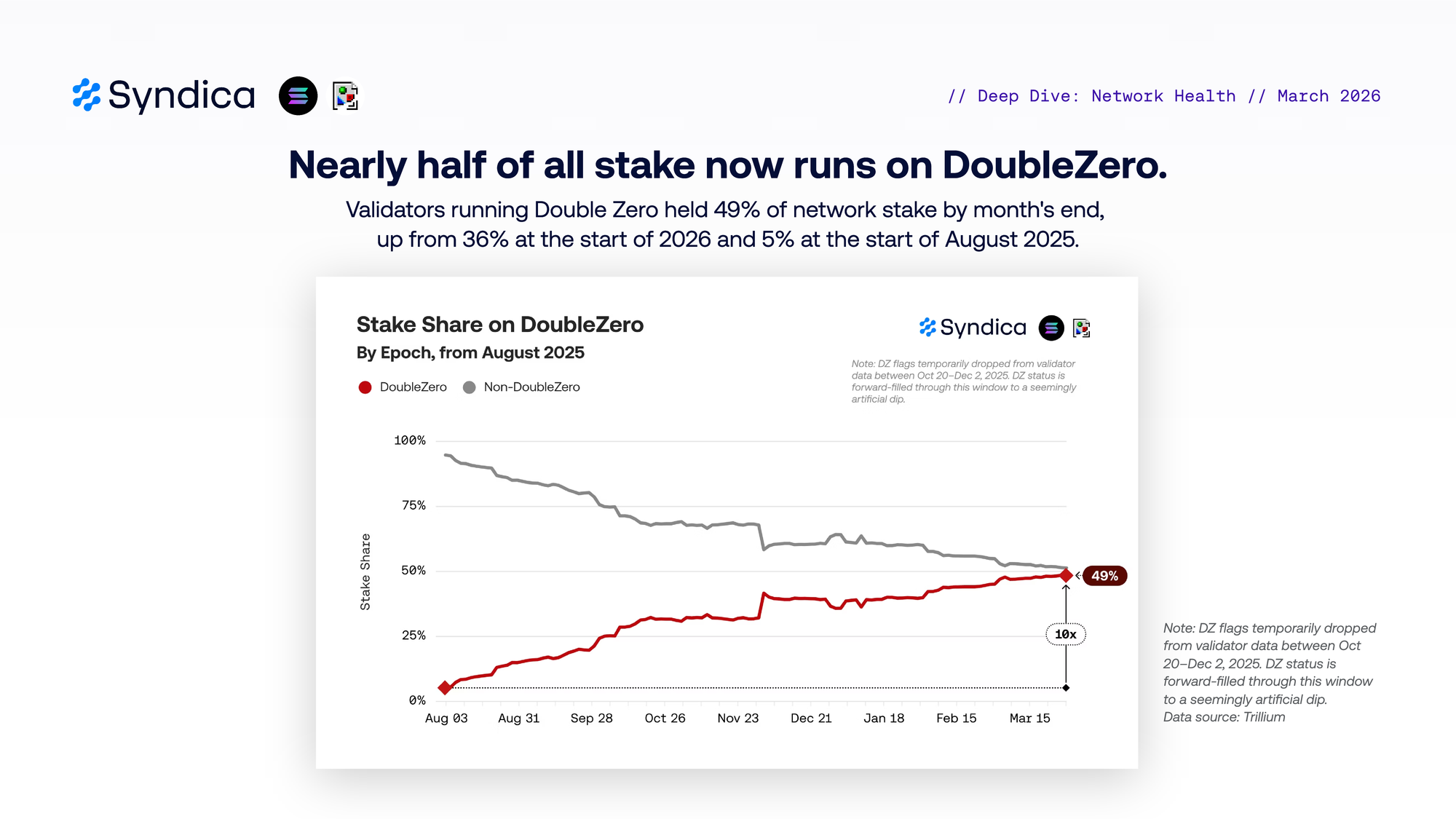
Nearly half of all stake now runs on DoubleZero. Validators running Double Zero held 49% of network stake by month's end, up from 36% at the start of 2026 and 5% at the start of August 2025.
Appendix Background Theory
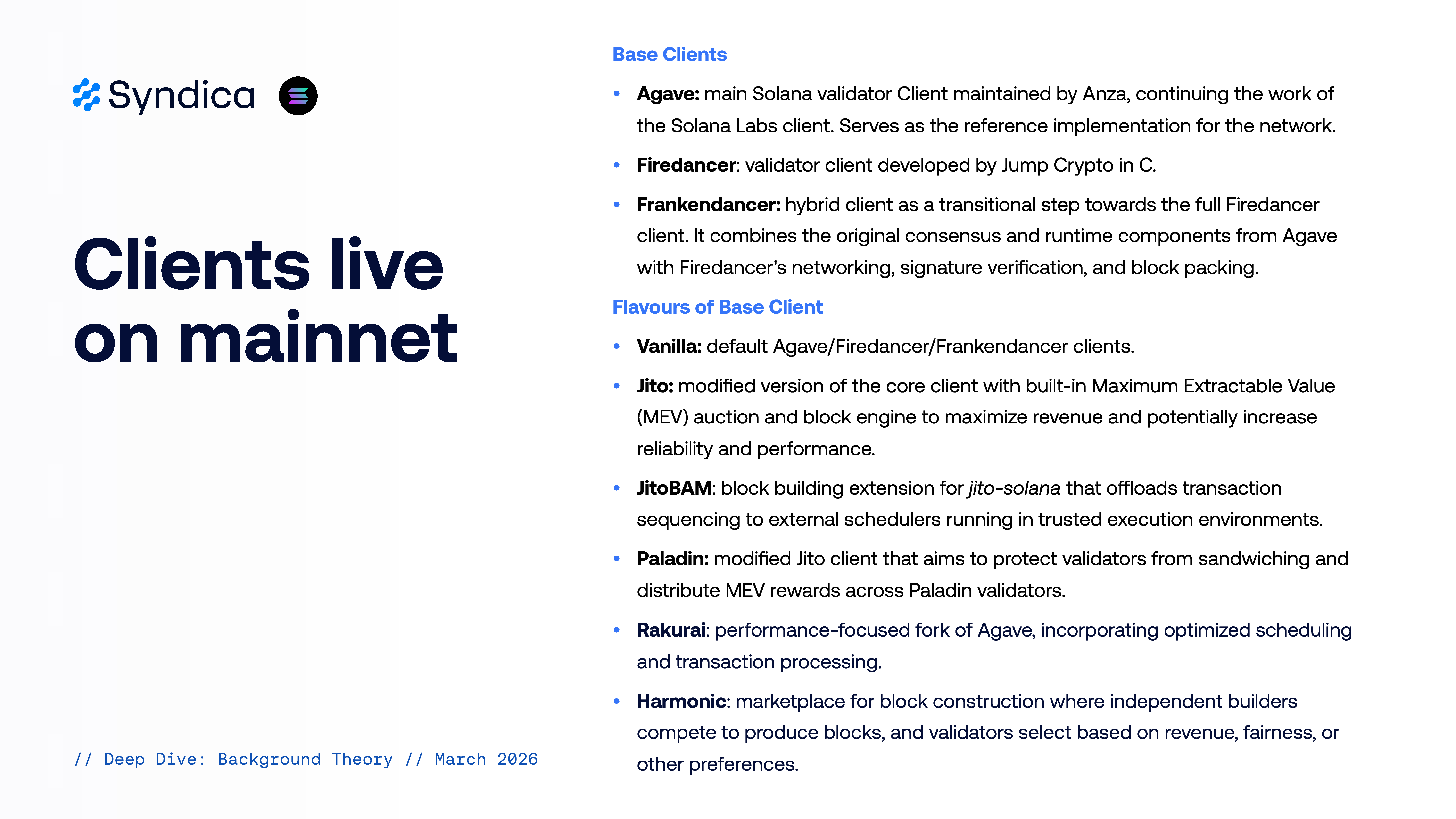
Base Clients • Agave: main Solana validator Client maintained by Anza, continuing the work of the Solana Labs client. Serves as the reference implementation for the network.
• Firedancer: validator client developed by Jump Crypto in C. • Frankendancer: hybrid client as a transitional step towards the full Firedancer Clients live client. It combines the original consensus and runtime components from Agave with Firedancer's networking, signature verification, and block packing. on mainnet Flavours of Base Client • Vanilla: default Agave/Firedancer/Frankendancer clients. • Jito: modified version of the core client with built-in Maximum Extractable Value (MEV) auction and block engine to maximize revenue and potentially increase reliability and performance. • JitoBAM: block building extension for jito-solana that ofloads transaction sequencing to external schedulers running in trusted execution environments. • Paladin: modified Jito client that aims to protect validators from sandwiching and distribute MEV rewards across Paladin validators. • Rakurai: performance-focused fork of Agave, incorporating optimized scheduling and transaction processing. • Harmonic: marketplace for block construction where independent builders compete to produce blocks, and validators select based on revenue, fairness, or other preferences.
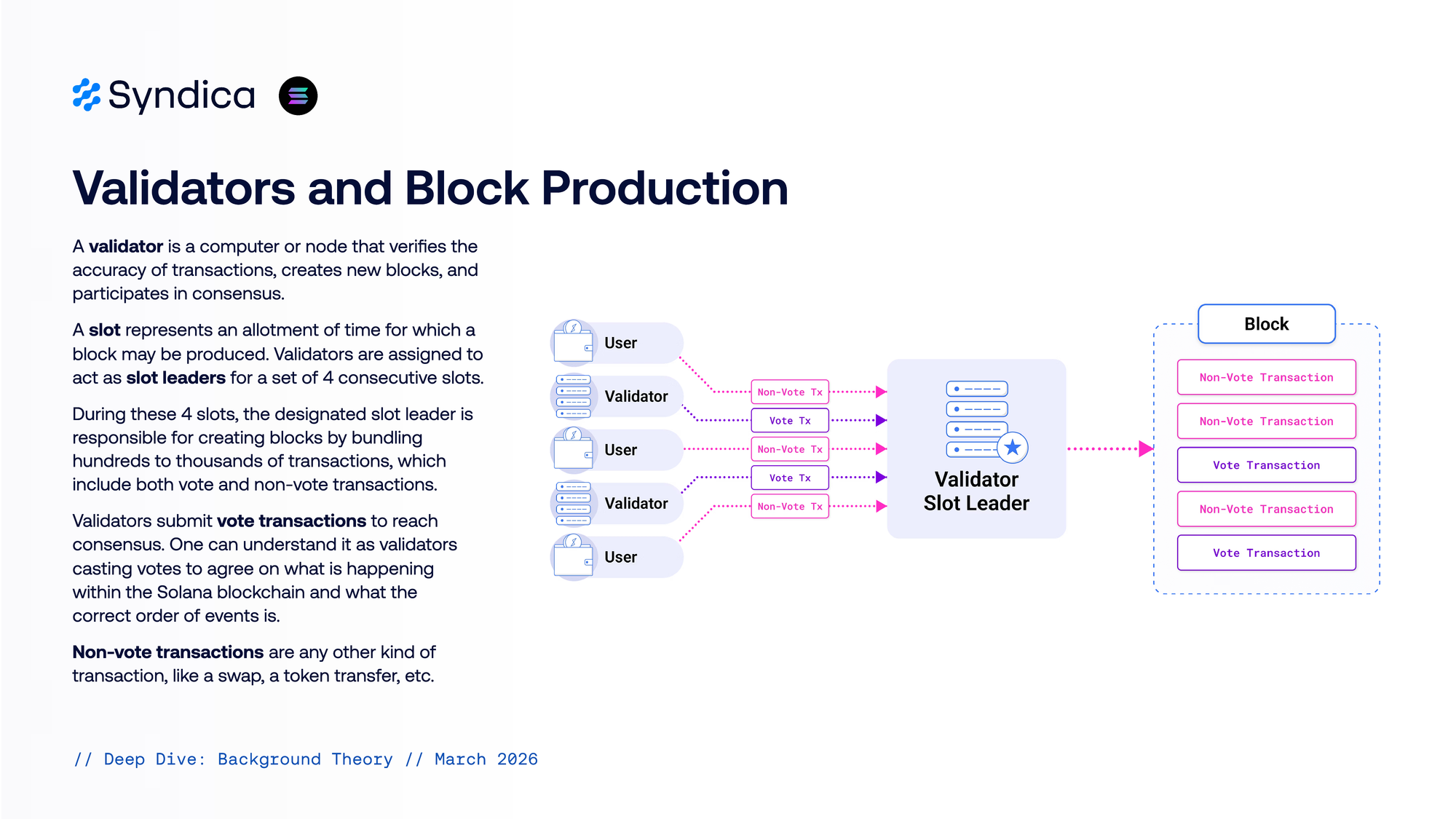
Validators and Block Production A validator is a computer or node that verifies the accuracy of transactions, creates new blocks, and participates in consensus.
A slot represents an allotment of time for which a block may be produced. Validators are assigned to act as slot leaders for a set of 4 consecutive slots. During these 4 slots, the designated slot leader is responsible for creating blocks by bundling hundreds to thousands of transactions, which include both vote and non-vote transactions. Validators submit vote transactions to reach consensus. One can understand it as validators casting votes to agree on what is happening within the Solana blockchain and what the correct order of events is. Non-vote transactions are any other kind of transaction, like a swap, a token transfer, etc.
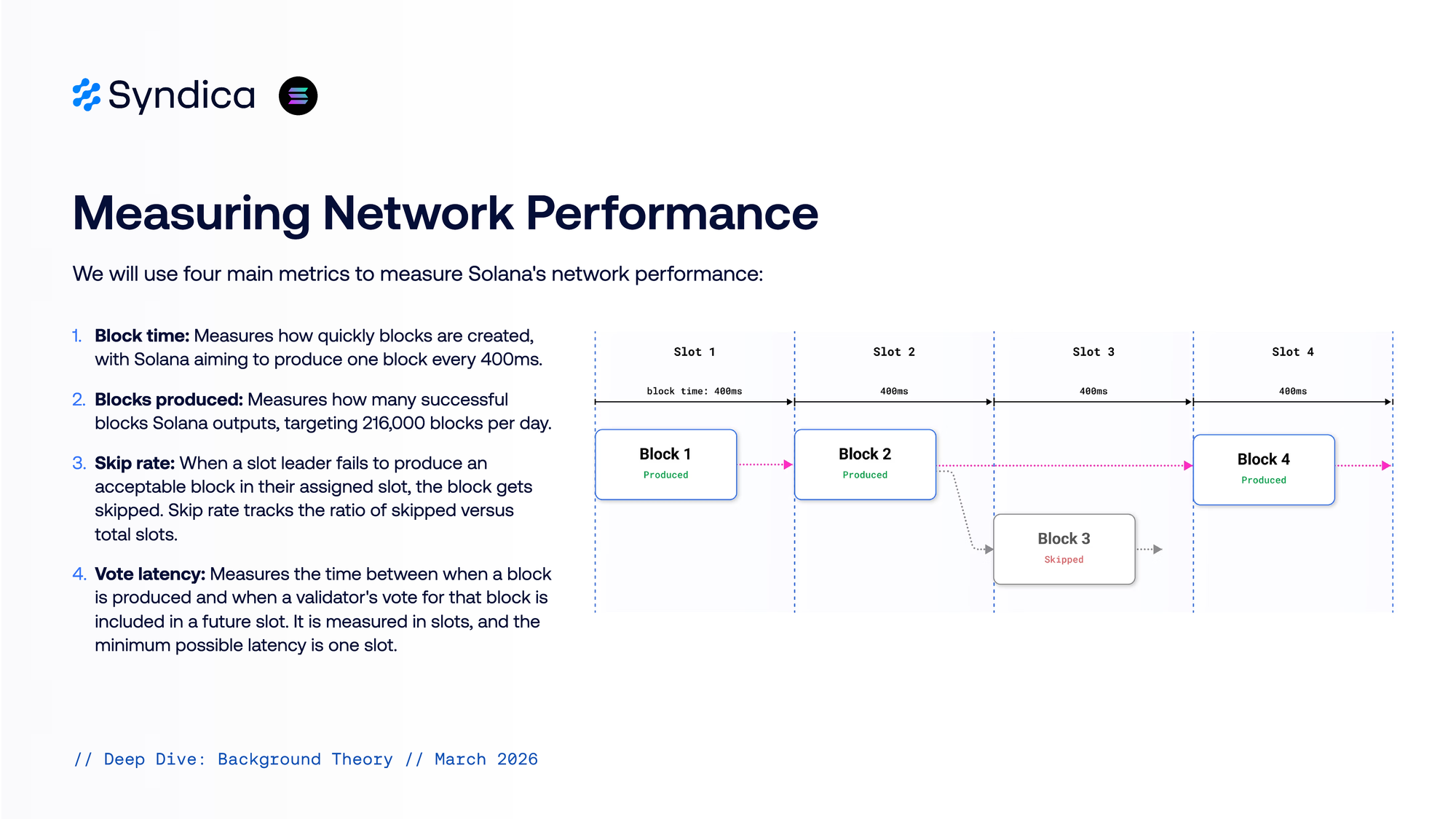
Measuring Network Performance We will use four main metrics to measure Solana's network performance:
- Block time: Measures how quickly blocks are created, with Solana aiming to produce one block every 400ms. 2. Blocks produced: Measures how many successful blocks Solana outputs, targeting 216,000 blocks per day. 3. Skip rate: When a slot leader fails to produce an acceptable block in their assigned slot, the block gets skipped. Skip rate tracks the ratio of skipped versus total slots. 4. Vote latency: Measures the time between when a block is produced and when a validator's vote for that block is included in a future slot. It is measured in slots, and the minimum possible latency is one slot.
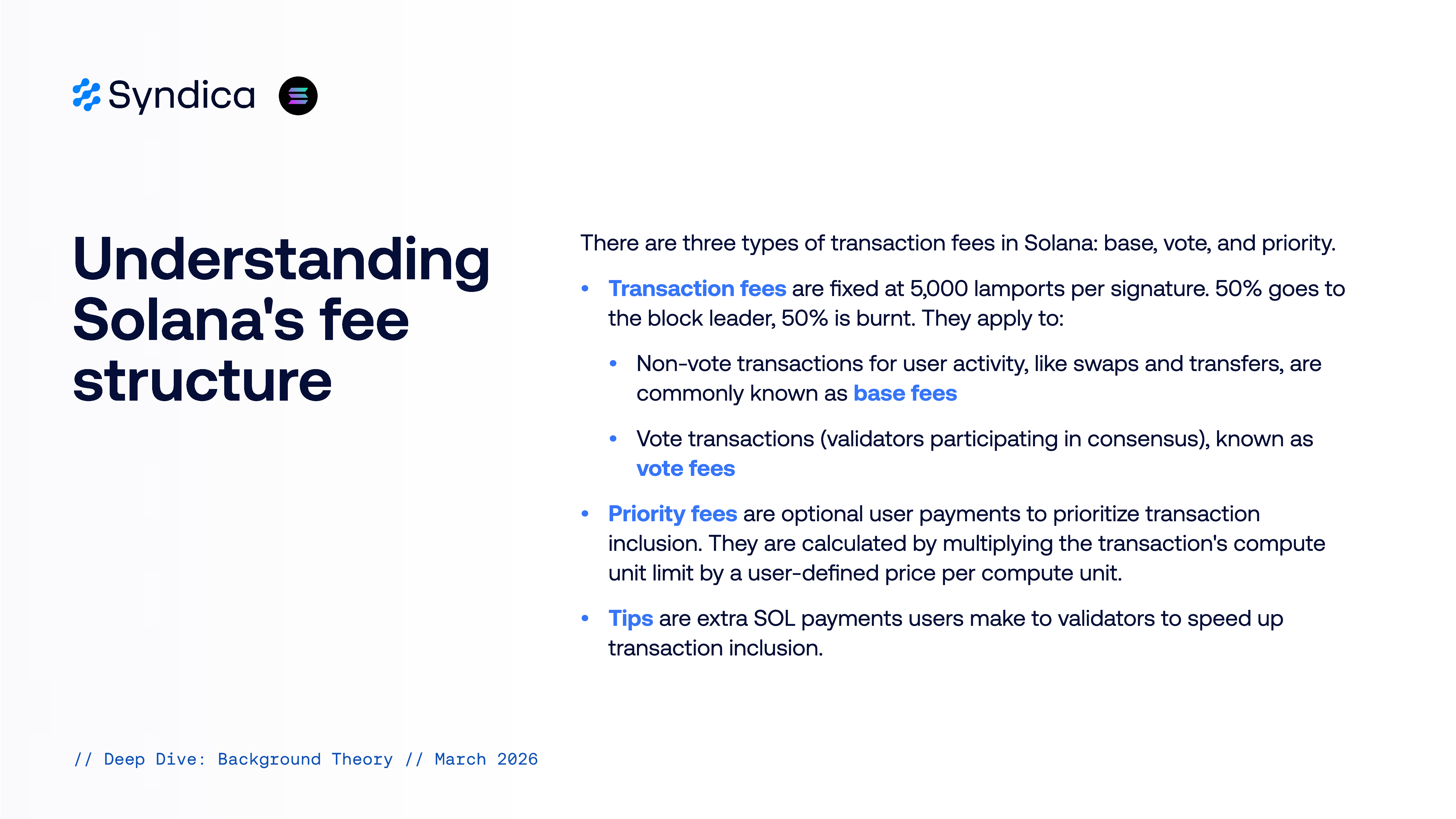
Understanding There are three types of transaction fees in Solana: base, vote, and priority.
• Transaction fees are fixed at 5,000 lamports per signature. 50% goes to Solana's fee the block leader, 50% is burnt. They apply to: structure
• Non-vote transactions for user activity, like swaps and transfers, are commonly known as base fees
• Vote transactions (validators participating in consensus), known as vote fees
• Priority fees are optional user payments to prioritize transaction inclusion. They are calculated by multiplying the transaction's compute unit limit by a user-defined price per compute unit.
• Tips are extra SOL payments users make to validators to speed up transaction inclusion.
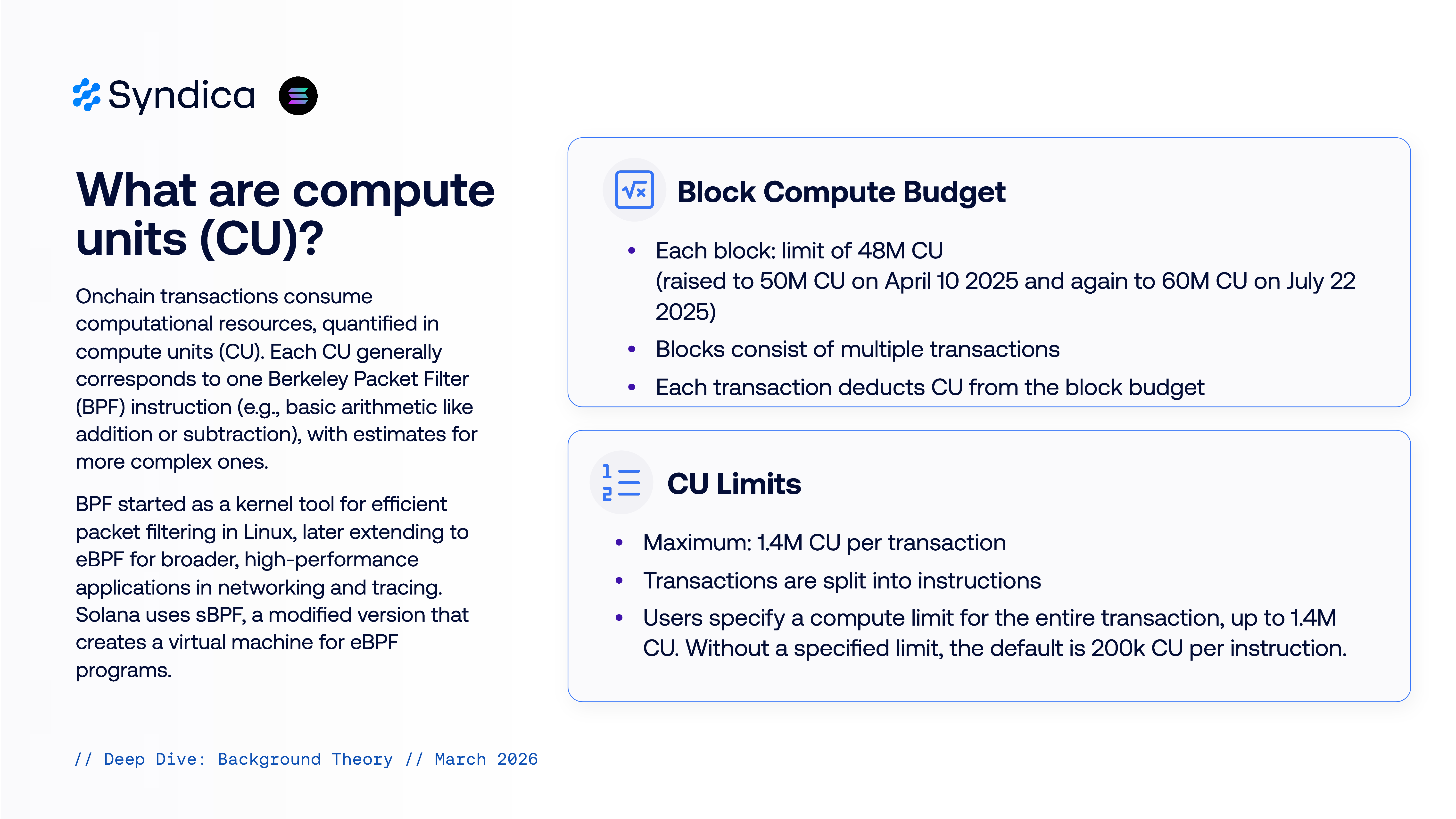
What are compute Block Compute Budget units (CU)?
• Each block: limit of 48M CU (raised to 50M CU on April 10 2025 and again to 60M CU on July 22 Onchain transactions consume 2025) computational resources, quantified in
• Blocks consist of multiple transactions compute units (CU). Each CU generally corresponds to one Berkeley Packet Filter
• Each transaction deducts CU from the block budget (BPF) instruction (e.g., basic arithmetic like addition or subtraction), with estimates for more complex ones. CU Limits BPF started as a kernel tool for efcient packet filtering in Linux, later extending to
• Maximum: 1.4M CU per transaction eBPF for broader, high-performance
• Transactions are split into instructions applications in networking and tracing. Solana uses sBPF, a modified version that
• Users specify a compute limit for the entire transaction, up to 1.4M creates a virtual machine for eBPF CU. Without a specified limit, the default is 200k CU per instruction. programs.
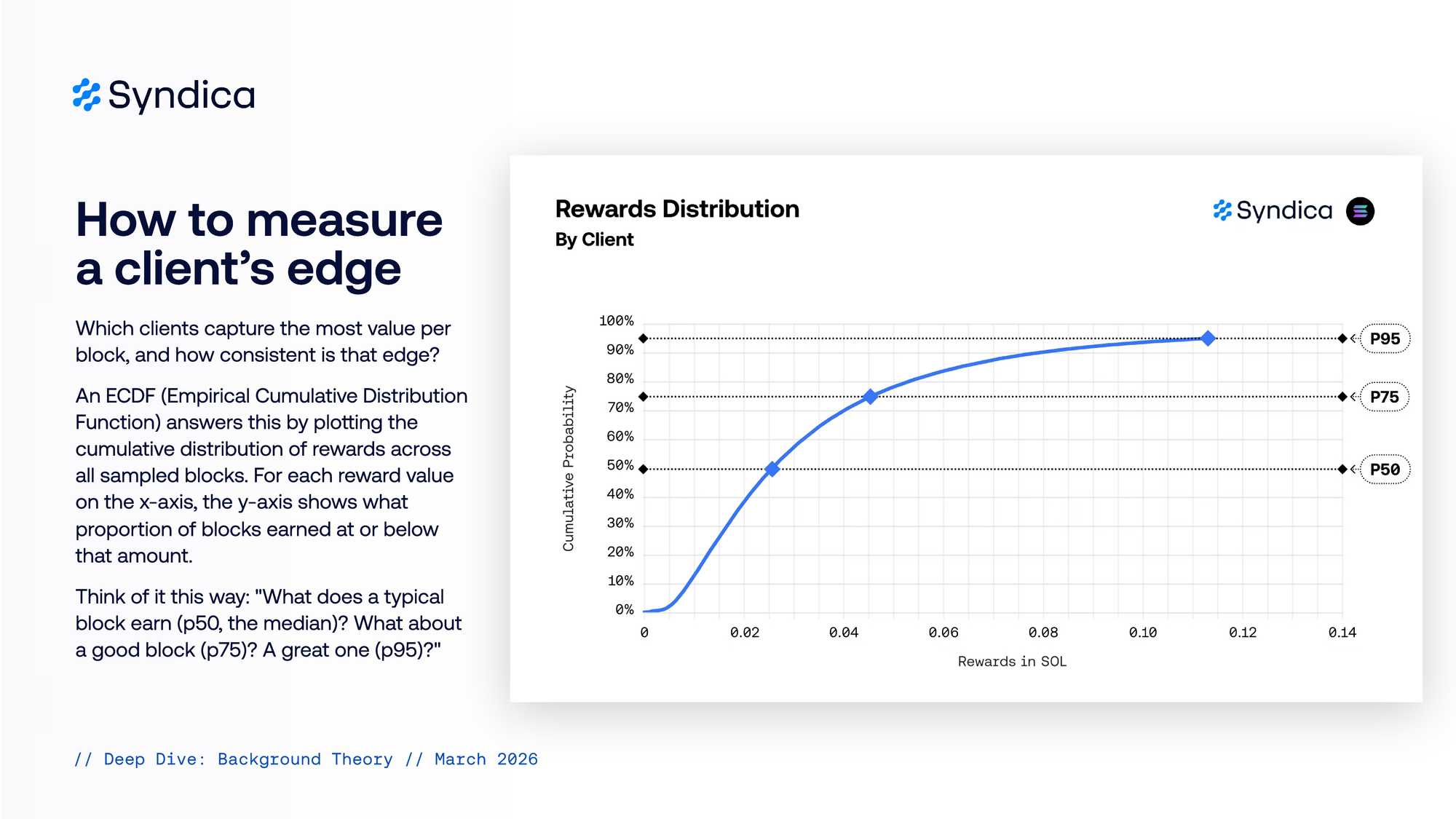
How to measure a client’s edge Which clients capture the most value per block, and how consistent is that edge?
An ECDF (Empirical Cumulative Distribution Function) answers this by plofing the cumulative distribution of rewards across all sampled blocks. For each reward value on the x-axis, the y-axis shows what proportion of blocks earned at or below that amount. Think of it this way: "What does a typical block earn (p50, the median)? What about a good block (p75)? A great one (p95)?"